
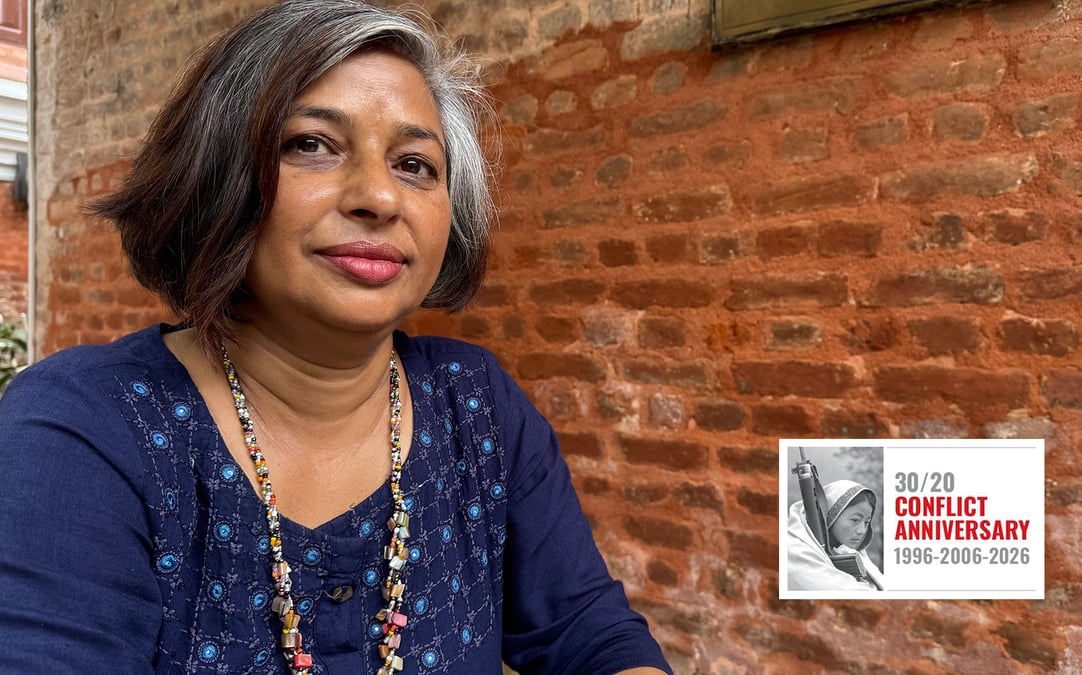
Lila Sharma was born into a family of seven sisters and a brother. From childhood she was aware of sharply defined gender roles. Women stayed home, daughters were married young to toil for in-laws.
As an adolescent, family pressure mounted for her to conform: cook, clean, marry and bear children. But Sharma had a rebellious streak, she quit college and joined the Maoists.
“People in Dang were mostly uneducated and culturally conservative, there was inequality and patriarchy,” Sharma recalls. “Bonding with Maoists in my age group, and learning to use a gun were empowering. We truly believed a revolution was necessary and possible.”
The Maoists had launched their armed struggle in February 1996, and young men and women were attracted by their promise of a just and egalitarian Nepal. People were also pushed to support the Maoists after police atrocities in the midwestern mountains in 1997-98.
Women made up one-third of the Maoist militia, and were often on the frontlines of attacks like the one on the Nepal Army base in Khara in 2002. The fighting raged all night, 90 guerrillas were killed. In hot pursuit, the Army strafed those retreating from helicopters.
“For one week, we fought our way out of Rukum to Salyan. We had nothing to eat as we carried our wounded comrades,” Sharma, who was battalion commander, recalls. “It was either kill, or be killed.”
Lila Sharma is now 50, and still believes in societal transformation. The sacrifices were not in vain, she says, it made Nepalis more aware of their rights.
“In a way, the GenZ uprising last year was a continuation of our struggle, and proof that some of the things we fought against were still prevalent,” Sharma says. “We called it people’s war, but it was actually a youth war. We were all young and idealistic.”
Twenty years after the 2006 peace accord, Sharma is disenchanted with how it all turned out: “When they got to government our leaders forgot what we fought for, the party let the people down.”
Sharma says there was genuine support for the Maoists in rural Nepal, where villagers protected, fed and helped the guerrillas, not always out of fear.
After the ceasefire, Sharma established the ex-PLA Women’s Academy, speaking at public fora defending women’s rights and gender equality. “We took up arms and we laid them down, but the struggle for equality goes on through peaceful mobilisation.”
MEMOIR OF WAR
Sharma was always a voracious reader, and kept a war diary. Recovering from cancer, she started turning it into a memoir. युद्ध लडें क्यान्सर जितें (Fought a War and Defeated Cancer) was launched in her native Dang recently. For Sharma it has been cathartic to relive the hopes and disappointments of war, and now waging her own personal battles.
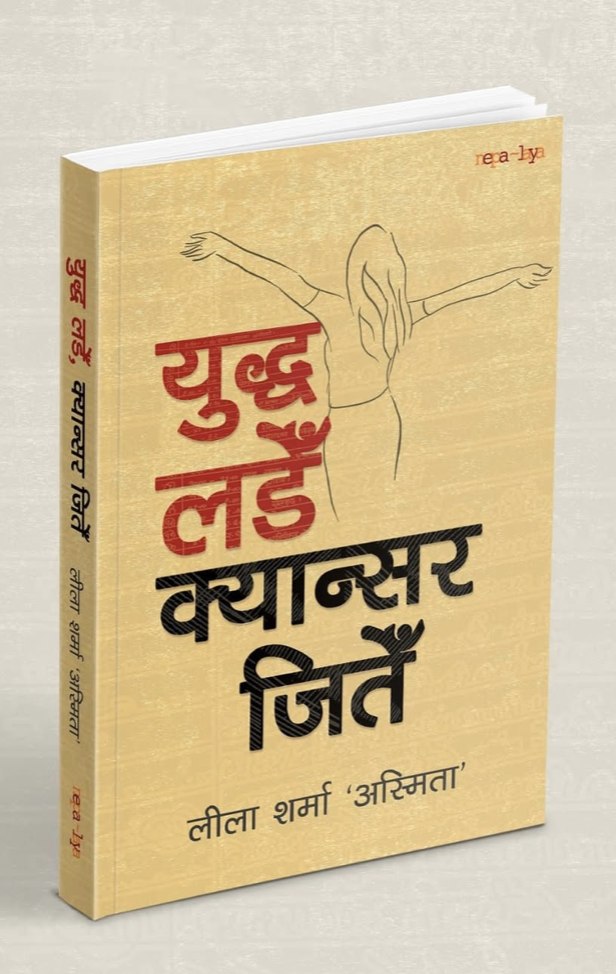
She writes of the brutality, hunger, exhaustion, grief, but also an adrenalin-driven exhilaration of going into battle, with the fierce idealism of youth. The violence was so pervasive that the boundary between dream and reality blured.
Young people were integral to the insurgency, and spent their formative years at war. There were relationships, marriage, and some even had children amidst the conflict. Sharma advised younger combatants that relationships were a personal choice, but that parenthood could wait.
After the ceasefire, Sharma joined the Young Communist League rather than apply for integration into the Nepali Army. She married another comrade and has a son.
“The marriage was a simple gathering to make a promise in front of our comrades to dedicate our lives to the nation,” she says.
Sharma was battle-hardened, physically and mentally strong. But there was another battle still to be waged: against cancer. Once again, just as on the battlefield, her fellow-fighters stepped in to help save her life through therapy sessions.
“The splits in the party leadership during the war, and what happened after the ceasefire did not match what we were willing to give up our lives for,” Lila Sharma says. “But it did raise society’s awareness about women’s rights, class and caste discrimination. A new generation of young Nepalis is now intolerant of injustice.”