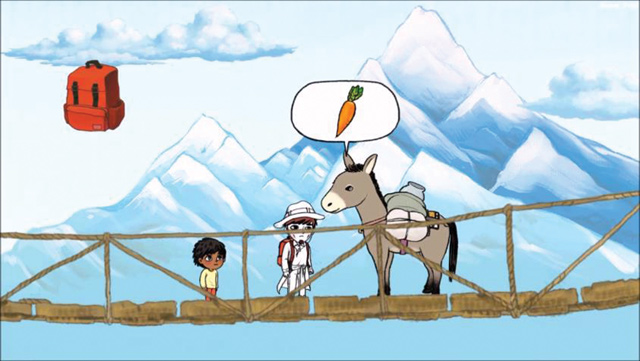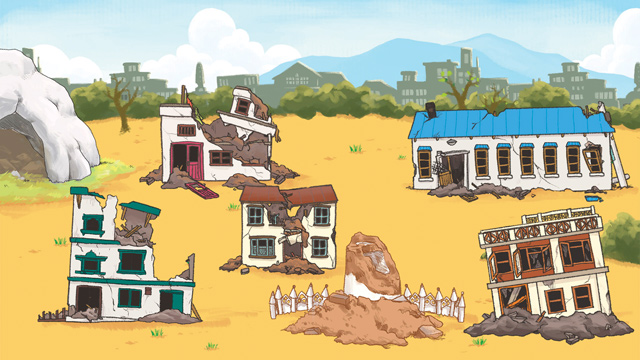
On 12 January, a promotional slogan for a new video game surfaced on Twitter. It read in Korean: 'Does a game have to have a player kill the enemy or spend money in virtual world in order to entertain ourselves? We are making a new game where you can save people, animals and reconstruct villages. This is about life in Nepal.'
The tweet was promoting a crowdfunding campaign for the 2D adventure/action game called ‘Himalaya Backpacker’, developed by a group of young Koreans.
was created in direct response to the April earthquake. The game is designed to have the player respond to natural disasters like earthquakes, landslides, and avalanches by rescuing people and animals. Later stages of the game go even further, as missions encourage the player to reconstruct damaged villages and heritage buildings in Nepal.A so-called ‘social impact game’, Himalaya Backpacker provides an interactive platform for players to engage and think about how to solve social issues across the world on a virtual platform. Other social impact games cover thematic issues that vary from climate change, medical research, and urban development to the life of refugees, LGBTQ issues, and the division of the Korean peninsula.
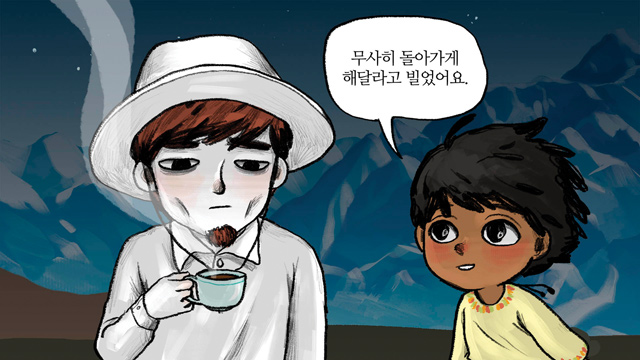
The developer of the game, Minseok Do says: “I noticed that people’s interest in the earthquake had begun to wane and I wanted to bring their attention back to Nepal through a game as the country still needs help."
Do, an MBA candidate in the Korea Advanced Institute of Science and Technology, has a background in electronic engineering and graphic design. He worked with three other developers and illustrators to ensure a high quality standard for the game’s graphics.
In making Himalayan Backpacker, Do used two popular games as reference: Ubisoft’s ‘Valiant Hearts’ and 11 Bit Studios’ ‘This War is Mine’. The former is an action/adventure game set during WWI and based upon archaeological research, which covered the educational aspect. The latter was modeled for its social impact component, as the crowd-funded game uses real stories and images of the Bosnian War, and all proceeds went to war orphans through the Warchild Foundation.