
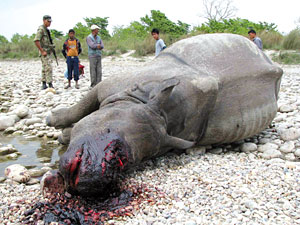
 PICS: RAMESWOR BOHARA OUTRAGE: A male rhino with its horn hacked off found in Bardiya National Park in April, |
Today, there are a few scraggly patches of forests, and even these have no undergrowth because of over-grazing. The national parks themselves show signs of encroachment.
The most dramatic deforestation has taken place in the two years after April 2006, as political parties, the landless, criminals and illegal loggers have all used the weakness of the state to clear the jungles. And this process went out of control during the April elections.
At the Banke DFO, an official shrugs as he shows permits issued to cut trees: most were given out just before and just after the elections in April. They were issued to community forests in which user committees and smugglers were in collusion.
"We can say that the local forestry officials facilitated and in some cases abetted the smugglers in logging forests," says Tapta Poudel, president of the Federation of Community Forest User Groups in Banke. Poudel says he saw 30 bullock carts hauling timber in the Baijapur area on election day alone as smugglers used the absence of security personnel to plunder timber.
User groups and villagers in the far western Tarai say community forests were under pressure even during the conflict from Maoists who wanted a cut from the sale of timber. This process turned into open extortion after April 2006 and especially in the runup to elections, they say. "The Maoists used timber to generate funds and at election time they converted the forests into votes by encouraging villagers to cut trees and grab land," says IP Kharel of Jana Morcha.
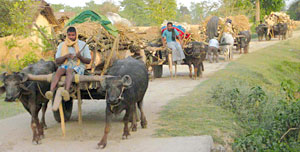 bullock carts full of concealed timber head off into India at the border in Banke. |
The Maoist leader heavily involved in deforestation, Pradip Chaudhari, was nominated by the Maoists to the CA.
Maoist leader Matrika Prasad Yadav has served as the Minister of Forests, and denies reports that his party has been involved in illegal logging, accusing timber smugglers of making the allegations after he stopped them. When approached by Nepali Times, Yadav said cryptically: "You find out who is logging and write about them, I'm not going to tell you who is or who is not involved."
Although deforestation has been most dramatic in the west, it has also been intense in Rautahat, Mahottari, Dhanusha, Sindhuli and Siraha, officials say. Keshav Raj Kandel, director general at the Department of Forests, says logging can't be controlled because thieves have political protection. "When you arrest an offender, you get a call from the Prime Minister instructing to release him, what can you do?" he asks.
There are no statistics about how much of the forest was lost during elections, but the estimate from Kailali alone is 21,000 hectares. Kailali DFO Man Bahadur Khadka says the past two years have been a free-for-all. "Before our eyes, we have seen dense forests turn into dense settlements," he says.
Krishnaraj Subedi, a member of a community forest committee, says 952 hectares of illegally settled forests were recovered, last year but the political parties pressured them to return the land. "Now we don't even bother," he says. Loggers who are caught red-handed have to be released because of political pressure, says a forestry official.