|
KIRAN
PANDAY
|
In the late 1980s, King Jigme Singye Wangchuck decreed that Gross National
Happiness (GNH) was more important to his country than Gross National Product
(GNP).
He then promptly started evicting Nepali-speaking Lhotsampas in a ruthless
campaign that can only be described as ethnic cleansing. So far, because of
complicit India and the international community, he has got away with it.
His regime has used every trick in the book of predatory diplomacy to detract
international attention from the very existence of the refugees-more than
110,000 of its citizens in makeshift camps in eastern Nepal. This glossy bhutan
national human development report 2005 (lower case from the original) pretends
the refugees don't even exist. Which is quite convenient because if you reduce
your population by one-sixth, obviously your per capita parameters suddenly look
much rosier.
Like its celebrated postage-stamps, publications of the Royal Government of
Bhutan are meant for display. This report is not an exception. It is crafted,
designed, and produced in bleached chlorinated paper to impress. The text
bristles with contemporary catch phrases: environmental sustainability, good
governance, cultural heritage. But like all police states, the more the regime
tries to convince readers that the government is doing great, the more you doubt
its real intentions.
Bhutan has notched notable successes in rural development, hydropower,
package tourism and public health. It is the only country so far to have become
tobacco-free by government edict. Aidocrats and journalists extol the virtues of
this virgin land. Learning from their hosts, they love to say how great Bhutan
is by pointing out what a mess Nepal is. The hypocrisy of New Delhi-based
diplomats is breath-taking: they will not tolerate dictatorship, press curbs,
ethnic cleansing or chauvinistic politics anywhere else in the world. But
because Bhutan is so cute, it's ok.
|
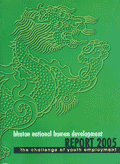
bhutan national human development report 2005
ISBN 99936-675-0-1
Royal Government of Bhutan,
Thimpu
|
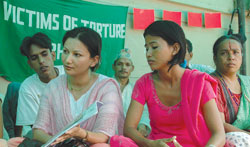
To get the true picture of Bhutan, you have to visit the camps in Jhapa or
spend time with the refugees camped out last week at the UN in Kathmandu. Just
as North Korea has the Juche Idea, Bhutan has GNH. It comes out of the same
dangerous ideology that sees itself as a superior and somewhat special race.
Compared to the dispirited diplomacy of poor democracies, dictators in the
Third World manage to attract the best and brightest to push their agenda.
Democracy is defined by private sector excellence and public sector mediocrity.
It's the other way round in well-entrenched autocracies where a combination of
hope and fear keeps some outstanding professionals tied with the regime. The
Bhutani government has managed to project itself as the likely victim and has
succeeded in hiding its crime against humanity of evicting over one-sixth of its
population.
Instead of working for resettlement of Lhotsampas in their homeland, even
international bureaucrats have now begun to let Thimphu scot free by resettling
them in third countries. As Tek Nath Rijal, the indomitable Bhutani freedom
fighter rightly insists, such a move is tantamount to surrender and will imperil
other minority communities in similar situations elsewhere.
The NHD Report 2005 needs to be read as an account of potential rather than
the reality of a country that wants the world to see it in soft focus with
rose-tinted glasses. If an honourable settlement of the refugee issue is made,
Bhutan still has the prospect of emerging as an inclusive and prosperous nation.
If it doesn't, King Jigme will go down in history as someone who needlessly
alienated a large segment of his people because of racial paranoia.
On 20 June when the rest of the world was celebrating Refugee Day the
Lhotsampa in Nepal marked their 14th year away from their country and yet
another Black Day in their unending saga of displacement and despair.
