
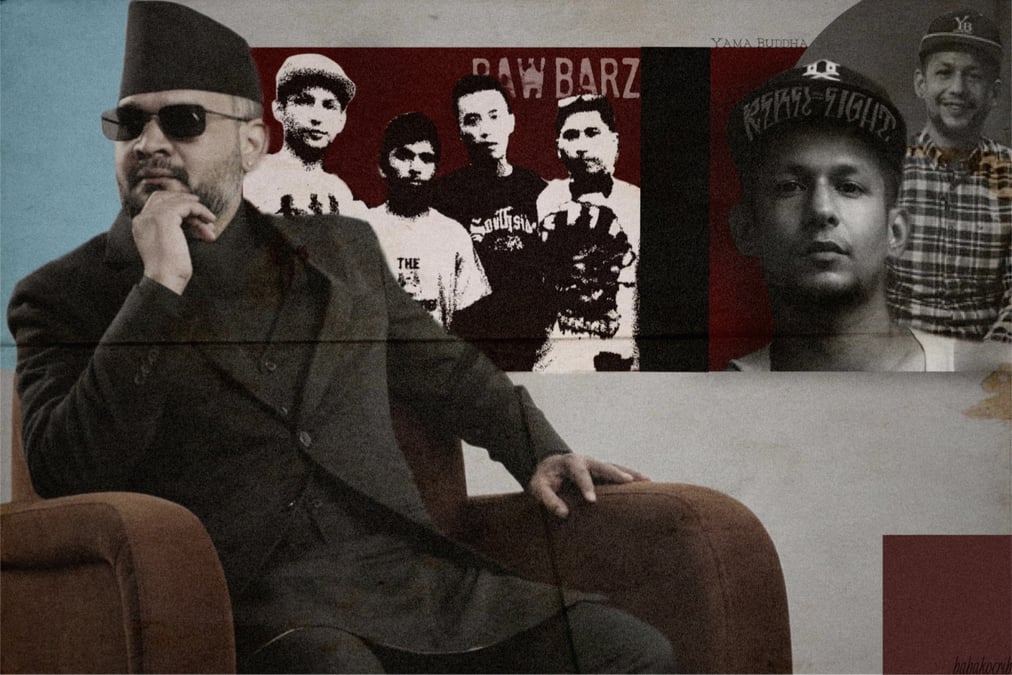
Balendra (Balen) Shah’s first Facebook post in 2012 was a rap song about his school days. In many other YouTube videos, a younger beardless Shah raps in expletives-ridden X-rated perfornances.
Fourteen years later, Shah was elected mayor of Kathmandu, resigned, and is now challenging a former prime minister in K P Oli’s home turf of Jhapa-5. This battle is not just about one constituency, but Nepal’s future political trajectory post-September.
But who is this man? Shah rapped about social issues and injustices ridiculing the establishment with profane lyrics. He crossed all boundaries, emerging as an iconoclast who has gone from critiquing the government to governance.
After announcing his candidacy for mayor of Kathmandu in 2022, people began digging into his
against Litl Grizl on YouTube called Raw Barz, pioneered by the legendary rappers Yama Budhha and Kolin Rana.Started in 2010, in its five-year run, Raw Barz worked to give underground voices a stage to turn wordplay into reputation and rhythm into recognition. Sacar and Uniq Poet were the first to partake in the rap battle.
Stinging lyrics and verses fired like friendly warnings were the ingredients that gave early Raw Barz its restless energy. Every line felt like a challenge, every performance like a small arena, where lyrics and delivery decided who held the floor. The crowd was lively and responsive.
“When I saw Balen, it was love at first sight,” recalls Girish Khatiwada, one half of the duo Girish Pranil (GP) who is regarded as Nepal’s first rapper. “Balen is lyrically versatile, with a sharp ear for language and a strong command of the technical elements of rap.”
Girish used to judge alongside Shah and Lay Zy on Nepal’s first rap reality show, Nephop ko Shreepech. The mentors for the show were Mr D, Easi 12, Kavi G, Dayjen and Vyoma, all rooted in Raw Barz.
This legacy was shaped by Yama Buddha in the 2010s, of a space that nurtured Nephop as an emancipatory culture, allowing young voices to break free from social silence, rigid norms, and limited platforms for expression.
Shah’s debut single,
, released in 2012, became a foundational underground track on his official YouTube channel. In it he sings about the system that neglects a street kid facing social adversity, and demonstrates his knack for seamlessly combining music and art with social commentary.The same year, he released Tathya, about media manipulation, corruption, and representation. In another Facebook post in 2013, he wrote a rap-like verse:
‘Balen mero nam, kaapi kalam le ladchhu mah,
Hatiyar ko kaam, sahitya le nai garchhu mah,
hamro desh ko shaan, ghatera achama parchu ma,
aam Nepali bavana ko pratinidhitwa garchu mah.’
Rough translation: I fight with pen and paper, weaponise literature and art to glorify Nepal, representing the aspirations of the Nepali people.
Also in 2013, Balen strove for political awareness and launched
featuring Nibhaal, a ‘lyrical protest’ against police brutality. It was his response to a rule that forbade young men from letting their hair grow. released in 2019 became a hit on its re-release on YouTube a year later with 12 million views. It was a call to truth, accountability, and a criticism of corruption.CRITICAL LYRICS
Shah’s socially critical lyrics took direct aim at an apathetic state and resonated with millennial youth at the time. Propelled by the social media reach of RONB, Balendra Shah was elected mayor of Kathmandu, beating candidates from powerful established parties.
with 10 million views on YouTube became the anthem of the September GenZ protest, propelling 35-year-old Shah himself the torchbearer of youth aspirations.“We used to hang out. It was around the time when Raw Barz came out,” remembers Manish Sharma, a close friend of Shah. “We later worked together on the campaign ‘We for Constitution,’ which was about urging the government to issue the Constitution of Nepal.”
He adds: “One might call him a rapper, but I prefer to call him a poet. His lyrics were a strong part of his art.”
Rapping is built on a set of skills that closely resemble those required in politics: timing, improvisation, argumentation and rhetoric, audience awareness, and sarcasm. A rapper must know when to strike a line, how far to push an argument, how to read the mood of listeners, and how to frame words so they leave an impact.
Shah’s first address in Maithili at Janakpur last week on his campaign trail for the March election had all of these skills combined.
This is not unlike New York City mayor Zohran Mamdani whose early life as a rapper under the name Young Cardamom helped shape his political instincts and debate performances.
Rap is not a bedtime story, it is a document of contemporary society. It is often debased for its foul language, something even Shah has been accused of in his older songs. But rap does not simply talk about violence or rage, but it is a reflection of our society and what exists within: conflict, corruption, ambition, survival.
“Shielding children from rap lyrics might protect innocence, but engaging with it critically can build awareness,” says Girish Khatiwada. “Rap is simply an art form like any other.”
The rap culture is getting stronger. ST MAN’s Cinema featuring Somea is already closing in on the five-million-view mark on YouTube, while Purple’s Bhatbhatey Ma featuring Gwala hit five million in a month.
If anything, Nepali hip-hop is not slowing down, it is accelerating, fully aware that people are tuning in, and Shah’s legacy looms large in all this.
Shah was asked
at the World Association of the Major Metropolises in Brazil last year on how he would want to be remembered as a mayor, to which he replied: “I would love to be remembered as an honest guy, rather than a musician or an engineer or a mayor.”म नेपाल हासेको हेर्न चाहन्छु
नेपाली को मन नाचेको हेर्न चाहन्छु
म नेपाल हासेको हेर्न चाहन्छु
नेपाली खुसिले बाचेको हेर्न चाहन्छु
[Verse 1]
अत्याचार, आक्रमण, अपराध, असमझदारी
विकल्प बिहिन, बिदेशी बैंक भन्छ भिखारी
शिकारी नेता, अभिनेता बन्छ क्रान्तिकारी
बिगारी केटाकेटी, भोको पेट रेटि सिपाही
अविवाहित चेलीबेटी, बोकि पेट खेपी पिटाइ
बिताइ रात, कुटाइ घात खाएर शरीर बिकाइ
देशको माटो नै मिठाई ठानी मैदान त्यो युद्ध को
गिद्ध थियो जो देशको लागि, भक्त झै प्रसिद्ध भो
निशब्द भो अवशेष बाकी, चोखो बोली जो सित थियो
सिरजफ्त भो देशब्यापी आत्मघाती जो पबित्र थियो
आफ्नो प्राण को आहुती, आफ्नै ज्यान को बिभुती
लाई हिडेका सहिद को केवल नामावली बिभुसित
कुण्ठित पिडामा डुबेकी आमालाइ के काम बिदुसी
गरिब लाई दुई छाक नै खुसी, सरिफ लाई चाहिन्छ कुर्सी
आमा कै सारी बेचेर धनाढ्य संगै छ पुजी
गोजि भरी भारु, भरौ भरेर भारती को रोजि म
[Chorus]
म नेपाल हासेको हेर्न चाहन्छु...
[Verse 2]
देश एउटा सुन्दर बगैंचा होस, रंगिचंगी फुलहरु
हरेक लाई समान गलैचा होस, सादर हरेक मुलहरु
अनुकुल, प्रतिकुल हरु चिन्ता गर्ने भावना होस
सामुहिक खुसी बिनाको के फाइदा त्यो चाहना को
औचित्य के त्यो कामना को एउटा हासो फुट्न लाई
उद्धेश्य लेउ, एक हौ हरेक हात हरु जुट्न लाई
गरेर अब देखाउ, कालो अतीत लाई मेटाउ
पालो हाम्रो हो भेटाउ, कल्पना गर शान्ती को
सपना देख्ने कै पूरा हुन्छ, जागृति नै क्रान्ति हो
विपना मा बाटो खुल्ला हुन्छ आकृतिको सालिक को
नसोच्नु तिमी मालिक हौ र मिहिनेत गर्ने नोकर हो
तिमिले ठोक्कर खानेछौ मानव मानवता बेगर को
एकपटक कारण बनी हेर अरुको सानो हासो को
उसको मुस्कान मा रमाइ हेर निस्वार्थ प्रेम साचो हो
यो खाचो हो मायाको, पूरा भए नेपाल हास्नेछ
एक आपस मर्म बुझिदिए हरेक क्षणमा बाच्नेछौ
[Chorus]
म नेपाल हासेको हेर्न चाहन्छु...
English translation:
I want to see Nepal smile.
I want to see the hearts of Nepalis dance.
I want to see Nepal smile.
I want to see Nepalis living happily.
[Verse 1]
Oppression, attacks, crime, and confusion,
No alternatives, foreign banks calling us beggars.
Predatory leaders turn into actors, posing as revolutionaries.
Corrupted children, hungry stomachs, wounded soldiers.
Unmarried daughters, carrying pain, beaten and burdened,
Nights spent enduring violence, bodies sold after suffering.
The nation’s soil treated as sweet sacrifice, a battlefield of war,
Those who devoured the country were praised like saints.
Silence remains, truth buried, purity erased,
Suicide glorified, martyrdom commercialised.
Sacrifices reduced to lists of names,
What comfort is that to a mother drowning in grief?
For the poor, two meals are happiness; for the elite, power is the goal.
Selling a mother’s sari to build wealth,
Pockets full of Indian currency, living off others’ labour.
[Chorus]
I want to see Nepal smile…
[Verse 2]
Let the country be a beautiful garden with colorful flowers,
Let there be equality, respect for every face.
What is desire without shared happiness?
What is hope if no one smiles?
Come together, erase the dark past,
Our turn has come, imagine peace.
Dreams come true when awakening becomes revolution.
Do not think you are the master and others your servants,
Without humanity, power collapses.
Create smiles for others, that is true love.
If we understand each other, Nepal will smile.
[Chorus]
I want to see Nepal smile…