China’s sharp economic slowdown has raised alarm bells around the world. But it has also thrown into relief the rise of another demographic powerhouse next door.
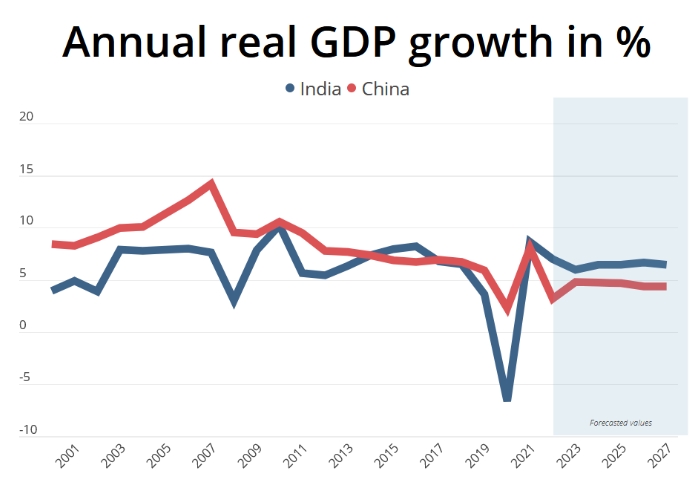
The Indian economy grew at an impressive 7.8% annual rate in the second quarter of 2023, and the country recently reached an important milestone by becoming the first to land a spacecraft on the Moon’s potentially water-rich south pole. India’s ascent, unlike China’s, has not been accompanied by an increasingly assertive foreign policy.
As India’s geopolitical, economic, and cultural clout grows, so does its global footprint. China’s ‘decline’, as some have begun to call the conclusion of the country’s four-decade-long economic boom, opens new opportunities for the Indian economy and other developing and emerging countries.
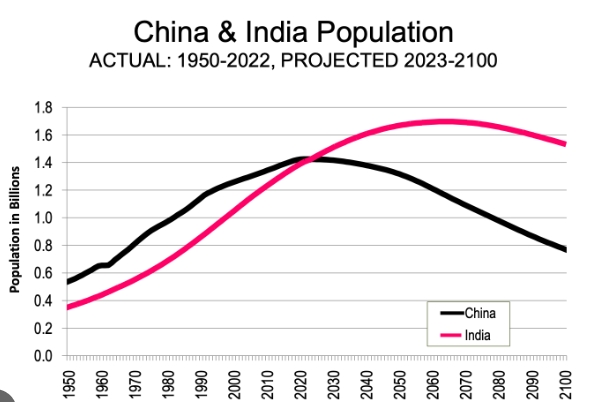
Earlier this year, India reached another milestone when its population officially surpassed that of China, which had been the world’s most populous country for more than 300 years. While China’s shrinking, rapidly aging population is likely to impede economic growth and may curtail its geopolitical ambitions, India – one of the world’s youngest countries, with a median age of 28.2 – is poised to reap a huge demographic dividend.
But the driving force behind India’s emergence as a major global power is its rapid economic growth. While India’s GDP is still smaller than China’s, the country is currently the world’s fastest-growing major economy and is projected to account for 12.9% of global growth over the next five years, surpassing the United States’ 11.3% share.
In addition to fueling a consumption boom, India’s youthful population is also driving innovation, as evidenced by the country’s world-class information economy and its recent moon landing, which the country managed to achieve despite a national space budget equivalent to roughly 6% of what the US spends on space missions. Having already surpassed the United Kingdom, its former colonial ruler, India’s GDP is poised to overtake that of Japan and Germany to become the world’s third-largest economy by 2030, behind the US and China.
Given its increasingly unstable neighborhood, it should come as no surprise that India has the world’s third-largest defense budget. The deepening strategic alliance between China and Pakistan underscores India’s precarious position as the only country bordering two nuclear-armed revisionist states with expansionist ambitions. Moreover, for the past three years, India has been locked in a tense military standoff with China along its Himalayan border. Bilateral relations, marked by intermittent clashes in the disputed Tibet-Ladakh border region, are at their lowest point in decades.
By confronting China despite the risk of a full-scale war, India has challenged Chinese power in a way no other country has done in this century. But despite leaning toward forging closer ties with the West, India remains hesitant to enter into formal military alliances with Western countries.
Western powers are partly to blame. US President Joe Biden’s reluctance to comment on the Sino-Indian military standoff, let alone openly support India, has sent a clear signal that India is responsible for its own defense. Given that the country’s future growth hinges on its ability to defend itself against external threats, India will likely step up its efforts to modernize its conventional armed forces and enhance its nuclear deterrence.