
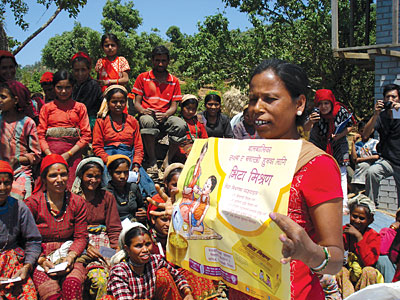
 DEWAN RAI LISTEN CAREFULLY: In Doti, Asha Shahi explains how to use WFP's vitamin powder sachets |
DOTI – A lorry full of rice sacks screeches to halt where the dirt road ends in Kalikasthan, 27 km from Dipayal. Women and children, dogged by swarms of flies, surround the vehicle. They clap and scream in joy and soon volunteer to offload the sacks as a two-man band beats drums.
The World Food Programme (WFP) is distributing food. Under its Food for Assets intervention, the immediate food needs of the population are met while mobilising them to build assets that will contribute to local enterprises, income generation and improved agricultural production.
As the clamour dies down Asha Shahi, a social facilitator from local partner Maxpro, orients the women by instructing them how to use micronutrient powders for children under the age of five. "Do not mix it with liquid food," she cautions.
In the light of the terrible diarrhoea-cholera epidemic that swept over parts of mid and far western Nepal last year, killing 282 (WHO, August 2009), it's a warning they'd do well to heed. WFP is especially keen to get the message across.
This is understandable. Last summer WFP, which provides food to 3.5 million Nepalis in 40 districts, was accused by several rights organisations, most notably INSEC, of providing sub-standard food that contributed to the epidemic. The government initially seemed to go along with the story rather than concede that it was its slow response and totally inadequate preparation that prolonged the public health disaster. Though it later issued statements denying the link between WFP and the epidemic, the damage was done. An uncritical media fraternity, too, appeared willing to cast unsubstantiated aspersions upon a donor.
This is as attributable to the tenor of journalism in Nepal as the plain ignorance of many reporters. At a March press conference held by Sameer Dixit's Centre for Molecular Dynamics to announce the results of tests on last year's stool samples from Doti, many mediapersons seemed palpably confused. Faced with evidence that cleared WFP, some protested, "But government told us WFP food was responsible!"
A much larger investigation was commissioned from the Natural Resources Institute in London by WFP last year. This was also categorical that WFP food could not have been responsible for the epidemic.
In Doti's Kalikasthan, meanwhile, Basanti Kumari Bhatta cuts her rice sack open and examines the contents. "Look, this is so fine," she mutters. She is well aware that this year, too, there have been rumours that WFP food is causing diarrhoea. But DR Bhatta, who coordinates food distribution in his ward, says there haven't even been any cases of diarrhoea in his VDC. "We've already talked with members of the Federation of Nepalese Journalists in the district about this. It's just a rumour."