
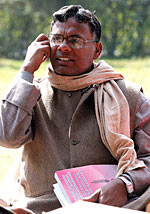
 KIRAN PANDAY |
There must be something in the Vastu of Singha Darbar that makes its principal occupants think and behave like little emperors. Like Louis XV, Prime Minister Pushpa Kamal Dahal announced last month that any effort to dislodge his government would trigger another revolution and Maoists would eventually 'capture' power.
His Indian mentors who persuaded him in 2005 to join mainstream politics probably forgot to tell the guerrilla chief that a revolving-door government is an essential feature of the parliamentary system. The day Balkhu Darbar decides that it has no further use for Premier Dahal, he will have to make way for Madhab Nepal. The mood in the legislature is turning distinctly anti-Maoist. Almost all the parties, including the kangresis, would be only too happy to join a UML-led coalition, whatever the unpredictable consequences of such an unlikely formation.
Dahal needs to realise that like everybody else in any democratic set-up, he is neither irreplaceable in his own party nor indispensable to the country. History has an uncanny habit of getting rid of powerful men when they least expect it. In any case, no prime minister since Chandra Shamsher, incidentally the prime minister who built Singha Darbar, has served what could be called a normal term of office in that jinxed palace.
Since the British days and the rise of the Ranas, Lainchaur has always been a factor in influencing the outcome of court intrigues in Kathmandu. The other influential player was always the army. Popular support, when it mattered at all, came last. The first elected prime minister of the country BP Koirala realised this reality when he found himself behind bars despite two-thirds majority of his party in the parliament. Dahal's party commands the loyalty of only about one-third of members of the legislative assembly.
The Tarai is another factor that can upset the best calculations of power brokers. Despite boasts of some Hindi-speaking Madhesi leaders and allegations of extremists of the left and right alike, the Indians have very few levers of manipulation in the plains of Nepal. Madhesis blame the Americans for funding and abetting King Mahendra's planned transmigration of Pahadis in the Tarai as a part of a Cold War strategy. US-friendly non-governmentals have recently made inroads into the central Tarai, but their impact is still largely peripheral. It's not for nothing that Matrika Yadav decided to explore China before designing a political outfit to face the challenges of the future?the northern neighbour has no baggage in the southern plains.