
It’s that time of the year again

Besides reducing our lifespans, air pollution is also affecting tourism by blocking Himalayan views

News
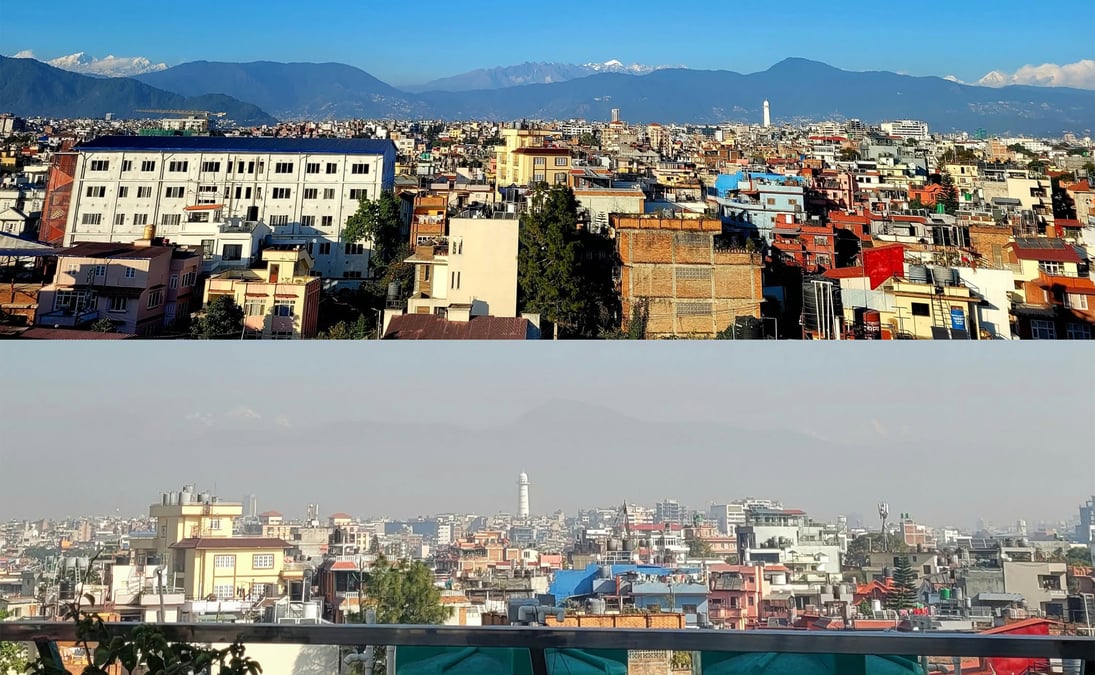
NOW YOU SEE IT, NOW YOU DON'T: These two pictures taken on Monday and Wednesday morning show how air quality has abruptly changed for the worse in Kathmandu as winter set in. Photos: RAMESHWAR BOHARA / FACEBOOK

With the onset of winter, a thick blanket of haze and smoke has returned to Nepal. The post-monsoon air quality this year has been slightly better because of late rains and prevailing winds blowing away crossborder haze.

Yet, Kathmandu Valley’s average Air Quality Index (AQI) is touching the unhealthy measurement of 134 most mornings, and is only expected to climb in the coming months.  

Ishwar Basnet from Tiger Mountain Hotel in Pokhara gets many international visitors who are drawn to Nepal to see its mountains, and when air pollution blocks the view they are disappointed.

“We receive multiple complaints every year when tourists arrive in Pokhara during peak pollution season and are left feeling duped, especially photographers. It hampers the appeal of Nepal,” says Basnet, adding that this year the visibility has been better.  

The annual average PM2.5 reading in Nepal hovers at 40-50 micrograms per cubic meter (μg/m³) -- eight times higher than the standard of 5 μg/m³ set by the World Health Organization (WHO). PM2.5 are microscopic suspended particles that is the primary pollutant in Kathmandu.

The main sources this time of the year are vehicular and brick kiln emissions, open garbage burning, post-harvest agricultural fires and a regional haze spike in the Indo-Gangetic Plain. 

Burning of stubble and garbage releases fine particulate matter into the air, which prevailing winds carry into Kathmandu, adding to the already polluted air, reducing visibility. This affects air traffic with flights stacked up waiting to land in Kathmandu, Pokhara and the Tarai towns.

A phenomenon known as temperature inversion traps a layer of polluted warm air on the ground under colder air above.

“This time every year, Kathmandu skies have to endure the fumes from Tihar firecrackers in Nepal and India, quickly followed by the imported air pollution from stubble burning in the Punjab,” explains environmental engineer Bhusan Tuladhar. “This year, the post-monsoon rain reduced pollution, but it is only going to get worse from here.”  

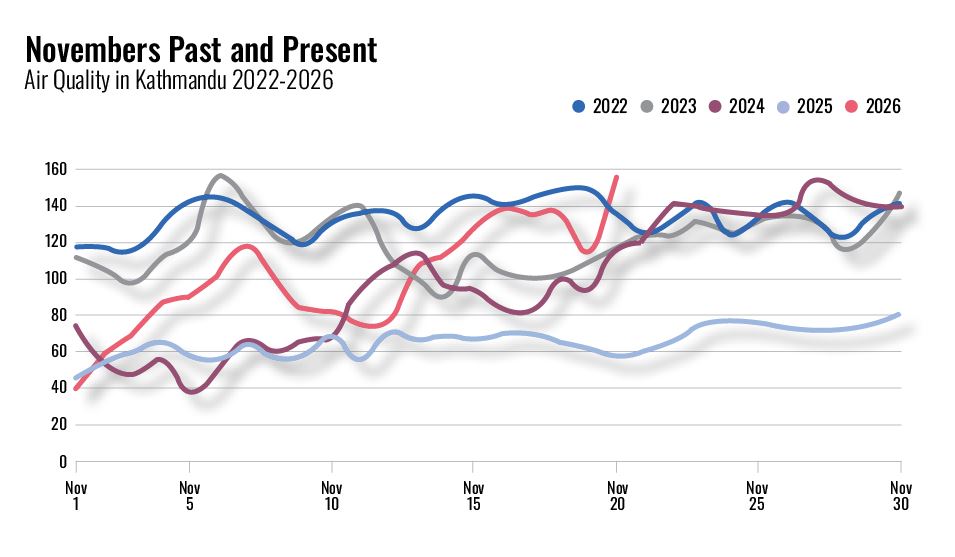
The Tarai suffers the brunt of the imported pollution. According to the World Bank report, 67% of the source of PM2.5 pollution in the Tarai are transboundary. A comparison of the annual average PM2.5 concentration in Kathmandu from 2025 and 2026 shows an 18% decrease in 2026, indicating improved air quality (see graph) primarily due to delayed rains in October-November.

Moreover, Kathmandu’s annual 2026 PM2.5 (21μg/m³) reading till now shows a drop by 52% compared to the last 6 years, making 2026 the least polluted year in that period.  
Aqi in novemebr

Despite the improvement, WHO still categorises Kathmandu’s air as a health risk. A bitter irony is that unseasonal extreme rainfall, itself a symptom of climate breakdown, acts as Kathmandu’s only temporary relief from toxic air.  

While transboundary pollution plays a major role in contributing to Kathmandu’s pollution, local emissions also play a part. 

“Nitrous oxides from vehicle emissions have gone down slightly due to the increasing adoption of electric vehicles, and sulfur dioxide from household and coal burning have also reduced – but these are not substantial enough to lower overall pollution levels in Kathmandu,” adds Tuladhar. 

Green stickers meant to regulate vehicular emissions can be bought over the counter, allowing owners of polluting buses and trucks to bypass their mandatory annual emission tests.

IMPACT ON TOURISM

 Studies show that air pollution reduces the lifespan of Kathmandu residents by an average of up to three years. Aside from that, pollution haze is also affecting tourism – mainly in Kathmandu and Pokhara.

“Visitors come to Nepal to enjoy breathtaking mountain views, beautiful landscapes, outdoor activities, and pleasant weather. When they are greeted with thick persistent smog, the overall experience is compromised,” says Deepak Raj Joshi, former CEO of Nepal Tourism Board.

While tourism accounts for only 7% of Nepal’s GDP, it employs at least 1 million people in the country. To be sure, tourism is also affected by calamities and political upheavals, but many visitors take to social media to express their disappointment for not being able to see the mountains. Adds Joshi: “Even if we assume that only 5-7% of all tourists coming to Nepal cancel their plans due to the poor weather, the potential revenue loss could be in the approximate range of Rs2.2–3.1 billion.”

Pokhara hoteliers also confirm that compared to last year, mountain visibility is better, and they have received fewer complaints since the rain cleared up the view.  

Monmohan Rimal from Hotel Annapurna View in Sarangot shares a similar sentiment: “Pokhara is known for its spectacular views of Annapurna, Dhaulagiri, Manaslu and Machapuchre. Naturally, tourists are disappointed when air pollution sabotages their plans.”

Likewise, tourists are not inured to the unhealthy air quality as long-term inhabitants of Kathmandu are, and are prone to allergies and sickness. This seasonal disruption has become a predictable pattern over the past years, yet adequate management and prevention measures have not been implemented. Nepal led a UN resolution to establish annual International Wellness Day on 14 April as well as declaring 2027 as Nepal Wellness Year, but the quality of air could affect that initiative. 

Tourism operators say along with a transition to clean energy, regional cooperation with neighbouring countries, particularly India, is crucial. Nepal should actively pursue cross-border cooperation on air-quality monitoring, information sharing, pollution forecasting and coordinated mitigation measures. 

For instance, crop residue burning has been banned in both Punjabs of India and Pakistan since 2015, yet it continues unabated. Nepal needs ‘anti-pollution diplomacy’ to work with neighbours and ask why their enforcement is failing and decide whether it wants to continue absorbing transboundary pollution without consequences. 

Says Deepak Raj Joshi: “Nepal cannot aspire to become a leading year-round tourism destination while compromising the quality of its natural environment. Clean air, clear skies and a healthy environment are not luxuries, but fundamental tourism assets. Protecting them is an investment in Nepal’s tourism future.”