
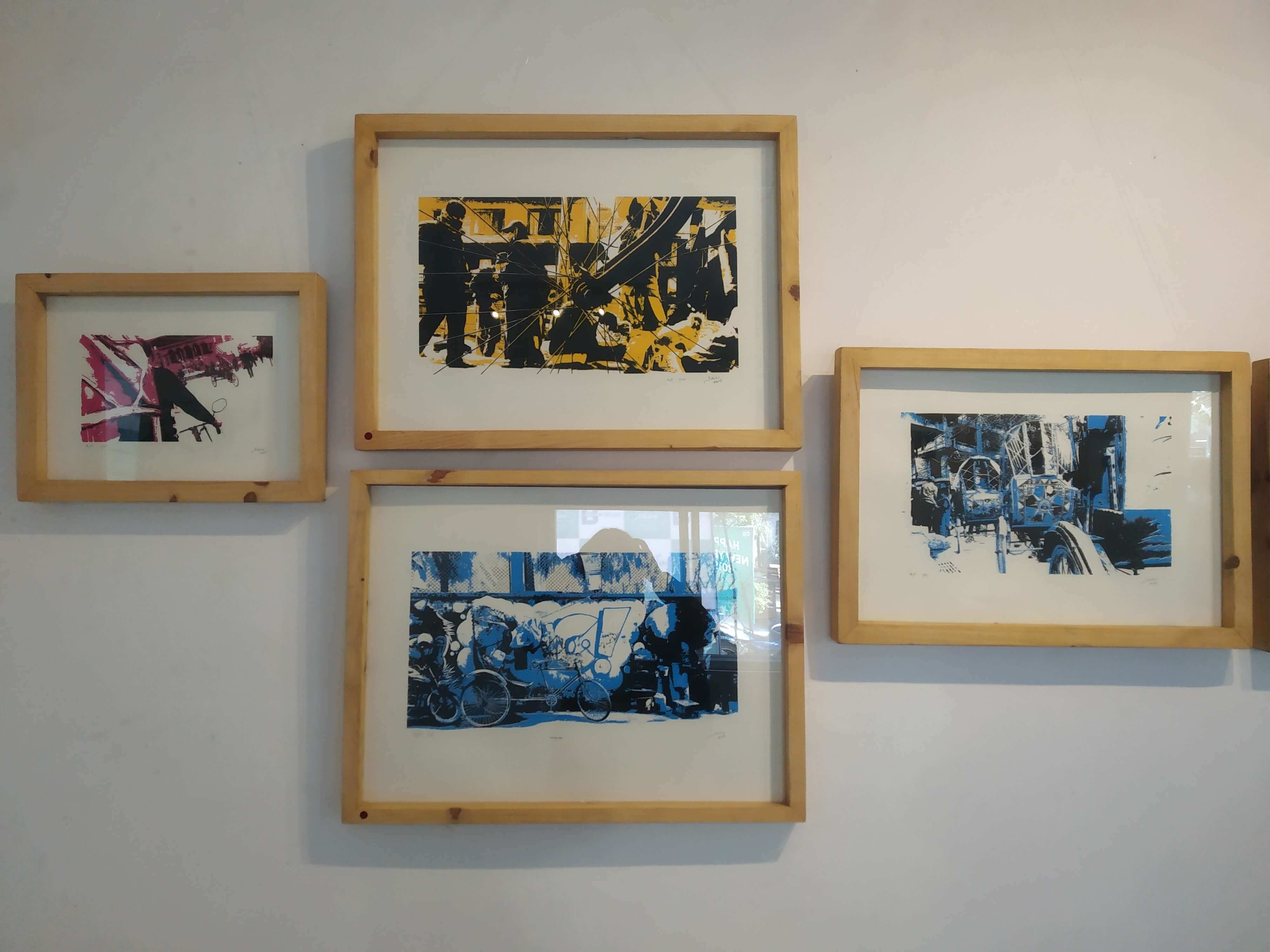
Innocent children smile from the back of a rickshaw. Crumbling buildings are supported by long timber beams. Prabod Shrestha’s photographs of the aftermath of the 2015 earthquake now exhibiting at Bikalpa Art Café in Pulchok are different in form and substance: instead of bromide or digital prints, he uses silk screen to transfer the imagers to paper manually.
Silk screen is an ancient art technique, but is used around the world mostly for paintings and rarely for photographs. A mesh on a wooden frame is used to transfer colors to canvas. Each new colour requires a new frame, so few colours are used.
“I wanted to experiment by using the technique on photographs,” explains Shrestha who processed his photographs digitally until the last step, when he manually transferred them to blank paper. The result are vibrant paintings dominated by single colours: sunshine yellow here, and azure blue there. The stark black line art combines with eye catching colours to give a portrait of Kathmandu city after the earthquake, when it was regaining its lively and constantly changing urban ambience.
Shrestha grew up in Kathmandu, and says the paintings represent his nostalgia for the bygone era of his childhood and also convey his feelings about its transformation. “I have always seen Kathmandu as a place of great mysticism, but also know that it is rapidly modernising,” says Shrestha, who lost his art gallery to the earthquake.