
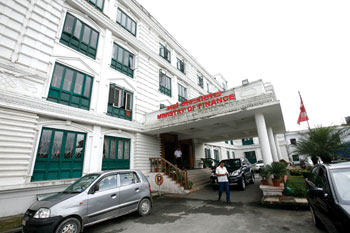
The Finance Ministry has been taking the lead in lobbying for the new directives with donors, while Chief Secretary Leela Mani Poudyal has sent directives to all line ministry secretaries to insist on foreign assistance only for medium and large-scale employment generation projects.
"Monitoring and evaluating smaller projects running on foreign assistance puts extra financial burden on the government and when resources are scattered the quality isn’t always consistent," Poudyal wrote in a 11-point directive he sent in April to the National Planning Commission, the prime minister and finance minister. The government will not accept aid projects of less than $5 million.
“We are not trying to undermine the achievements in social sectors achieved through foreign aid in the last decade but it is now time to focus on projects of national priority that will empower communities financially,” Madhu Marasani of the Finance Ministry’s International Economic Cooperation Coordination Division told us. “Human rights are also protected when people are financially empowered, so we are reassessing our priorities.”
Marasini’s office recently released the Development Cooperation Report 2012-13 which stated that more than one-third of the $960 million foreign aid to Nepal through 580 projects last year bypassed the government’s budget. The government hopes that the new policy will direct most aid monies through the budget process.
However, other Finance Ministry officials say although the percentage of directly-funded aid projects in 2012-2013 increased slightly from 23 per cent in 2011, it's because the government just couldn’t spend aid money.
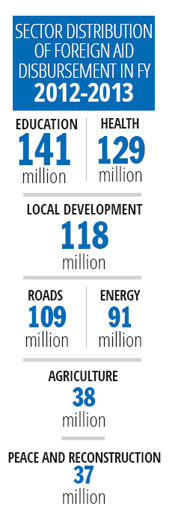
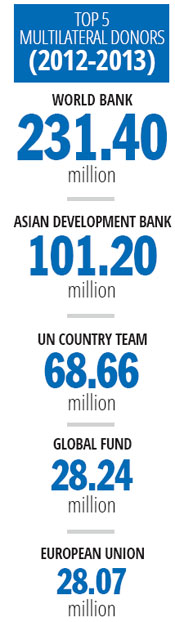
“Off-budget projects have increased because of the weak government mechanism to implement projects,” said one official, citing that only 36 per cent of foreign loans and 74 per cent of grants earmarked last year were ever spent.
At the recent annual meeting of the Asian Development Bank in Astana of Kazakhstan, Finance Minister Ram Sharan Mahat stressed the need to channel foreign aid into infrastructure projects. However, most donors feel that unless the government works on spending capacity and delivery, it will not be able to raise more money from multi- and bi-lateral sources.
One donor official told us in a background interview: “This is not the first time the government has told us to shift from social sectors to infrastructure projects, but first we need to see improvements on implementation of existing projects before asking us to commit.”
Read also:
Visualisation: Nepal’s foreign aid policy
Nothing to hide
“Strengthening the SWC makes more sense than lumping all INGOs in one basket and portraying them in negative light,” says Ashutosh Tiwari, of Wateraid, who chairs the Association of INGOs in Nepal (AIN). “Having a one window policy to report our activities would have made it easier for us to report to and for the SWC to relay findings to concerned ministries.”
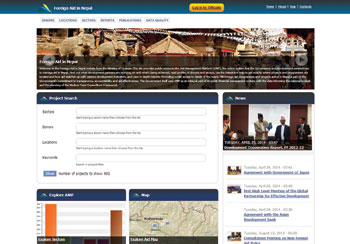
The Finance Ministry is working with AIN to bring all INGOs under the AMP ambit to better monitor and coordinate aid flows to Nepal. So far, over 80 AIN members have received AMP-related training.
“We hope bringing INGOs and donors under one platform to monitor aid flow will help to avoid duplication of similar projects and show donors and concerned ministries where foreign aid is concentrated,” says Tilak Bhandari of Finance Ministry who works with INGOs on aid management.
Earlier this week, the Embassy of Denmark signed an agreement with UNDP for a grant assistance of Rs 9 million for support to the Finance Ministry’s AMP initiative.
“This will ensure important work on the aid management information systems of the Ministry of Finance will run smoothly,” said Jan Møller Hansen, Chargé d’Affaires, Embassy of Denmark. “It will contribute to enhancing coordination and documentation of development assistance to Nepal.”