
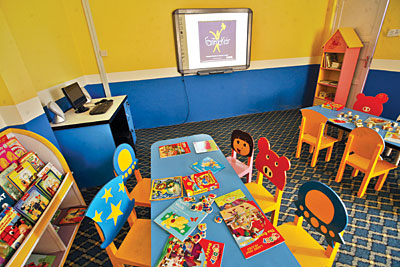
 KIRAN PANDAY FAST TRACK ED: Interactive Learning Stations make you want to be in school |
Whenever one thinks of school, the picture of a swing swaying over a muddy playground and a teacher writing busily on the blackboard, cane at the ready, comes to mind. But the whole nature of private education is changing in Nepal. The latest crop of internationally accredited schools employ cutting-edge teaching methodologies and technology enhanced classrooms. For the upwardly mobile parents of today, this is everything they never had, and they don't want their children to miss out.
Parents are willing to pay higher fees and commit themselves to involvement in school activities to enroll their kids in these schools. What's all the fuss about? Part of the reason may be the disenchantment of students and parents with the conventional, rote-learning education system they're accustomed to.
But it may have more to do with the desire to provide one's children with globally saleable education. Schools like Imperial World, Bridgewater International, Eurokids, Kavya, Premier and Ullens have one thing in common. All of them are either part of an international chain of schools or employ modern international teaching methodologies. Ullens, for example, is the only school that offers the globally recognised International Baccalaureate Diploma program in Nepal. Entry into the program qualifies students for higher education anywhere in the world.
With more Nepalis are vying for opportunities around the world, the need for globally competitive education is being felt more than ever. Schools have capitalised on this demand. Shreeram Pande, whose two children study in Ullens, says, "Giving kids the right education is the most important thing. Everything else will fall into place if the education is right."
Equipped with modern amenities and teaching aids, these schools claim they are changing the way kids learn. Imperial World, which has a franchised partnership with FasTracKids, a US-based early education program, offers a technology based teaching methodology. In place of the usual blackboards, classrooms use Interactive Learning Stations that deliver multimedia content and allow children to interact with objects and images they see on a screen. "The idea is to familiarise kids with technology from a young age and also to improve their learning and motivation. This way, the kids learn in a fun way and also retain information better," says Principal Shirish Shrestha.