
From an experimental documentary on the 2004 murders of 12 Nepali workers in Iraq, to a mixed media installation featuring an actual coffin parcel sourced from Tribhuvan International Airport, to digital collages and paintings portraying the effects of war on people and their faith, Tuladhar, Gurung, and Sigdel will highlight the plight of Nepali migrant workers and breathe life into the anonymous faces buried under statistics.
Tuladhar’s 10-minute documentary Descending into Shadows recounts the reactions of Kathmandu to the murders of the 12 Nepali migrant workers in Iraq by the Ansar al-Sunna Army and the riots that engulfed the city afterwards, mainly targeted at government buildings and foreign employment agencies. With the aim of documenting reality, Nhooja has juxtaposed the interviews with text on the incident from international news agencies interlaced with audio from the execution video in the background.
Nepal survives on the remittance sent back by migrant labourers, yet they are one of the most vulnerable demographic in the country. Thousands of young men and women escape the drudgery and hopelessness at home only to find themselves toiling in foreign lands under slave-like conditions with low wages and lack of safety equipment. The number of deaths among Nepali migrant workers is one of the highest in the sub-continent, a fact highlighted by the arrival of three to four coffins per day at Kathmandu’s international airport.
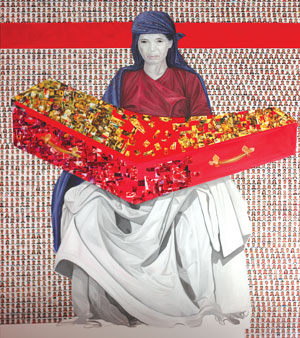
Hit Man Gurung uses an actual coffin used to return the dead from abroad to depict the reduction of the migrant worker’s identity to a wooden box. Expressing how each labourer shares a common story, the interior of the coffin is covered with a collage of photographs of those who apply for visas every day, with calligraphy about their origin and destination overlaying their pictures. Outside the coffin are tiny prints of passports of the same people, on top of which is a world map, highlighting the areas with the highest concentration of Nepali migrant workers in the world.
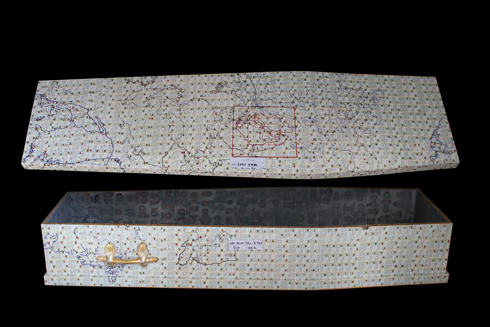
Titled I Have to Feed My Country and My Family (pic, above), his coffin installation and paintings inspired by Michaelangelo’s Pietà, Gurung contrasts the optimistic dreams of migrant workers with their dark realities and, sometimes, their untimely deaths.
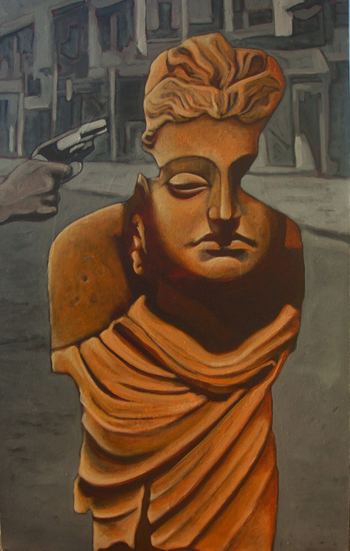
The third artist, Sunil Sigdel, is showcasing the digital collages Last Moment of Life, My Faith Dies in Afghanistan, and his painting Me and My Grandfather to express the effects of conflict on an individual’s spiritual belief, physical reality, and emotions. Inspired by Eddie Adams’ iconic Vietnam War photograph Saigon Execution, Last Moment of Life shows us how despite the boundaries, human emotions and empathy triumph all else and connect us physically.
Ayesha Shakya