
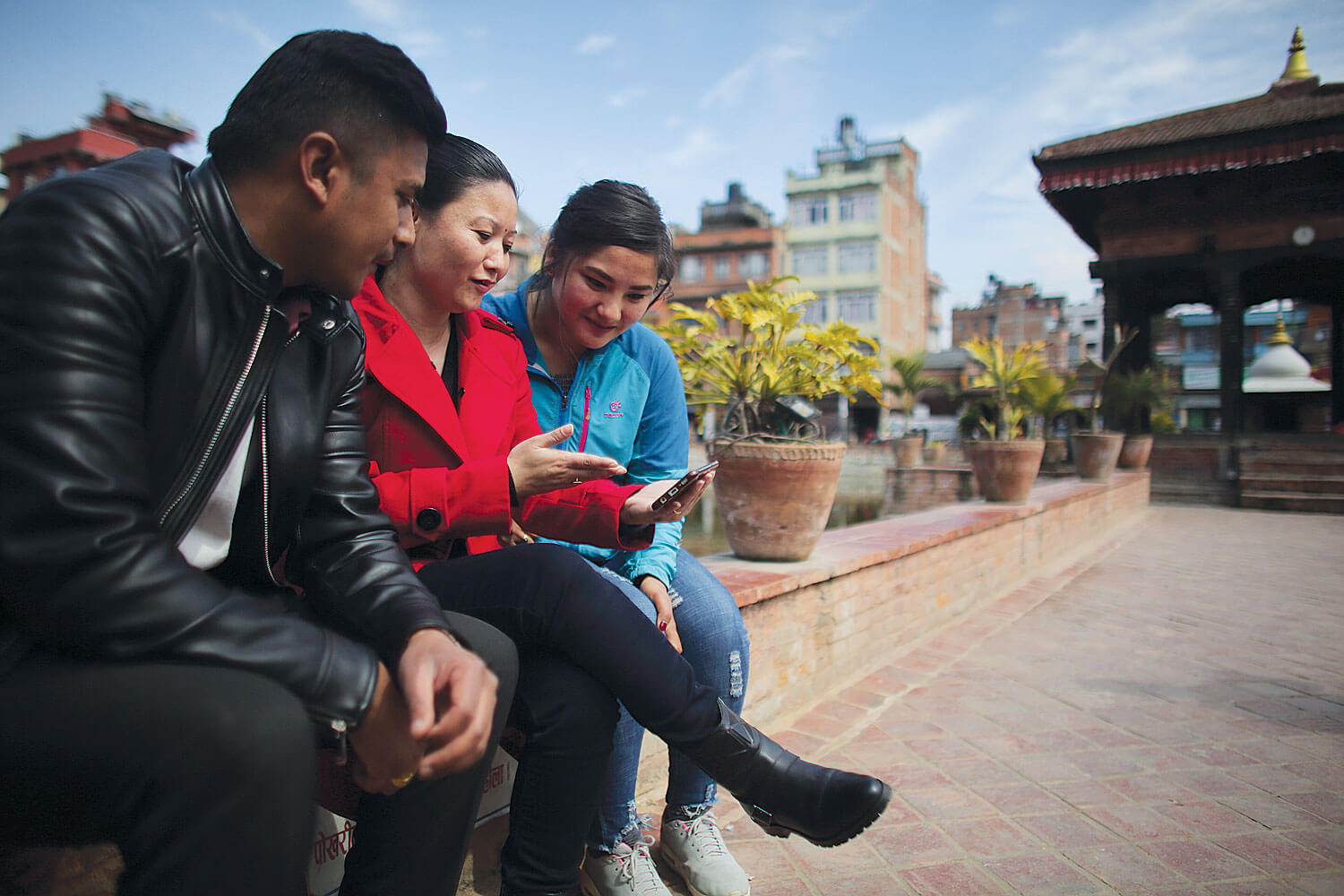
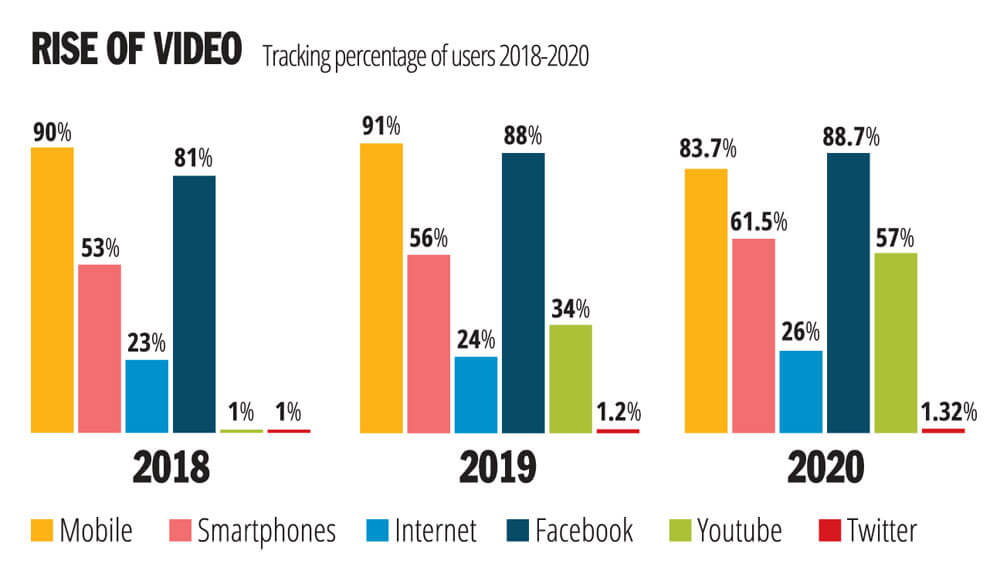
With 96% of Nepali households now owning mobile phones, the country is fast reaching phone saturation. Of those with the devices, 61.5% have smart phones, and this proportion is expected to spike sharply in coming years.
At present only 26% of Nepalis use the internet on a daily basis, but as more people upgrade to data phones, and to better connectivity and bandwidth, the online population will grow – with implications for society, politics and the e-retail economy.
One of the most important shifts in the past two years has been the explosive growth in YouTube use – up from virtually zero in 2018 to 34% last year, and then almost doubling to 60% in this year’s survey. (See graph, right)
The annual Nepal Media Survey is carried out by Sharecast Initiative, and this year involved 4,830 respondents in 48 districts from all seven provinces in January and February.
Comparing data for the past three years allows us to track changes in the spread and popularity of platforms, devices and apps and also to break down data by province, gender, age, ethnicity, education, or income.
“The most striking revelation in this year’s survey is the surging popularity of the YouTube platform,” explains Madhu Acharya of Sharecast Initiative. “The proliferation of new YouTube channels in Nepal is fed by this voracious demand for videos on mobile devices.”
Still, YouTube has a lot of catching up to do, as nearly nine million Nepalis now have Facebook accounts. The survey showed that 88.7% of respondents were on Facebook. But this was only a marginal increase from last year, which may suggest that the platform is maxing out. Answers to a multiple-choice question revealed that 35.6% are also on Messenger and 7% on WhatsApp, both owned by Facebook.
Sharecast disaggregated the data for Facebook to show that there were more men using it (94%) than women (82%), and more unmarried people on it (94%) than married (87%). The word ‘internet’ is often used synonymously with ‘Facebook’ by Nepalis, and when it comes to the proportion of Facebook users among survey respondents, there is almost no difference between the lowest income bracket (88.5%) and the highest earners (87.9%).
Read also: Nepalis are drifting to digital media, Madhu Acharya and Bhumiraj Chapagain
If this is surprising, so is it that more people in rural areas (88.6%) use Facebook than in the cities (87.5%). Most Nepalis with Facebook accounts are in the 16-44 age group, however the app has a strong user base even among people above 60, (81%) which could have to do with parents’ desires to communicate with grown children studying or working abroad.
There are significant differences in the demographics of Facebook and YouTube users. City-dwellers tend to be on YouTube more (71%) than villagers (48%), and only 22% in Far Western province say they watch videos there (possibly because of lack of bandwidth). Perhaps most surprising is that YouTube channels are most popular among people above 60 -- could it be that older people are clicking on religious programs?
The sustained popularity of the Imo messenger app is possibly due to the large numbers of Nepali workers in West Asia. Breaking down the responses shows that nearly twice as many women said they used Imo than did men, and most of these were from poorer families in rural areas.
Among other apps, despite the apparent popularity of TikTok, only 3% of survey respondents said they used it. Interestingly, the number of women TikTok users was more than double that of men users, and most were unmarried. Although Twitter posts are quoted often by the mass media, the numbers of its users are still low (1.3%) and while many city-based startups use Instagram for marketing, only 3% of Nepalis are on the platform.
Nepal’s legacy media retains readers despite social-media spread
The results of the Sharecast Initiative Survey 2020 show that the proliferation of mobile internet has put pressure on print and broadcast media, and that although the audience for traditional media has shrunk in the past, it is holding on to its readership for now.