
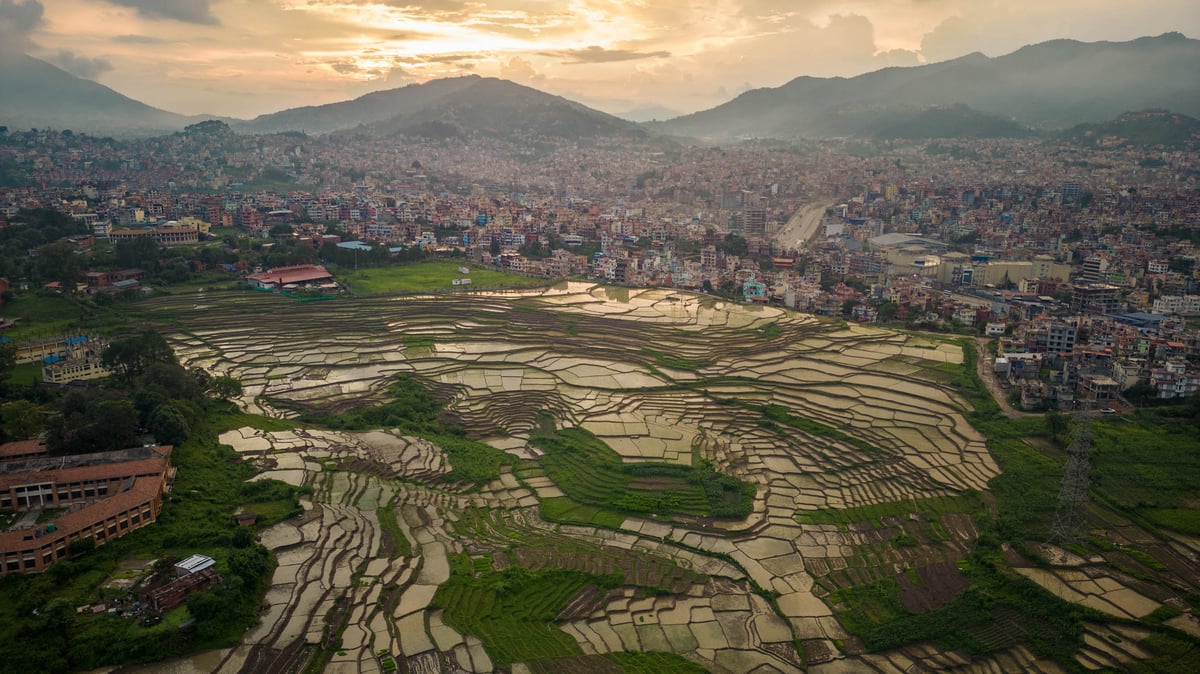
From high school, Nepali students memorise that Nepal is an ‘agricultural country’, and that 80% of the population is engaged in farming.
While it is true that most Nepalis are still dependent on agriculture, the country’s economy is shifting to services. Seven in every ten families also depend on remittances for household income.
Agriculture now contributes less than 25% to Nepal’s economy, and this is down from 81% three decades ago. The number of Nepalis engaged in the service sector used to be only 16% at that time, and today it has gone up to 29%.
Nepal’s economy has been transformed in recent decades during which new professions, businesses and enterprises have flourished. The finance, information technology (IT), hospitality, trade and other sectors have expanded.
Meanwhile, the role of agriculture in Nepal’s economy has diminished.
The strength of a country's economy is measured by the total value of goods and services produced annually, its GDP. Economies are divided into three sectors of activity: agriculture and forestry, manufacturing and construction and the service sector, which includes IT, finance, insurance, real estate and tourism.
Economies move through a cycle of expansion from the primary to the secondary to the tertiary sectors. Many developed countries are considered to have advanced because of the industrial sector.
However, Nepal’s industrial sector has not grown in comparison to other nations. Indeed, while the industrial sector contributed 8% to the economy 50 years ago, it reached a peak of 21% some decades later, but at present has declined to 12.5%.

Industry is supposed to enhance production and in the process create jobs. But Nepal’s weak industrial development is one of the factors that drove 690,000 Nepalis to go abroad last year.
The lack of industrial growth has meant that Nepal depends largely on the third service sector stage, which makes up almost two-thirds of the nation’s economy.
Nepal’s economic change has been brought about by a lack of meaningful growth in the agricultural and industrial sectors, as well as improvements in Nepal’s service sector.
“But this is only structural change, not a structural transformation needed for radical improvements to the economy,” says economist Dilli Raj Khanal. “For there to be such a transformation, we need to up our productivity in all sectors: agriculture, industry or service.”
The service sector also has inherent risks. While a small number of people involved in the service sector can increase production and add value to the economy, it may not create many jobs.
Moreover, because the service sector mostly involves educated, tech-savvy and business-minded people, its benefits are mostly limited to their circles, increasing socio-economic inequality.