
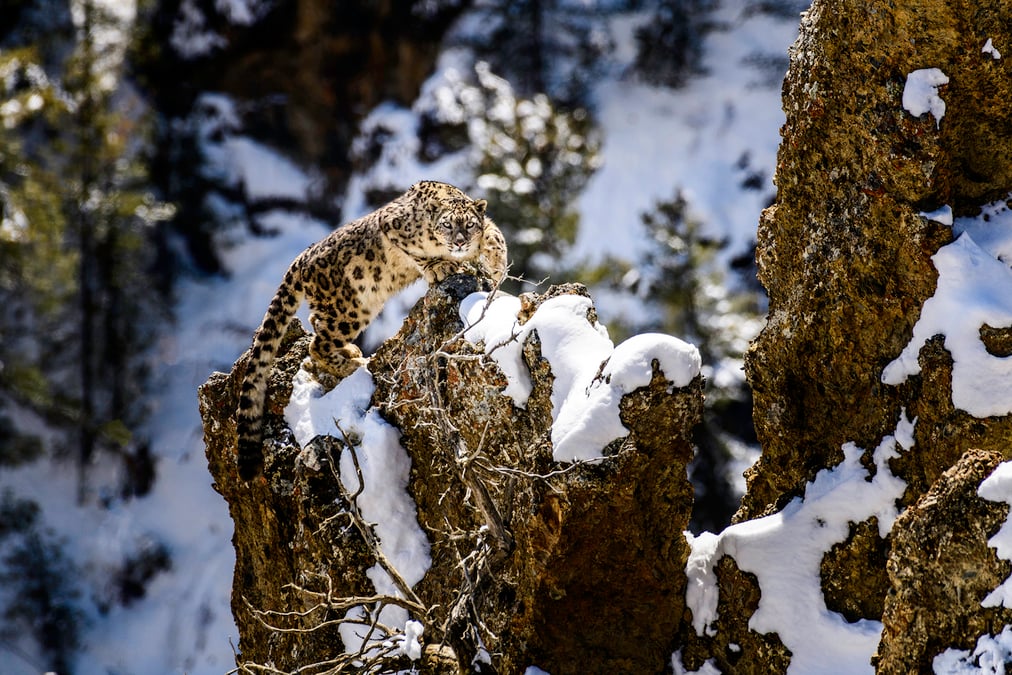
Four years ago, during a snow leopard expedition to Upper Dolpo a traditional medicine practitioner at the ancient Samling Monastery told me about the role this elusive Himalayan predator plays in local tradition.
Sherab Tenzin Lama is an ‘Amchi’ healer who has been practicing traditional medicine, a knowledge system passed down through generations. Over cups of a potent local drink alternated with hot water, the conversation progressed from snow leopards to the spaces that host them.
The rangelands of this remote trans-Himalayan region sustain the livestock on which communities depend, and they also support the prey base for snow leopards. People here raise yaks, sheep and mountain goats, harvest medicinal plants and earn money from trekking groups.
When World Wildlife Fund Nepal (WWF) began snow leopard conservation efforts in Upper Dolpo in 2018, livestock losses to wildlife were common. Improved corrals to protect sheep and yaks from predators, and a new approach to help victims access compensation for livestock losses have shown results.
Being an optimist, I imagined that successful management of human wildlife conflict was just a matter of time. And the outcome was indirectly proportional to the available resources. But that meant success would take a long time.
If wildlife kills decrease, would livestock density not increase? If it does, could the rangelands withstand additional grazing pressure? And, if so, what would happen to the people who depend on these mountains? What would be the effect on other wildlife like blue sheep and the snow leopards?
Having witnessed the changes over the decades, Amchi Sherab agreed that unmanaged rangeland use and over-extraction of natural resources would not be sustainable. Better road access, over-tourism and modern lifestyles and climatic breakdown added to the risks.
As a healer who depended on locally available herbs and medicinal plants, he had a practical outlook on the changes sweeping his land. Generations of native inhabitants have organically and conscientiously looked after this isolated region of Nepal using traditional knowledge, beliefs and values.
For instance, different parts of plants are used in Sowa Rigpa, the traditional science of healing. Plants are never uprooted, only a small proportion of flowers are collected leaving the rest for its propagation, and only parts of the roots are taken so that the plant does not die.
MOUNTAINS AND MINDS
“This is how we ensure that this plant is available for generations after us,” Amchi Sherab explained. That conversation four years ago left a strong impression on me. The knowledge for sustainable rangeland management existed, hidden deep in the mountains and in the minds of elders and faith leaders.
Back in Kathmandu, I began exploring how traditional knowledge about conservation could be supported to protect nature from new challenges. WWF had already been supported the Amchi of Dolpa in conserving medicinal plants.
One of the pioneers of this initiative was Yeshi Choden Lama, who along with Nepal's top conservationists was among 24 people killed in the helicopter crash at Ghunsa in the Kangchenjunga Conservation Area in September 2006.
With colleagues who shared this interest, WWF continued Yeshi Choden Lama’s work to support local youth, organising community consultations. The information was augmented through interviews with Amchi, monks, and elders.
TIn 2023, the Shey Phoksundo National Park (SPNP), Shey Phoksundo Rural Municipality (SPRM), faith leaders, and community youth came together to work towards integrated rangeland co-management.
In mid-2025, WWF was awarded the Darwin Initiative grant from the UK government to revive faith leadership for high mountain rangeland conservation in Nepal. Partners include Asia Network for Sustainable Agriculture and Bioresources (ANSAB) Nepal and Sowa Rigpa Association Nepal (SRAN).
This combines the community’s traditional knowledge with modern science, to create, build capacity and mobilise local institutions to collaborate on managing rangelands.
ANSAB supports sustainable harvesting of priority medicinal plants and helps elevate community earning through value chain optimisation and market linkage. SRAN helps the Amchi adapt the traditional practice to current circumstances so that this knowledge system is preserved and passed down.
Community-based rangeland conservation and management sub-committees consisting of youth, herders, women and faith leaders, have been formed. Harvesting and trade of medicinal plants have been initiated.
However, coordination among various groups in this remote landscape is challenging. The community’s socio-economic timelines are aligned to the seasons and packed tight, it allows for limited free time. Changing climate and increasingly unpredictable weather have disturbed the traditional timetable for these seasonal activities.
Snow leopards are at the top of the food chain, and protecting these elusive cats means sustaining local communities that hold nature in the highest regard and strengthening human-wildlife coexistence. Local livelihoods needs to be secure so the predators do not cause loss of livestock.
Zooming out of Dolpo, away from Nepal and toward High Mountain Asia, the larger challenge is to protect the ‘water tower’ that supports 2 billion people living downstream who depend on rivers that start here.
Friday, 23 October is Snow Leopard Day and 2026 also marks the International Year of the Rangelands and Pastoralists. It is an opportune time to remind ourselves of the interconnectedness of people and nature, and the part that human beings play in maintaining the natural order and systems.
The planet’s biodiversity is at a turning point. Yet, as indicated in WWF’s Living Planet Report 2026, there is hope. We can apply the knowledge of past generations with current technology to protect nature and enrich human life.
We can build a world where people thrive with nature. There is no alternative.
Sheren Shrestha is the Manager for Mountain Programs at WWF Nepal.