
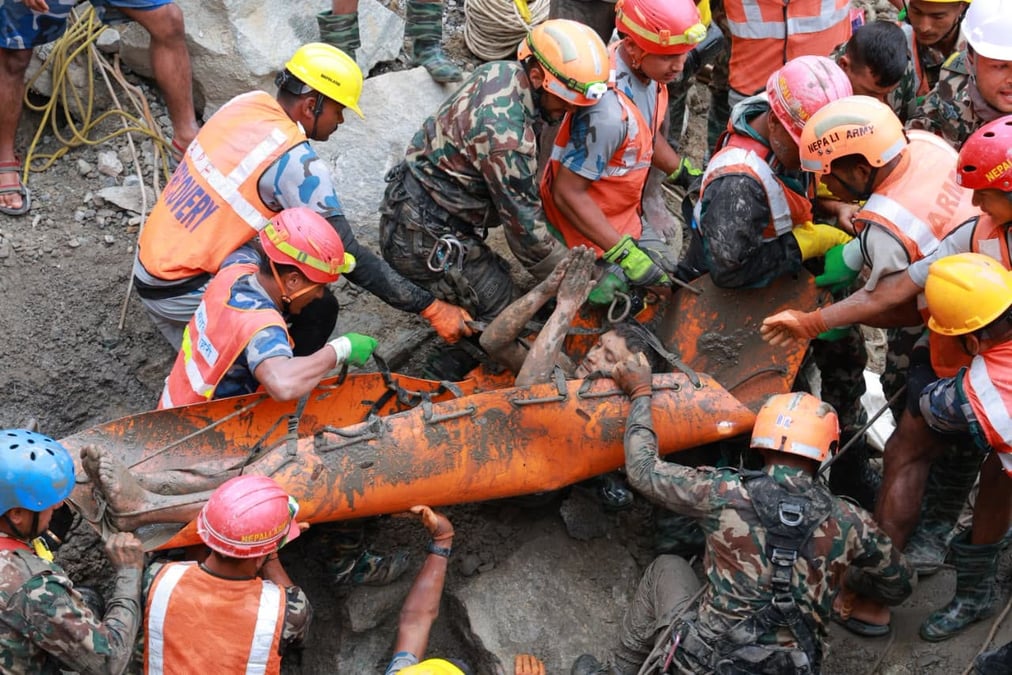
Nine days after the Nepal flood, search teams on Friday rescued two people alive from the tunnels of the Trisuli 3A project amid renewed hopes that more survivors might be found. The rescued men are mechanical foreman Sanjay Sah and supervisor Kabir Maharjan.
Following his rescue, Sah told security forces that when the disaster hit, he was trapped as he was trying to get everyone else to safety. Sah added that he had been in contact with three or four other people in his vicinity.
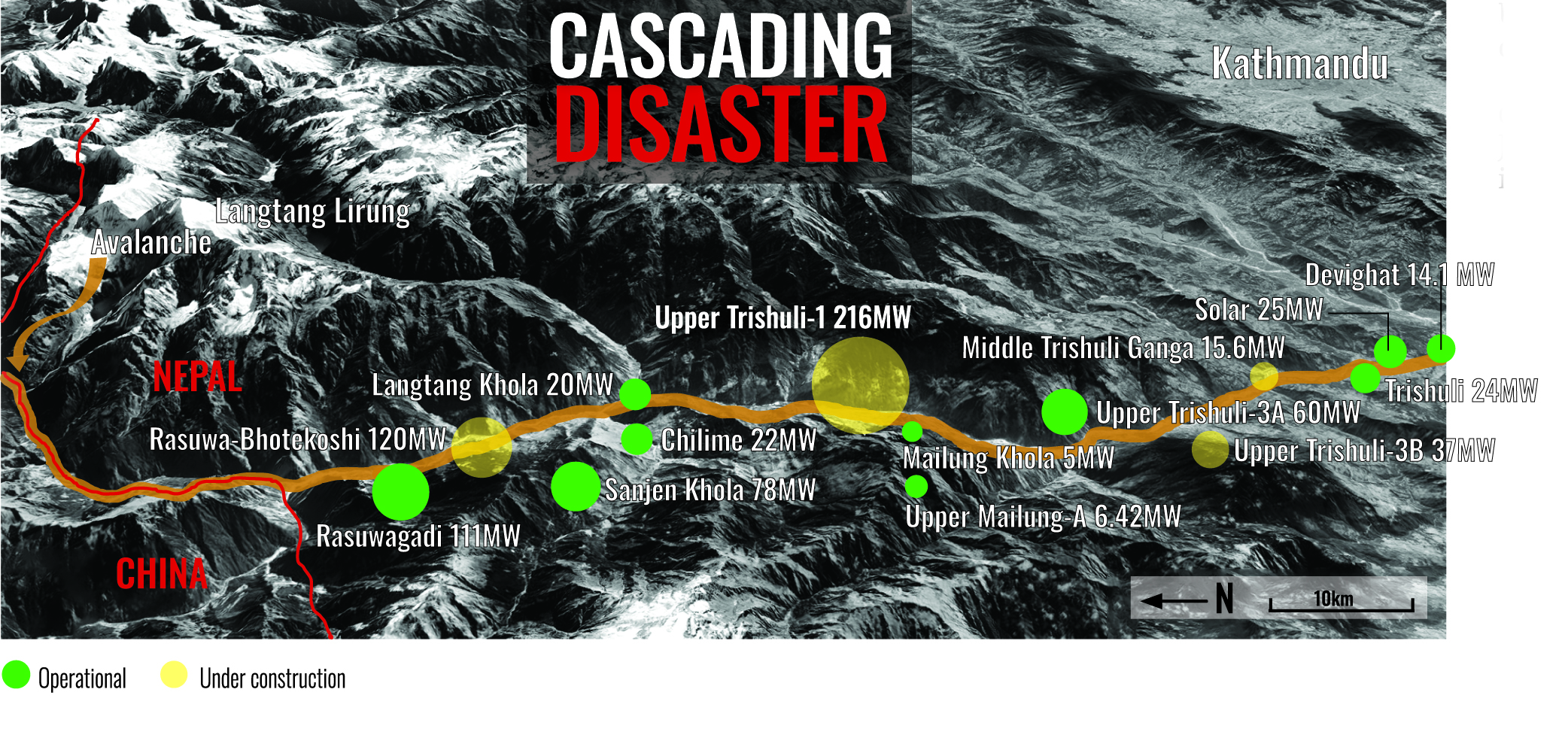
Search and rescue teams coninue to look for more than 900 trapped workers, engineers, and supervisors across at least 12 damaged hydropower projects.
Last week’s catastrophic debris flow along the Rasuwa-Nuwakot corridor has damaged or destroyed at least a dozen hydropower projects that has reduced Nepal’s total generation capacity by one-tenth.
Besides the loss of life of engineers and specialised workers, this is expected to have a major downstream impact not just on post-monsoon domestic electricity supply and power export revenue, but also affect the banking and insurance sectors, and Nepalis who invested in stocks in the private power producers.
Nepal could generate up to 3,700MW of power mainly from run-of-river schemes that depend on the flow of water on rivers, and not large reservoirs. These plants are built right on fast-flowing Himalayan rivers, and divert water through tunnels to power houses.
“Nothing is left. The structures have all been swept away, many projects that were started during my tenure at the NEA have also been destroyed,” says Kulman Ghising, who headed the Nepal Electricity Authority (NEA) till last year, and who fought the election in March from his Ujyalo Nepal Party.
The disaster has also rattled the financial market. Several private power producers have seen their share prices plummet this week, as the scale of the disaster and damage to plants became apparent. Investor are now concerned over plants having to be written off, reconstruction costs, as well as what this means to hydropower plants on other snow-fed rivers.
The Independent Power Producers’ Association, Nepal (IPPAN) estimates the damage to a cascade of plants along the Bhote Kosi and Trisuli at Rs30 billion. However, that is just the cost of the physical structures, tunnels and powerhouses.
“That loss has been calculated in terms of the cost of the project, while revenue loss has not been factored in. The actual loss is going to be much higher,” predicted Dinesh Dulal, chief of Sustainable Energy Banking at NMB Bank.
Most hydropower projects in Nepal are covered by insurance, allowing developers to claim compensation equivalent to project costs. However, such claims are subject to the fine print and specific conditions and may not fully address delays, lost revenue or wider economic effects.
The financing challenge remains steep. The Prime Minister’s Relief Fund has reportedly received about Rs40 billion from corporate and private donations so far, while reconstruction needs may go up to Rs900 billion, leaving a gap of more than Rs700 billion that may have to be filled through alternative government resources or international aid.
Dulal says Nepal is disproportionately bearing the cost of climate breakdown even though it produces less than 0.1% of greenhouse gas emissions. An average Nepali burns 0.54 tonnes of carbon per year, whereas the figure for the United States, for example is 16 tonnes. China’s per capita carbon emission is 9.3 tonnes and Qatar scores a whopping 40 tonnes.
“Nepal has a negligible contribution towards climate change, yet is most vulnerable to its impacts. The cascading effect of this was seen with last week’s disaster,” says Dulal.
The biggest project severely damaged is the 216MW Upper Trishuli-1 backed by South Korean investors and the International Finance Corporation (IFC). Upper Trishuli-3A and Upper Trishuli-3B have also been badly affected. (Map)
Power from the Rasuwa-Nuwakot corridor is evacuated through the Trishuli-3B 220-kV substation which was damaged, and several transmission pylons came down.
The destruction includes headworks, powerhouses, tunnels access roads, bridges, construction facilities and transmission lines. Much of it is buried under tens of metres of debris that is hardening like concrete.
RISKS ELSEWHERE
This disaster is reminder to hydroelectric plant cascades on other rivers like the Arun, Marsyangdi and Bhote Kosi East that concentrating so many plans on one river is risky. It is also a lesson for other Himalayan states of India which has also already suffered major damage from glacial lake collapse or ice-rock avalanches.
“Future projects must be decentralised to minimise the risk of disasters, smaller projects must be spread out,” said senior watershed expert Madhukar Upadhyay. “We must factor in debris flows on this scale.”
Ironically, the Rasuwa-Nuwakot corridor suffered a flash flood on 8 July last year after a glacial collapse in China that damaged many of the plants. They had just been repaired when last week’s disaster struck.
“Camp houses for hydropower projects were made in the same area that was destroyed by the previous year’s floods. That must change and we much build them higher up the slopes,” says Dulal.
The floods have drawn international attention and are expected to feature in climate summits, including the upcoming COP conference in November in Antalya, Türkiye. Prime Minister Balendra Shah has been urged to attend that conference as well as the UN General Assembly in New York this month to present Nepal’s case for loss and damage.
But Upadhyay says: “Even if Nepal gets compensation from the fund, the flood will come next year as well. That does not solve the problem. The matters of discussion have not reached the required level yet.”
For Kulman Ghising the destruction is especially poignant because as head of NEA he had sanctioned many of these projects, but he never expected the debris flow to be as high and destructive as it was.
He told us: “Early warning systems must be made more robust and alternate routes for evacuation must be established so that human loss can be minimised.”