
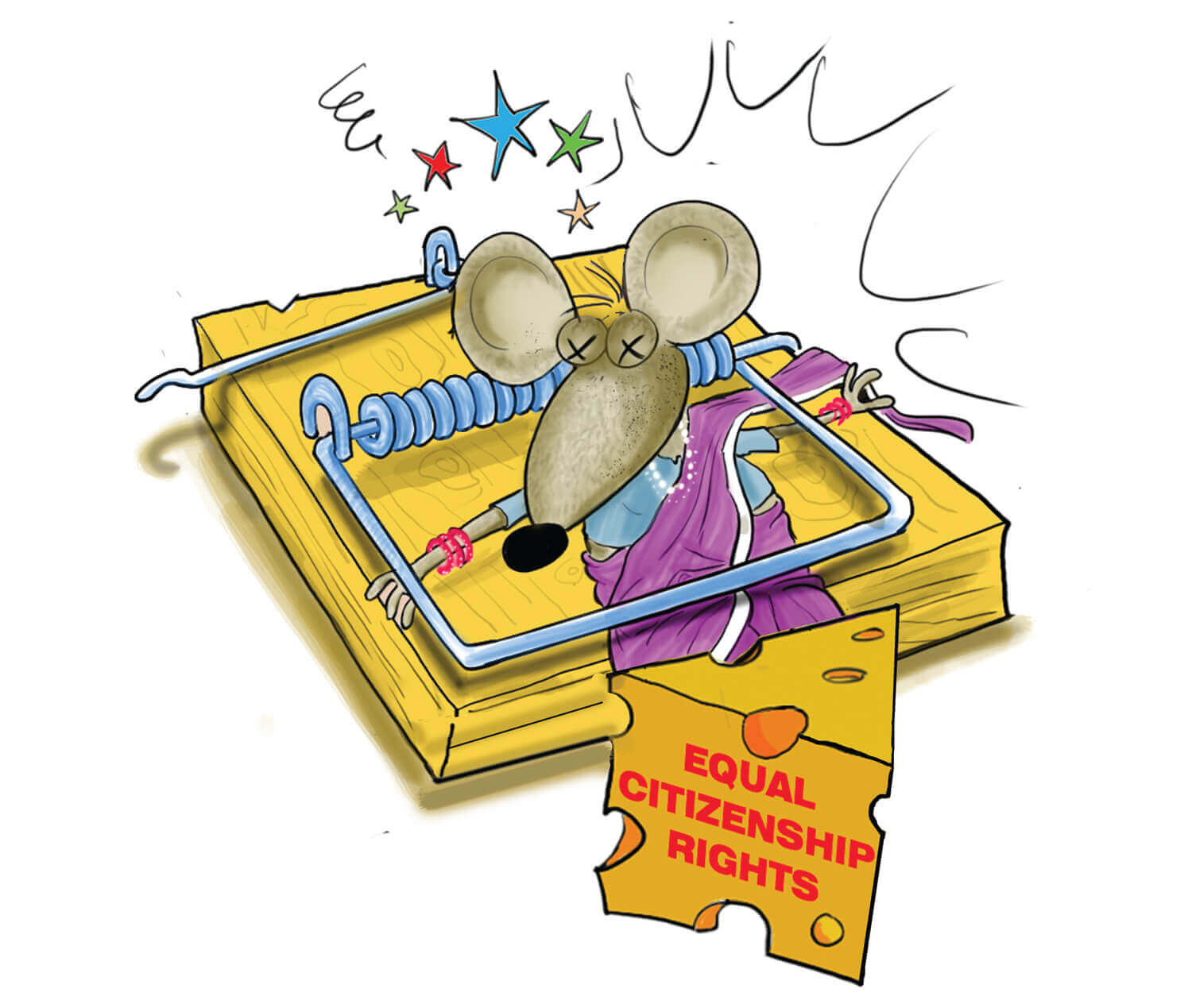
Seven years after the Supreme Court issued a landmark verdict in the Sabina Damai vs Government of Nepal case, allowing children to obtain citizenship in the name of the mother alone, the 2015 Constitution and a draft bill in Parliament have set the clock back.
Activists say the 2015 Constitution which was drafted, debated and promulgated mainly by men, denies equal citizenship rights to women, and the draft bill further entrenches Nepal’s patriarchal culture. The three main objectionable provisions are:
a) A foreign woman married to a Nepali man can get naturalised citizenship right away, and is given six months to furnish proof that she has renounced her original citizenship. But if a foreign man marries a Nepali woman, he will not get Nepali citizenship. He can apply for naturalised citizenship after residing in Nepal continuously for 15 years. But his marriage to a Nepali woman will not count, and he has to apply for naturalised citizenship just like any other foreigner.
b) Children of a Nepali man married to a foreign woman are entitled to citizenship by descent. But the children of a Nepali woman married to a foreign man will get naturalised citizenship, and that too only after producing proof they aren’t already citizens of their father’s country. They can get citizenship by descent only if the father has naturalised Nepali citizenship.
c) Children above 18 can easily get citizenship if their fathers are Nepali, but it is much more difficult if they only have their mother’s citizenship. If the father is unknown, is estranged, or refuses to accept them, their mother will have to ‘declare’ to authorities that she does not know who the father of the child is.
“The constitution and the citizenship bill perpetuate the male notion that their semen is superior, and women are not equal to men,” says former Supreme Court Justice Balram KC.
KC was one of two justices who ordered the Dolakha district administration in 2011 to grant citizenship to Sabina Damai through her mother’s name. Sabina’s father was not known, and Dolakha’s Chief District Officer had refused to grant her citizenship unless her father’s identity was established.
Read also: All parties are technically illegal, Om Astha Rai
The Supreme Court not only directed the Dolakha administration to grant Sabina citizenship without asking about her father, it also ruled that women would henceforth be able to pass on citizenship to their children even without their husbands.
“That verdict was not just for Sabina Damai, but for every person whose father is unknown and who wants citizenship through his or her mother’s name,” KC says.
Barring a few exceptions, male-dominated district administration offices have defied the precedent set by Damai vs GoN and continue to deny citizenship to offspring of single mothers.
In 2013, Shanti Nagarkoti filed a petition at Supreme Court after she was denied citizenship by the Kathmandu district administration unless she provided her father’s name. Two years later, the Supreme Court ordered the Kathmandu administration to grant her citizenship despite her father being unknown.