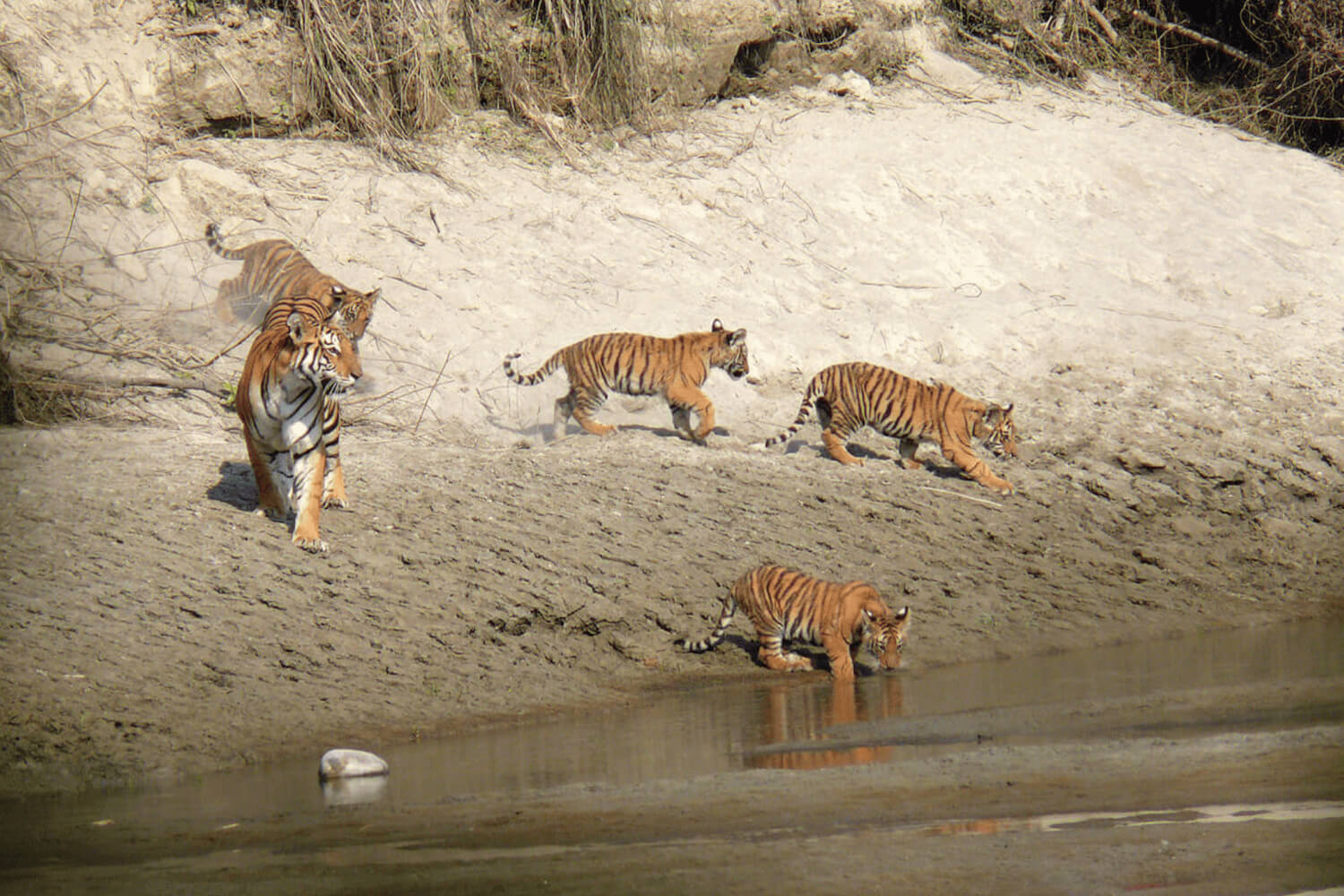
- The decomposed body of an adult tiger was found in Banke’s Gokul Community Forest in May. It was difficult to say how it died, but four missing canines gave a clue.
- Last September, a tiger was found dead inside Bardia National Park, and it looked like it had been hurt in a territorial fight with another tiger.
- Three years ago in Bardia, a tiger had been electrocuted in a fence set up by villagers to prevent predators from killing livestock.
- Two tigers have been killed in the past two years after being hit by speeding trucks on a highway that cuts through Bardia.
- A tiger drowned in 2018 in an irrigation canal that also goes through the park, bringing the total number of tigers lost in Bardia to six.
Nepal’s tiger conservation efforts in the past decades appear to have been too successful. Overcrowding within national parks is driving tigers out of sanctuaries in search of territory, leading to increasing contact with humans.
With fewer ranger patrols during the Covid-19 lockdown, there has also been a worrying increase in poaching of wild animals inside parks, including tigers. Former guerrillas from Nepal’s Maoist conflict who have not surrendered their arms are also found to be involved.
In March, a wounded tiger was found dead near the Indian border in Suklaphanta National Park with a wire trap embedded deep into its neck.
Since 2015, the Wildlife Crime Division of Nepal Police’s Central Investigation Bureau (CIB) has apprehended smugglers and seized 37 tiger pelts and other body parts (31 new and six old). Although most of them are believed to be from Indian tigers being trafficked via Nepal to China, some of them could be tigers from Nepal.
Earlier this year, two poachers, Chakra Bahadur Bista, 34 and Ganesh Tiwari, 24 of Surkhet district were arrested within the Bardia park premises when they shot at Nepal Army soldiers on patrol.
They had set up a tent 6km northwest of the park where officials found three loaded guns, 17 rounds of ammunition, slingshots, nets and sickles. The two are awaiting trial.
“Tigers are known to prey on livestock here. Villages must have poised the carcass anticipating the tiger to return to feed on its kill and fearing an attack on humans in the process,” says Ramesh Budathoki of the Division Forest Office in Banke.
Unlike Chitwan National Park, where there are relatively fewer cases of tiger-human contact, Banke and Bardia districts in Nepal’s western plains have reported an increasing number of tiger attacks, and a spike in retaliation killings of the cats.
"Poaching is still rare, but tigers are being killed in electrified fences and traps by villagers trying to prevent tiger attacks,” says Asim Thapa of Bardia National Park. “Nonetheless this is a setback in our conservation efforts.”
Nepal is the first tiger range country to attain the international target of doubling the number of its tigers by 2022. A census three years ago counted 235 tigers in parks across the country, up from 121 in 2009. But Nepal may now be a victim of its own success -- overcrowding in protected areas and a decrease in prey density means the tigers are venturing out of the forests for food and coming into contact with humans.
Wildlife poachers have also used pandemic-induced lockdowns to actively smuggle endangered animals. Collectively, they are undermining Nepal's success in tiger conservation.
“Whether it’s a case of wildlife smuggling or locals poisoning the tiger, it adds challenges all the same in our efforts to protect the endangered species,” says the head of National Nature Conservation Fund Bardia Rabin Kadaria.
In July 2020, the Regional Investigation Bureau of Lumbini Province posed as buyers to arrest three poachers who were in possession of tiger pelts and 10kgs of bones.
Based on their statements, the Division Forest Office Banke filed a case against them in the district court. It emerged that Prakash Lamichhane with his brother Manoj had shot one of the tigers in the Banke National Park on 2 April 2020. Manoj confessed to skinning the tiger right after the kill, and implicated seven others.
The crime came into light only three months later when one of the culprits, Nawaraj Ghartimagar, was jailed in another wildlife crime. The CIB then analysed his cellphone call details and found out that he was in touch with Surjit Ramja Budha.
The CIB had earlier arrested Budha in 2020 from a hotel in Tulsipur with Um Bahadur Rana and Ramit Sunar for trading in tiger pelts. Rana and Sunar are former Maoist guerrillas and have confessed to killing a tiger in Banke.
"Wherever a tiger is killed, it is a matter of great concern because these are endangered species. Earlier we used to nab poachers smuggling tigers from India, but there has been a worrying rise in tigers killed in Nepal’s parks also," says ecologist Haribhadra Acharya with the Department of National Parks and Wildlife Conservation.