
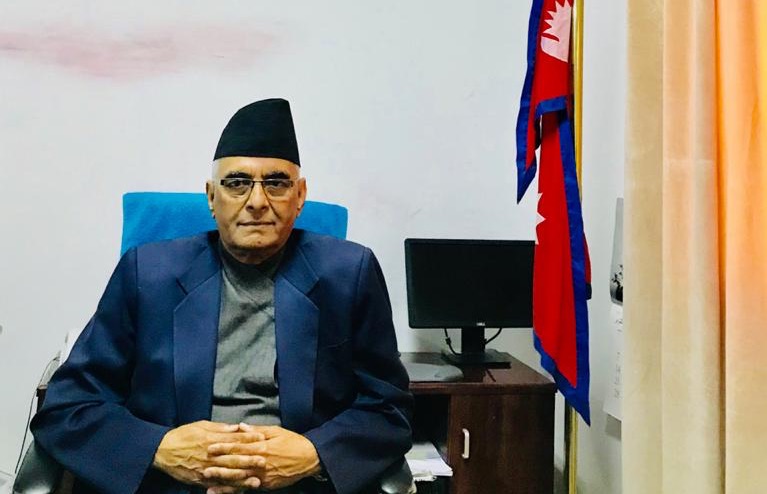
Nepal’s new budget last week pushes Nepal’s missions overseas to ensure the welfare of the country’s migrant workers during the Covid-19 pandemic. Nepal’s outgoing ambassador to Saudi Arabia Mahendra Prasad Singh Rajput spoke to Upasana Khadka of Nepali Times on his tenure in one of the most popular destination countries for Nepali migrant workers.
Nepali Times: What are some of your reflections from the last four years of your tenure in Saudi Arabia?
Mahendra Prasad Singh Rajput: Just like other countries in the region, there is the practice of kafala, which means workers are at the mercy of employers. But I have also seen a positive momentum over the years here, especially the recently introduced Labour Reform Initiative which has challenged many aspects of the kafala system by allowing workers to change employers under certain criteria or to leave without an exit permit. We also managed to raise the minimum referral wages of workers to 1,300 Saudi Riyals from 1,000, which had to undergo cabinet approval and was long overdue.
There were many cases in which we had to help Nepali workers. One Nepali, Prem Bhujel, actually stayed in the embassy shelter for 2.5 years because he was unable to exit the country unless he cleared hospital fees that had racked up to 800,000 Riyal. It was waived after the embassy appealed to the conscience of the hospital chief. Then there was Tanka Bahadur Raskoti who had been incognito as a camel caretaker for 18 years. We located him, coordinated with the sponsor to pay him 50,000 Riyal before he was sent back to Nepal to be reunited with his family.
There were three death penalty cases that we were able to reverse by closely communicating with the highest authorities in the Labour Ministry and mayors of provinces. A big lesson from all this is that a lot rests on personal relationships with government counterparts and agencies while dealing with individual cases, or common issues faced by Nepalis. Communication opens up avenues for solutions, no matter how complex the case.
A significant event during my tenure was of course the Covid-19, especially the first wave, that overwhelmed us with many panic-stricken Nepalis. As many as 28,000 Nepalis registered to return in government-supported repatriation flights although we had an inkling that many would change their minds about returning eventually. Around 18,000 returned in the government-supported flights. The close cooperation with Nepali community groups in Saudi Arabia during the crisis helped stranded migrants with shelter and food across the country.
The second wave has been a lot calmer, and many are in fact feeling safer to stay on in Saudi both to hold on to their jobs and because the healthcare system is better. At least a weekly Kathmandu flight would help the few workers who are stranded. Fortunately, there is no discrimination here between locals and foreigners when it comes to vaccines.
Recovery of labour demand for new Nepali hires in Saudi Arabia has also been robust compared to other destination countries. This is encouraging, and also a testimony to the strong reputation Nepalis have built for their work ethics and honesty and the bilateral ties between the two countries.
What are some of the common challenges faced by Nepali migrants in Saudi Arabia?
When there are hundreds of thousands of workers, there are bound to be problems. Our challenge is to minimise them. A large number of migrants who come to Saudi Arabia are not well oriented to the culture, laws, practices and even their own terms of employment as stated in the contract. They sign whatever they are made to sign.
While there is a mandatory pre-departure orientation for migrants, I can tell from the receiving end here that workers still lack basic knowledge of life in Saudi Arabia when they arrive. This needs to be urgently addressed. There are many Nepalis in jail because they did not fully comprehend the consequences of dealing with alcohol, or did not have the driving skills despite coming here as drivers which also makes them prone to accidents.