
The schoolteacher walked ahead of me through the terraced hillside above Dullu in the west of Nepal, and paused where the path crests a small rise to gesture at a clearing below. We descended together into it.
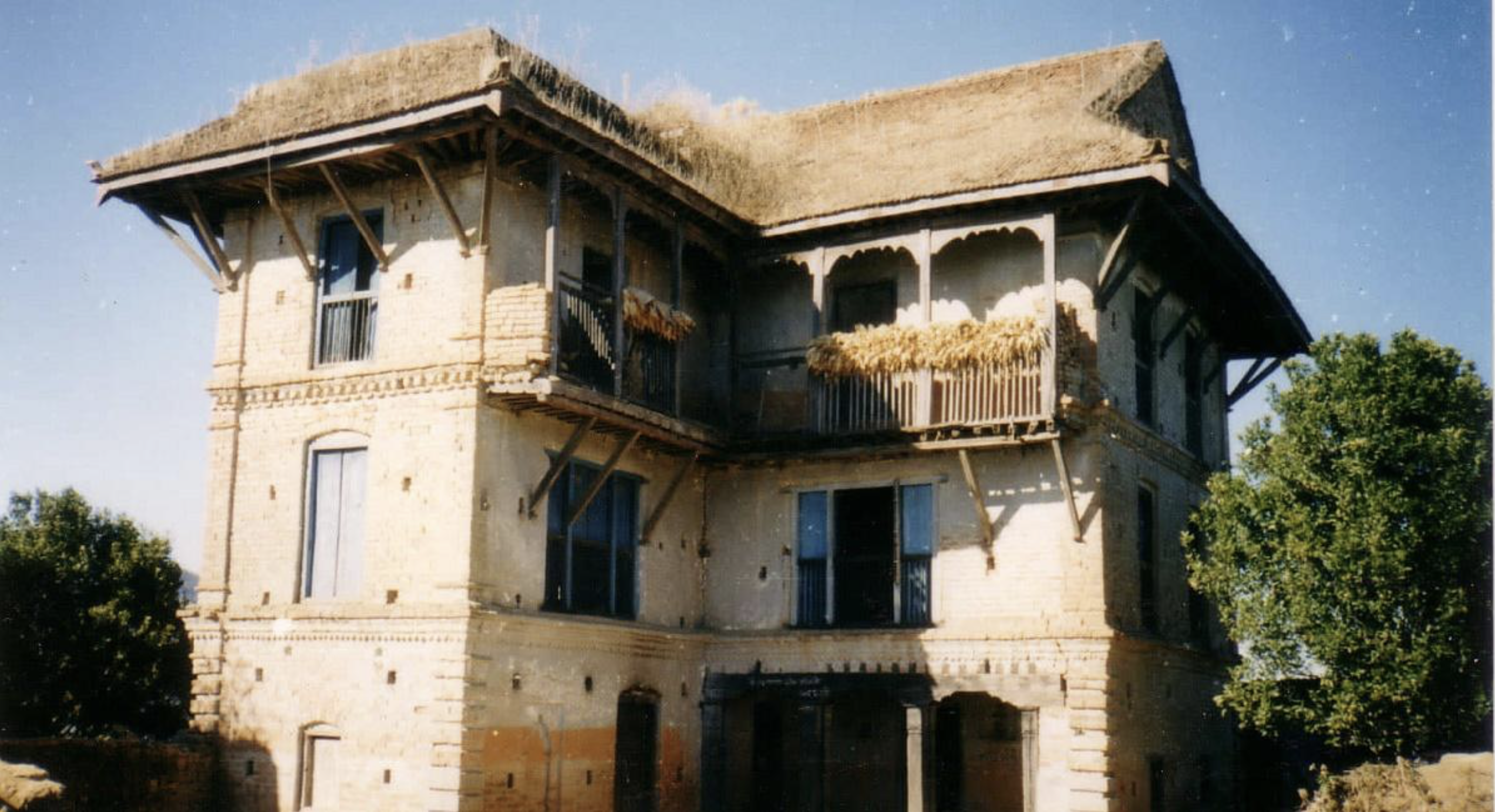
There was one standing wall, sun-bleached, cracked along its upper courses, listing slightly as though exhausted, rising from weeds and what looked, from a distance, like piled rubble. This was all that remained of the Dullu Darbar, a palace built in the 1920s by artisans from Kathmandu on the site of the old Malla royal compound – centuries earlier it was the winter seat of Khas-Malla kingship.
“It burnt for several days,” the teacher said. “You could see smoke from several villages away. Nobody came. Nobody stopped it.”
Two decades on, the Dullu Darbar exists primarily as a negative space: a wall, a museum of surviving objects established in the shell of what was burnt, and an absence so complete that most accounts of the Maoist insurgency from 1996 to 2006 simply do not mention it. This is an attempt to take that absence seriously, and to ask why the taking-seriously has taken so long.

The scholarship on the war has grown considerably since the Comprehensive Peace Accord (CPA). What has not grown is a reckoning with what the conflict destroyed. The insurgency’s destruction of cultural heritage remains largely unaccounted for.
This is not an accidental omission. It reflects the structure of post-conflict discourse in Nepal, which has consistently privileged political negotiations, constitutional change and the institutional trajectories of the post-conflict state.
What is absent from that discourse is the systematic destruction of heritage sites across western Nepal, the banning of traditional music and the erasure of local cultural life as a deliberate revolutionary program.
To understand why the palace was targeted, we need to understand what Dullu was, and what it was not, in the imagination of the Nepali state.
THE WRONG SIDE
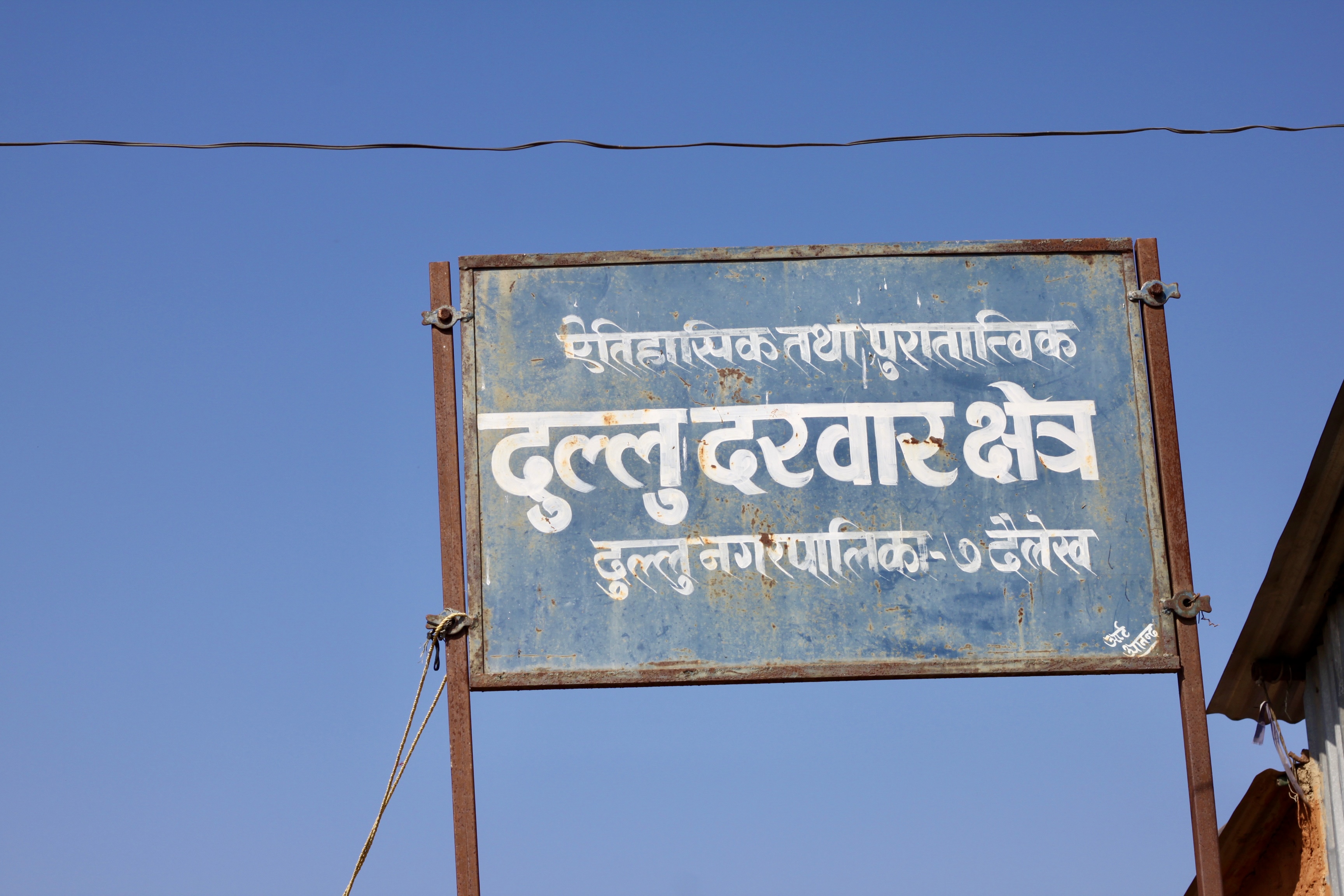
The oldest inscription in the Nepali language is believed to have been composed here, during the reign of King Bhupal Damupal, some time in the 10th century. A dynastic pillar erected in 1354 CE by the Khas-Malla king Prithvi Malla still also stands on the site.
These are not minor antiquities: they are among the earliest material traces of the language and polity from which the Nepali nation claims its origins. And yet, none of it was legible to the Kathmandu-centred national heritage imaginary. Dullu was on the wrong side of the mountains, the rivers, and the historical imagination of the state.
By the time the writer Manjushree Thapa travelled to Dailekh, Kalikot and Jumla during a 2003 ceasefire, she found in western Nepal – the epicentre of the Maoist insurgency – a country almost entirely invisible to the capital: district headquarters that lacked road access, a generation of children whose schooling had been destroyed by the conflict, a population long dependent on migration to India for survival.
The Karnali basin had some of the country’s worst food insecurity, lowest literacy, and highest maternal mortality. It also had the weakest state presence – which is another way of saying it had the most fertile ground for an insurgency that promised to address exactly these failures.
The Karnali basin’s heritage was provincial residue in the national imagination, which made it, when the insurgency arrived, both a target and an absence: important enough to destroy, invisible enough that its destruction would go unrecorded.
The Maoists – officially, the Communist Party of Nepal (Maoist) – launched their ‘People’s War’ on 13 February 1996, drawing directly on Mao Zedong’s dictum that political power grows out of the barrel of a gun.
The movement’s vocabulary was explicit: the government, the monarchy, and the social order they sustained were all ‘feudal forces’. That term came with operational consequences. If the old palaces of the hill districts were materially feudal, if they concentrated in brick and timber the accumulated hierarchy of caste and kingship, then destroying them was not vandalism, it was doctrine.
It was also, within a framework the Maoists drew consciously from their ideological forebears, a form of political iconoclasm: the deliberate destruction of images and objects that anchor a particular symbolic order, undertaken not in spite of their significance but because of it.
The burning of a palace is not incidental to this program. It is the program. By eliminating the physical substrate of a symbolic order, the revolutionary actor performs, for witnesses and perpetrators alike, the death of the world the destroyed object had inhabited.
The cultural program of the insurgency operated within this logic. Cadres moved from village to village staging songs and plays depicting Maoist heroism, schools were reordered around revolutionary calendars, the royal national anthem was banned in Maoist-controlled areas and replaced with revolutionary songs.
The Maoists’ student wing formally demanded the anthem’s abolition. In western Nepal, even traditional deuda folk songs were suppressed as part of what the movement’s publications called the elimination of ‘declining and indecent culture’.
Marie Lecomte-Tilouine, a French anthropologist at the School for Advanced Studies in the Social Sciences (EHESS) in Paris, and a scholar who has produced one of the most sustained accounts of the Maoist insurgency’s cultural dimensions, has documented this from her fieldwork in Achham.
The Maoists asked Damai bards in western Nepal to replace the apostrophe ‘O King’ with ‘Hey Comrade’. Some could not. The form was built around the address to the royal patron, and without it the recitation came apart. They chose silence.
The Maoist leadership understood its own project in these terms. Interviewed in 2000, the party’s chairman, Prachanda, said that “a whole cultural revolution was going on among the people. Questions of marriage, questions of love, questions of family, questions of relations between people. All of these things were being turned upside down and changed in the rural areas.”
This was not cultural change as a byproduct of political change. It was, as Lecomte-Tilouine identifies in one of her essays, a cultural revolution in the technical sense: a structured program for unmaking the symbolic infrastructure of the old state and replacing it with a revolutionary alternative.
The burning of the Dullu Darbar was one of the most significant single acts in this campaign, but the pattern it represented was geographically coherent and repeatable.
The attack on Achham, in Sudurpashchim Province, gives the clearest picture of what that destruction looked like in practice. On 13 February 2002, the sixth anniversary of the beginning of the ‘People’s War’, approximately 2,500 Maoist guerrillas stormed Mangalsen, the district headquarters, bombing government buildings and executing officials and security personnel.
According to a report in Nepali Times the following week, they killed all 57 soldiers in the Mangalsen garrison, along with 77 policemen and five civilians, in what was the single most damaging strike by the Maoists up to that point.
The Mangalsen Darbar, a three-storey, 30-room palace built around 150 years earlier by the Achham king Tikabhuk Shah and his son Dal Bahadur Shah in the style of Kathmandu’s Hanuman Dhoka Darbar, was caught up in the bombardment and severely damaged.
The Galkot Darbar in Baglung sits at the other end of the evidentiary spectrum. After Bharatbam’s death in the early 1980s, the palace passed to his son Madhavbam Malla, a schoolteacher who lived there with his family and maintained the building.
In 2002, Maoists killed Madhavbam and forced his family to flee to Kathmandu. Maoist cadres also looted historical documents from the palace. Their fate is unknown, and they are almost certainly gone forever. Unlike a ruined wall, their absence leaves no visible trace.
Iconoclasm works precisely because it is irreversible. What the doctrine could not account for was the kind of significance the Dullu Darbar held beyond its feudal associations. When it burnt, it took with it proof of a past that had already been systematically neglected.
Lecomte-Tilouine returned to Dullu in the spring of 2003, a year after the palace was burnt, having first done fieldwork there in 2000. The account she gathered of what had happened in Dullu during the intervening years came through a villager she calls Shyam, a Kshatriya man in his mid-forties, not a political activist, interviewed by a trusted local intermediary.
Shyam opens not with the palace but with music. The Maoists had banned traditional music in Dullu: the deuda songs, the damaha drum, instruments that accompanied weddings and funerals.
“When they heard music somewhere, they would immediately turn up, encircle [the musicians] and ask them: ‘Why are you playing music?’” This, Shyam says, was where the fire started within the entire population.
What follows in his account is a confrontation between two incompatible cosmologies. The Maoists organised a ceremony of social reversal, forcing dominant-caste people to eat food cooked by oppressed-caste people, climbing step by step through the caste hierarchy – from the Badis to the Damais to the Kamis to the Kshatriyas – seeking to dismantle the logic of caste pollution through enforced ritual transgression.
When they reached the dhamis, dominant-caste ritual mediums through whom deities speak, 35 of them began simultaneously to be possessed. They put stones in their mouths, chewed on them and spat them out. The Maoists, Shyam says simply, were surprised. They gave up.
Later, Maoist cadres seized a dhami and cut his sacred lock of hair, which a dhami never cuts, and confiscated the metal statues from his temple. The stated purpose was ideological: to demonstrate publicly that there is no godly power.
The villagers’ interpretation ran in an entirely different direction. They concluded that the Maoists had taken the lock of hair for the gold and silver rings devotees had tied into it, and had taken the statues out of greed. This misreading is a measure of the chasm between the Maoists’ cultural program and the people they were claiming to liberate. The Maoists were performing the destruction of superstition. The villagers were watching petty theft.
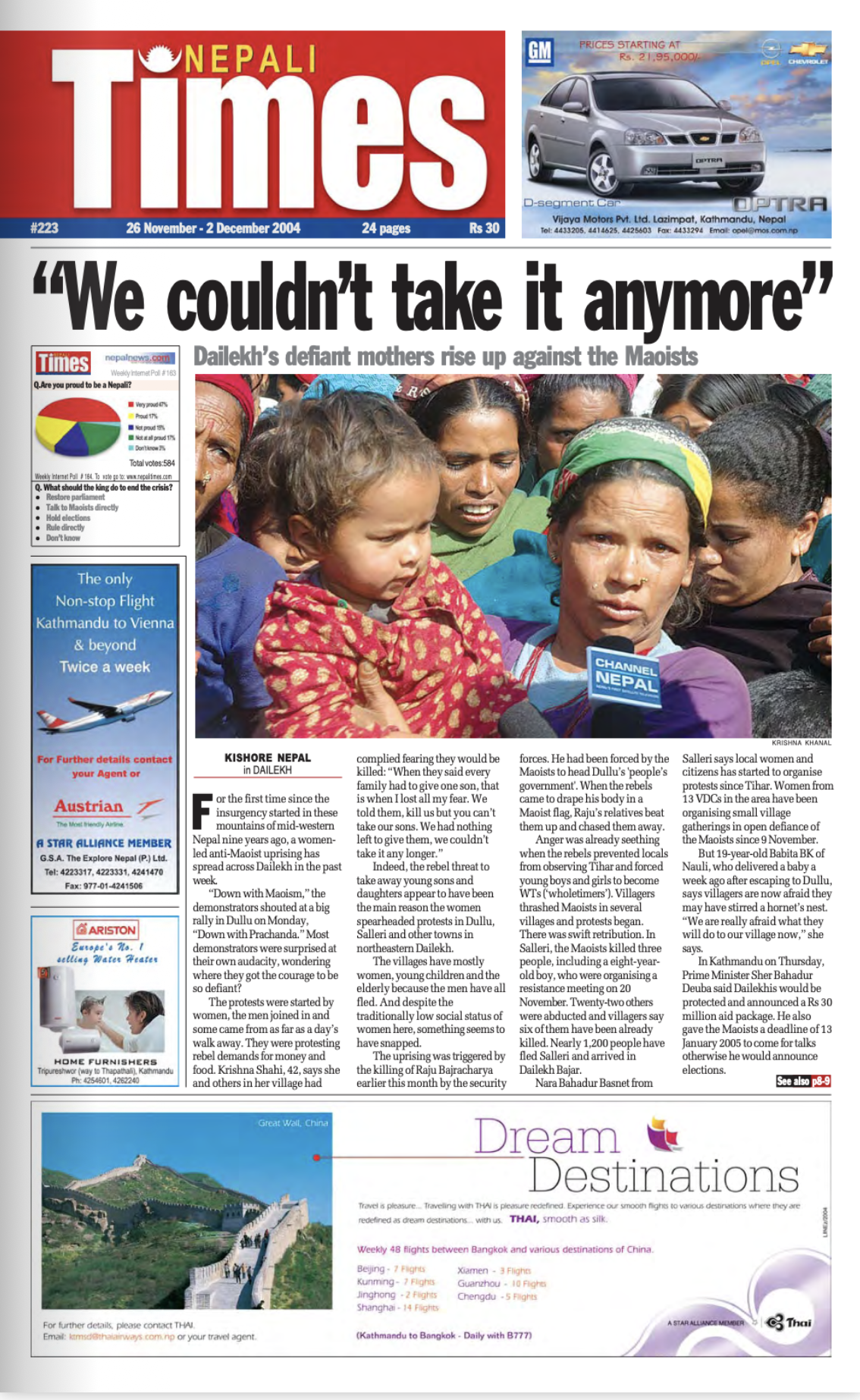
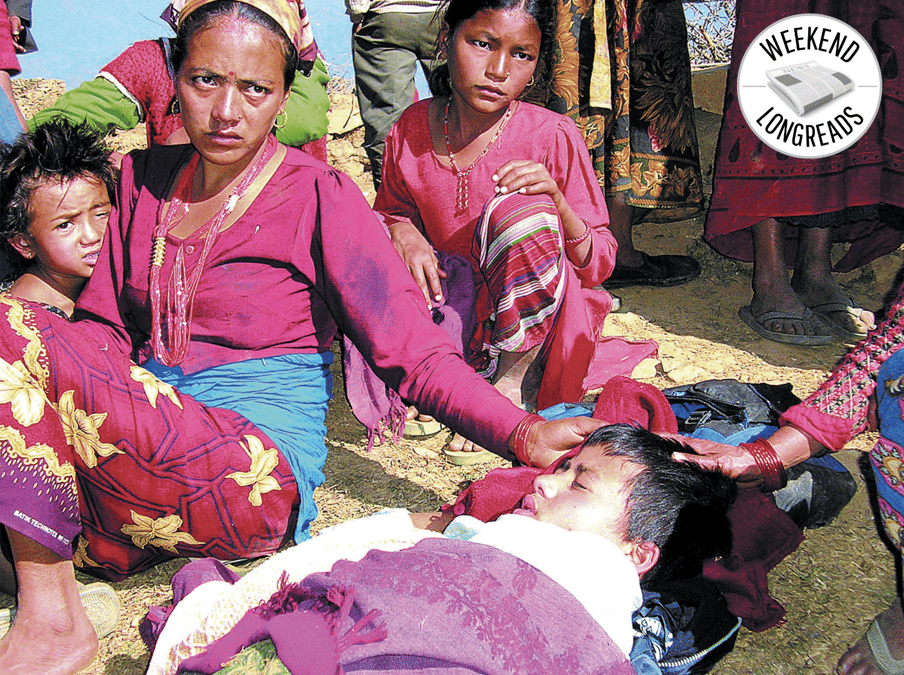
In 2004, Dullu rose up in revolt against the Maoists, much to their shock and chagrin. The trigger was forced labour on a Maoist road project, plus the cumulative weight of years of violence by the party, the deeper cause was the cultural attacks set out above. The uprising was civilian-led, largely driven by women, and it spread from Dullu across 13 neighbouring village wards within weeks.
Afterwards, the Maoist Dailekh District Committee published a formal repentance text in Janadesh, the party’s weekly newspaper, confessing its mistakes in the district. Among the listed errors: ‘insisting that religion, culture, traditions, festivals and food, etc. be not contrary to Marxist rules’. The repentance was practical rather than moral: the committee specified that action in the religious and cultural field should be avoided because “it weakens the People’s War”.
Not because destroying the dhamis’ locks of hair was wrong. Because it was counterproductive. This is the document that tells you most clearly what the cultural program was: not an excess, not a local misreading of central policy, but a program applied consistently enough that the district committee had to formally enumerate its mistakes.
POST-CONFLICT NARRATIVE
The mixed reception of the palace’s burning in Dullu is what the post-conflict national narrative has most thoroughly erased. My own interviews over the past year produced testimony that mirrors what Lecomte-Tilouine found.
A former schoolgirl who was 12 years old in 2002 described watching an older Dalit neighbour at the edge of the crowd weeping, and not being able to tell, for a long time, whether the tears were of grief or something else.
“He kept saying, ‘Now it is gone,’” she told me. “He meant the rule of it. The shape of the thing.” For those at the bottom of the caste hierarchy the palace had always represented exclusion, its destruction carried a genuine charge of liberation.
A former schoolteacher broadly sympathetic to the Maoists at the time, now spoke with the clarity of long retrospection: “We all knew the palace represented the old power. That part was true. But what they burnt was also our proof that there was once a great kingdom here, that the Nepali language came from here, that this place mattered. They burnt the proof.”
This phrase, “they burnt the proof”, names something that scholarship has not yet adequately grappled with. Political iconoclasm is, by definition, selective: it targets the symbols of the enemy, not one’s own. But the Dullu Darbar was not only a symbol of feudal authority.
It stood on the site of a medieval capital whose history the Nepali state had spent a century marginalising – a history that belonged, in some real sense, to the very communities in whose name the Maoists claimed to act. And yet what burnt was irreplaceable.
The CPA signed in November 2006 ended the fighting, committing both the government and the Maoists to establishing a Truth and Reconciliation Commission (TRC).
The commission took nine years to constitute. Its mandate, as defined in the 2014 TRC Act, covers ‘grave violation of human rights’. It does not extend to the damaha drum that was not played at a funeral in Achham in 2003, or the manuscripts that were taken from the Galkot Darbar and have not been seen since.
The Supreme Court ordered a Commission of Investigation on Enforced Disappeared Persons in 2007, but the government did not establish it until 2015. In the decade since, the commission has verified a list of 2,514 disappeared persons but has completed no investigations nor determined the exact fate of so much as a single victim.
The Maoists, having renounced armed struggle and entered mainstream politics, won the first election after the war. The leaders who authorised the burning of the Dullu Darbar went to Parliament, to the cabinet, to prime ministership. The palace remained a ruin.
The heritage violence of the civil war has never been named as such in Nepal’s post-conflict settlement. Because the Maoist movement understood its own iconoclasm as constitutive rather than incidental, that framing has held: what was burnt and looted and smashed has been absorbed into the story of a justified struggle. It has not been named as destruction. It has not been mourned.
The schoolteacher who walked me up the hillside did not want to be recorded. In Dullu, retrospective disillusionment takes a specific form: not monarchist nostalgia, not rejection of the republic that emerged from the war, but a particular grief over cultural loss compounded by the post-conflict state’s indifference.
The ruins of the Dullu Darbar are legible as ruins. They tell a story about power and violence and selective memory that is available to anyone who makes the journey here, who stands before the solitary surviving wall and tries to read in it the dimensions of what used to stand there.
This piece was originally published in Himal Southasian on 26 May 2026. A longer version of this piece can be found online.