
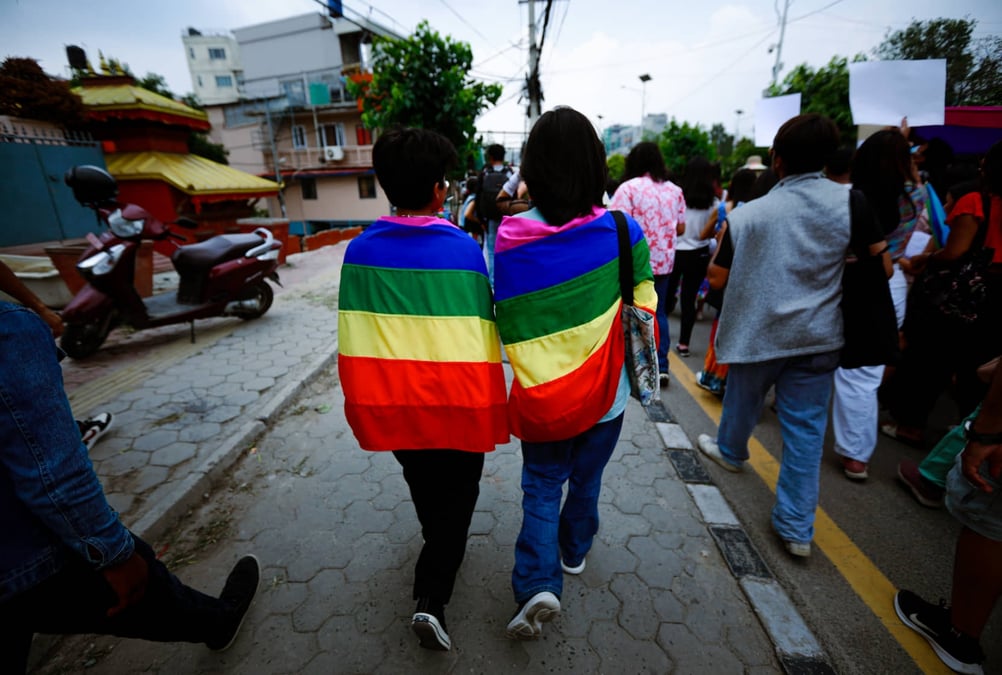
Last April, Nepal became the first South Asian country to provisionally recognise same-sex marriage, and the second only to Taiwan in Asia.
The Supreme Court ruling on Sunil Babu Pant and Others v Nepal Government in 2008 decriminalised same-sex marriage and ordered the government of to make arrangements, including enacting new laws or amending existing laws, to ensure the rights of people with different gender identities and sexual orientations.
The Constitution guarantees fundamental rights to gender and sexual minorities, and Nepal has long been recognised for its relatively progressive LGBTIQA+ laws in Asia.
In 2023, Supreme Court Justice Til Prasad Shrestha issued a temporary order to register same-sex and non-heterosexual marriages, following which a municipality in Lamjung became the first authority to recognise a same-sex union, registering the marriage of Maya Gurung, a transgender woman assigned male at birth and legally recognised as male, and Surendra Pandey, a cisgender man.
The Supreme Court had ordered the creation of an interim registry for non-heterosexual marriages until Parliament could change the law. But there has been little progress to codify marriage equality into law, which activists say hinders progress to protect queer rights in Nepal.
Article 18 of Nepal’s Constitution states ‘..nothing shall be deemed to prevent special provisions by law for the protection, empowerment or development citizens including..gender and sexual minorities’.
However, this is in contradiction with Nepal’s Civil Code, Section 67 of which defines marriage as being between ‘a man and a woman’.
“Even though the Constitution guarantees the right to equality, the Civil Code has gendered terms like ‘man’ and ‘woman’ which automatically exclude same-sex couples,” says Sujan Panta, a legal expert on sexual and gender minorities. “This has caused it to become a major issue for many same-sex couples as they are not legally allowed to get married.”
Mitini Nepal, alongside Forum for Women and Law and Development, filed a writ petition on in December 2022, to nullify Civil Code Section 67 and to legally recognise same-sex marriage. The petition suggested using gender-friendly terms to define marriage, such as using ‘persons’ instead of ‘man’ and ‘woman’ and using ‘spouse’ instead of ‘husband’ and ‘wife’.
Experts and members of the LGBTQIA+ community have noted that legal discourse surrounding marriage equality in Nepal has so far been limited to marriage registration. Indeed, the provisional recognition of same-sex marriage does not grant the full legal rights and marriage benefits to same-sex couples that are afforded to heterosexual couples, which includes inheritance, adoption, and divorce laws.
‘Marriage registration, unlike other civil matters, invites a complex web of legal repercussions. It affects laws on divorce, domestic violence, polygamy, adoption, child adoption, custody, property inheritance and property division amongst spouses,’ wrote lawyer Aastha Dahal in an op-ed in Nepali Times in 2023 after the Supreme Court’s interim order to register same-sex marriages. ‘Barring domestic violence Nepali laws in all these matters only envision a spousal relationship between a heterosexual man and woman.