
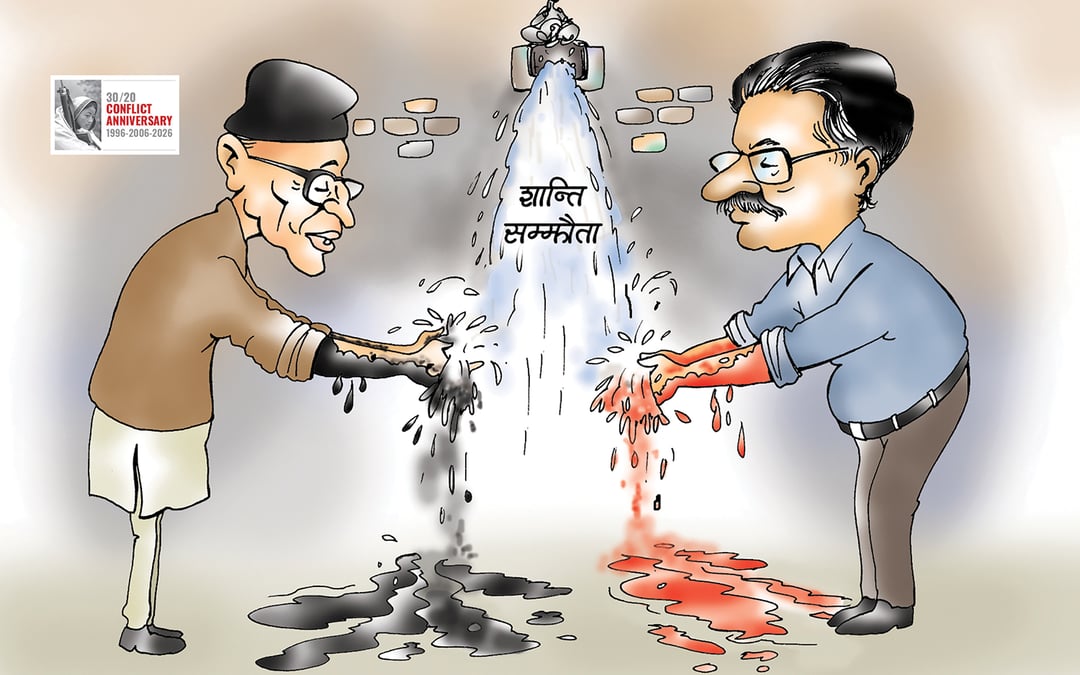
* Maoist leader Pushpa Kamal Dahal launched an armed struggle in which 17,000 people were killed, many of them civilians accused of being class enemies. Kin of many of those killed during the conflict saw the perpetrators move around freely, yet did not seek retribution.
* Former Prime Minister K P Oli and his Home Minister Ramesh Lekhak were accused of bearing responsibility for the massacre of 19 youth outside Parliament last September. They served less than two weeks behind bars.
* Last week, former prime minister Sher Bahadur Deuba returned to Nepal to welcoming crowds after six months in self-imposed exile.
Many other known fraudsters, rapists and sexual offenders roam around openly in broad daylight because their victims have not bothered to pursue justice.
Rampant impunity in Nepal has sent the message to other potential crooks that they can literally get away with murder. Perhaps ordinary citizens do not pursue war criminals because they do not trust the judiciary or law enforcement to prosecute the case.
But the anger had been building up, and exploded in last year's protests, resulting later in the landslide victory of the RSP and the installation of Balendra Shah as prime minister. Nevertheless, there has been a remarkable lack of systematic revenge against members of the previous regime that one might have expected.
There is a Nepali saying which translates to: ‘you pretend to hit me, and I will pretend to wince in pain’. The detention of Oli and Lekhak was essentially to show voters that the PM was acting decisively against wrongdoers of the past.
CLASS WAR
Ethno-separatist or sectarian violence in Sri Lanka or parts of India have left a legacy of bad blood and a feeling of us vs them. Nepal’s Maoist insurgency, however, was a class war, after which the guerrillas became partners in coalition governments with their sworn enemies. This meant that both sides colluded to bury wartime excesses and let the transitional justice process lapse.
After the decade-long insurgency finally came to an end with the ceasefire in April 2006, Nepalis were so deeply traumatised and economically drained that public sentiment turned overwhelmingly to seek normalcy, security, and an end to daily terror. Individual vengeance was largely suppressed by a collective societal consensus to protect the fragile peace at all costs.
The abolition of monarchy itself was carried out in a civilised manner. The Constituent Assembly voted to turn Nepal into a republic on the afternoon of 28 May 2008.
During the war, atrocities were committed by abstract entities — the ‘insurgents’ or ‘state forces’ — rather than purely localised personal enemies. Social psychology shows that when harm is attributed to a collective or an ideological machine, individuals find it harder to anchor personal, targeted vengeance against a single neighbour, defusing personal accountability.
Sociologist Émile Durkheim’s idea of societal equilibrium can explain the post-war scenario. The peace deal of 2006 rescued Nepal from a state of acute anomie (normlessness), where wartime lawlessness had shattered societal conventions. The sudden transition to structured peace provided a predictable framework in which people eagerly clung to this new social order because human beings inherently crave the stability of social regulation over chaos.
Nepali anthropologist Dor Bahadur Bista posited that atrocities, deaths, and disappearances are frequently rationalised as a matter of fate.
The belief in reincarnation also promotes the conviction that wrongdoers will ultimately be punished in their next life, so there is no need for the victim to pursue payback in this life. Another factor could be that Nepal’s elite comprises a handful of clans interconnected by kinship or patronage.
One of the often overlooked factors could be the combination of foreign labour migration and standard state compensation served as a critical economic safety valve that neutralised post-war vengeance in Nepal
Together, these economic factors shifted the public focus away from retributive justice and effectively flattened deep-seated political grievances into structural financial relief.
Visitors, especially from the Subcontinent, remark on the relative lack of road rage on Nepal’s highways even when there is so much reckless driving. Since everyone is breaking traffic rules anyway, there is little open anger against another road user, say, making an illegal U-turn.
Still, this hypothesis cannot lead to complacency, thus allowing grievances of excluded and discriminated groups to pile up until the rage breaks through a critical threshold to explode into violent revenge.
Nirmal Niroula, is Professor of Sociology at South Georgia State College in the United States.