
The year end coincides with Nepal getting a strange new government that is an amalgam of right and left, monarchist and republican, secularist and pro-Hindu state, those who fought for federalism and against it.
Still, let us hope that in 2023 they can improve health and education, work on jobs at home and on migrant workers welfare. The need for better protection for migrant workers was spotlighted during the World Cup in Qatar this year.
In 2018, K P Oli of the UML launched Nepal’s contributory Social Security Fund (SSF). To say that it was a damp squib would be an understatement.
Now, there is news that the SSF will be extended to migrant workers, effective March 2023. This is a positive and welcome step that (as always) will rest on implementation. This means migrant workers will be eligible for old-age pension, accident benefits, and support for dependent families of the deceased.
Workers have to contribute a minimum of 21.33% of prevailing monthly minimum wage. The extension of the SSF scheme to Nepali workers overseas is important because of the sheer numbers of workers involved, and also the lack of a social safety net for their families.
The government already has a Migrant Welfare Fund (MWF) as well as a mandatory insurance scheme for families of deceased migrant workers with valid labour approvals.
A handful of migrant workers have also got medical expense benefits for grave injuries or illnesses that they returned with. Just in the last fiscal year, 1,243 families got death benefits while 143 received accident benefits.
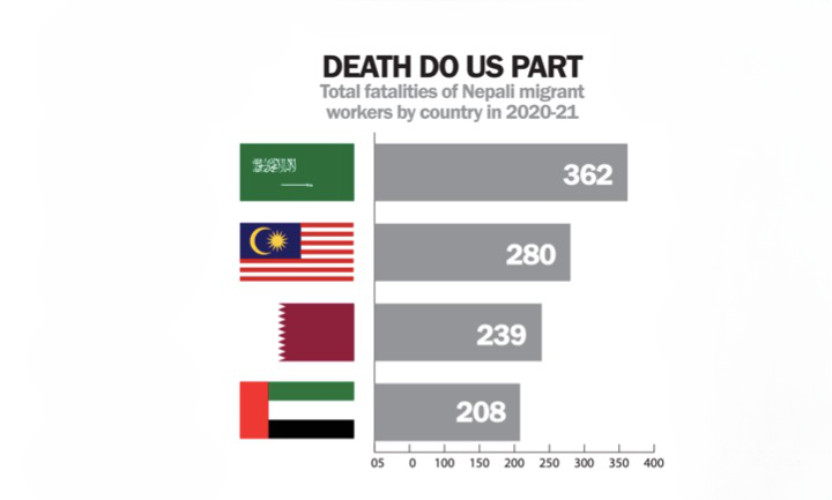
Of the total 1,089 fatalities of migrant workers (see graph breakdown) 104 were attributed to cardiac arrest, 427 to ‘diseases’, 171 were ‘natural’ deaths, 248 were ‘others’.
Non-work related fatalities are generally not eligible for compensation for families. But Nepal’s own MWF provides critical support for deaths abroad that are are un-investigated and un-compensated.