
 Perplexed by the intensity and impact of the Second People's Movement Nepal's international minders have been lining up to visit Nepal. They may still be uneasy with the six-point roadmap of the seven party alliance and their 12-point understanding with the Maoists but the parties have for now been given the benefit of doubt. After the success of the Kathmandu Spring dips and donors grudgingly accept that the insufferable parliamentary party leadership do a saving grace.
Contrary to the fears of widespread violence, the civil disobedience movement was characteristically peaceful. And despite doubts about their ability to guide and control the agitation, party leaders were able to withdraw the movement in an orderly manner as soon as their main demand, reinstatement of lower house of parliament, was met by a reluctant monarch.
The movement may have looked unplanned but it wasn't as chaotic as everyone feared. Nearly everyday, millions poured out into the streets all over the country for three weeks but not a single shop-window was broken by agitators anywhere even though some government buildings were vandalised. Protestors faced batons, tear-gas, rubber bullets and live ammunition but not a shot was fired in self-defence from the streets. Studies in urban uprisings show that crowds of over 50,000 inevitably descend into lawlessness resulting in arson, looting and brutal killings.
In Kathmandu, more than half-a-million protestors marched past army barricades defying shoot-to-kill curfews but the multitude maintained restraint in the face of provocation. This was the first-of-its-kind political upheaval involving widest possible cross-section of population. Is this the way oppositional politics will unfold in the twenty-first century? It seems the world wants to know and is willing to see Nepal without Cold War blinkers for the first time since the Maoist insurgency began a decade ago.
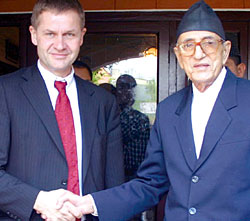
Even hard-boiled Marxist firebreathers in India seem to be fascinated by the success of Nepal's Purple Rhododendron Revolution. CPI-M leader Sitaram Yechury graced the VIP visitor's box of the inaugural session of the reinstated parliament. Richard Boucher, United States Assistant Secretary of State for South and Central Asian Affairs, paid a much-publicised visit soon after. Norwegian Minister for Development Erik Solheim was here this week.