 |
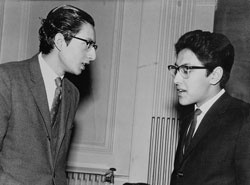
| YES, YOUR MAJESTY: King Birendra (right) while he was studying in Eton in 1964 with Chiran S Thapa, who would later be his secretary and adviser. |
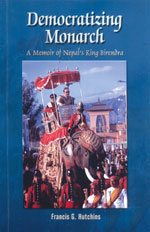
For Francis G Hutchins, author of Democratizing Monarch - A Memoir of King Birendra, his pupil at Harvard during the academic year 1967-68 could do no wrong.
The late king, then crown prince, was a good student "always affable, polite and attentive, deferential toward his parents, wore jeans like other students at Harvard at the time, and retained his remarkable modesty even after he returned to Nepal and became officially...both an emperor and a god, albeit of a benign and approachable sort." Small wonder that the late king became "part of (the author's)... life."
King Birendra was a cut above lesser mortals but, whether Aristotle would have been as uncritical of Alexander had Aristotle outlived his pupil of another time and place, will remain one of history's mysteries. The Aristotle-Alexander reference is derived from Hutchins' fascination with that tutor-king relationship.
Professor Hutchins has delved deep into Nepal's history and assisted by Fr Ludwig Stiller's seminal works has used state-of-the art analytical tools developed and used at Harvard's Department of Government to assess King Birendra's three-decade reign. He places King Birendra as a successor to Kings Tribhuban and Mahendra, and above all to Prithbi Narayan Shah, comparing Nepal's unifier to George Washington.
To Hutchins, the problems faced by Prithbi Narayan Shah, who succeeded in founding "a dynamic pre-modern empire more socially progressive than any seen before" became even more complicated and difficult during the five-decade restoration of Shah rule 1951-2001.
With "Mao's China having swallowed Tibet in 1959" and relations with India having "necessitated greater vigilance," even greater than toward China to "forestall cultural if not political absorption."
In such an adverse geopolitical environment, one would have thought that the right strategy would have been to examine alternatives to forestall hostile military action. King Birendra chose to have one kind of relationship with India, based on the shared practices of Hinduism and India as the transit country for international trade and a strategic relationship. With China, it was the Himalayas as the boundary and the Tibetan culture and way of life common to the peoples on either side of the mountains.