
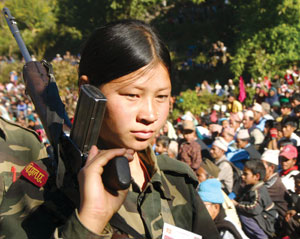
 KIYOKO OGURA WHO IS WHO?: In Nepal as well as in Colombia, women formed a sizeable proportion of the fighting force. In the picture, a PLA combatant in Rolpa during Nepal's war. |
When I just arrived in Nepal, a friendly man at a small shop in Bhaisepati asked me where I was from. After I said Colombia, he replied with a grin: "Ah, the land of the FARC."
I was taken aback because normally few in Nepal have heard of Colombia (those that have think of the capital of Sri Lanka, or a university in New York) let alone a South American guerrilla group. That was the first time I realised that there may be a link between the conflicts in Colombia and Nepal.
Nepal is ahead of Colombia in guerrilla matters in some ways. It signed a ceasefire in 2006 and concluded the peace process with the Maoists, and the former combatants are in the process of integration into the national army and assimilation into society. The Maoists became the largest party in the 2008 elections, and have been leading the government.
In Colombia, FARC has just entered the peace process and the country has the dubious distinction of having one of the longest running conflicts in the world today. FARC has been fighting for the last 48 years and two generations of Colombians have never known peace.
News of the peace process has been greeted with hope and apprehension; after all, there have been failed peace attempts before. A recent public opinion poll showed that 75 per cent of Colombians welcome the peace talks, but 45 per cent do not hold much hope that it will succeed.
The last time there was a ceasefire in 1998, the President Andrés Pastrana government gave an area of 42,000 sq km to the rebels as a safe haven in the southeast of the country, promising no military strikes there. The rebels took advantage of that to rearm, regroup, improve training and boost drug trafficking. They continued their urban offensives, extortion and kidnapping. Pastrana was also faulted for not having a clear plan about the process, and was naive in trusting the rebel group. The peace process collapsed within three years, but the straw that broke the camel's back was FARC's hijacking of an aircraft and kidnapping of a well-known politician.
