
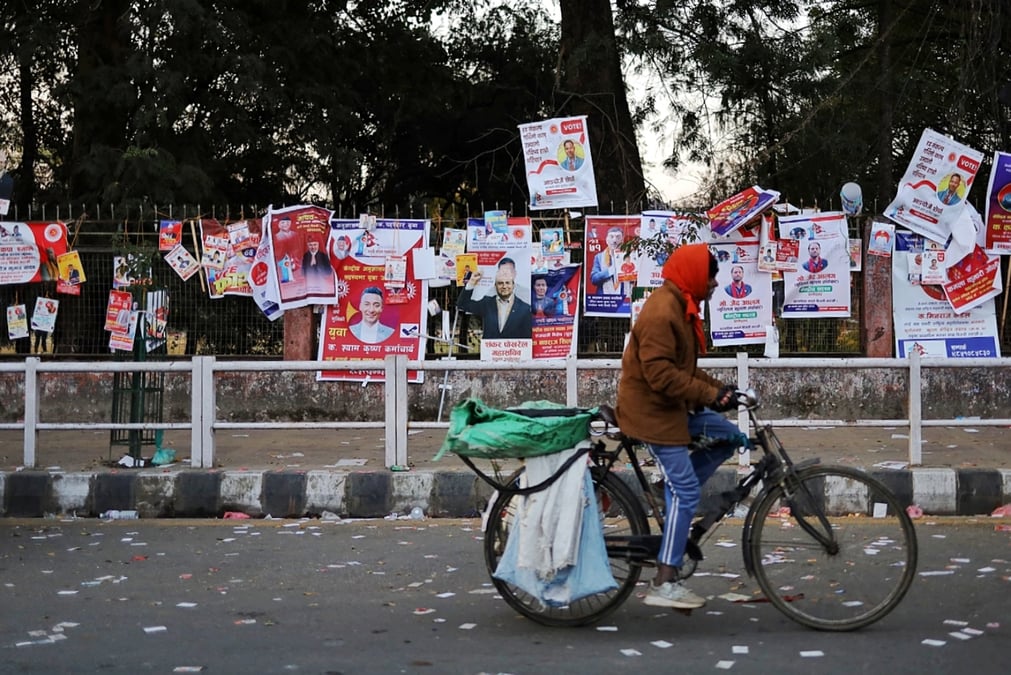
The chaos, mismanaged voting process, and campaign leaflets littering the streets outside the venue of the UML general convention at Bhrikuti Mandap this week was a fitting metaphor for the state of Nepal’s politics 100 days after the September upheaval.
The interim government of Prime Minister Sushila Karki wants to focus exclusively on holding credible elections on 5 March. But with less than three months to go, her attention is being constantly diverted by clamour from youth activists on the one hand, and recalcitrant legacy parties on the other.
Leaders of the UML-NC coalition that was in power on 8 September have not yet said sorry like they meant it – not just for the massacre of young protesters but also for decades of misrule, nepotism and corruption.
The UML, NC and their leaders have kept both options open: elections and Parliament reinstatement. The re-election of K P Oli as the UML chair on Thursday is not just a reflection of how delusional he is, but also loyalists who think September was a conspiracy.
Things are not much better in the NC camp, where the party secretariat messed up registration documents for its own convention in January. Its leader Sher Bahadur Deuba still shows no signs of trying to even give the impression that he wants to pass the baton to capable younger figures in his party.
Some new parties are hoping for a postponement of elections so they can organise better. The former Maoists in the NCP are already at the hustings, and the UML and NC are using their conventions as campaign rallies, even as they agitate for restoration of Parliament.
Even if Oli’s main challenger for UML leadership, 71-year-old Ishwar Pokhrel, had won, the party would not have a fresh new face. Oli sidelined respectable colleagues like former foreign minister Pradeep Gyawali, and to show that its rally in Bhaktapur was bigger than it was, UML propagandists used AI to clumsily exaggerate crowd size.
There are younger cadre within both parties who are speaking up, but their voices are too feeble for the establishmentarians to pay heed. The UML, NC and NCP are all falling back on traditional vote banks among rural seniors with ancestral party loyalty. They are also hoping that new populist parties will cancel each other’s youth votes in urban areas.
But they forget there are 800,000 new voters, and underestimate diaspora influence on political preference. All three mainstream parties are fielding older, tainted candidates, and they may find that just like the Kathmandu mayoral constituency in 2022, they will be swept away by the youth tide.
After the UML’s turn, it will be the NC’s special convention next month, and the gerontocrats are still reluctant to hand over to young turks like Gagan Thapa, who himself will be 50 next year.
The third in the triumvirate, Pushpa Kamal Dahal, may have thought shedding the ‘Maoist’ suffix from his Nepali Community Party would make him more popular, but he is too tainted to breathe new life into the party.
Ujyalo Party Nepal of Energy Minister Kulman Ghising has good prospects with widespread support on social media, just like the RSP’s jailed leader Rabi Lamichhane. But there are doubts about integrity with both. Birendra Basnet is trying to do with his new GLP what he achieved with Buddha Air, but he may find politics is a much more turbulent affair.
ABOVE THE NOISE
The GenZ are the voice for reform, but internal rifts and clashing egos have diminished their clout. If they are not to repeat the same mistakes of the ‘alternative’ parties before them like the RSP, Sajha and Bibeksheel, youth activists must rise above the noise and play a check-and-balance watchdog role.
As journalist and political commentator CK Lal wrote in Kantipur op-ed this week, the youth are ‘impatient, but directionless’. Regimes can be toppled, but how can the political culture be changed? Alas, ever since 1950, it seems Nepal’s revolutions never complete a full revolution.