
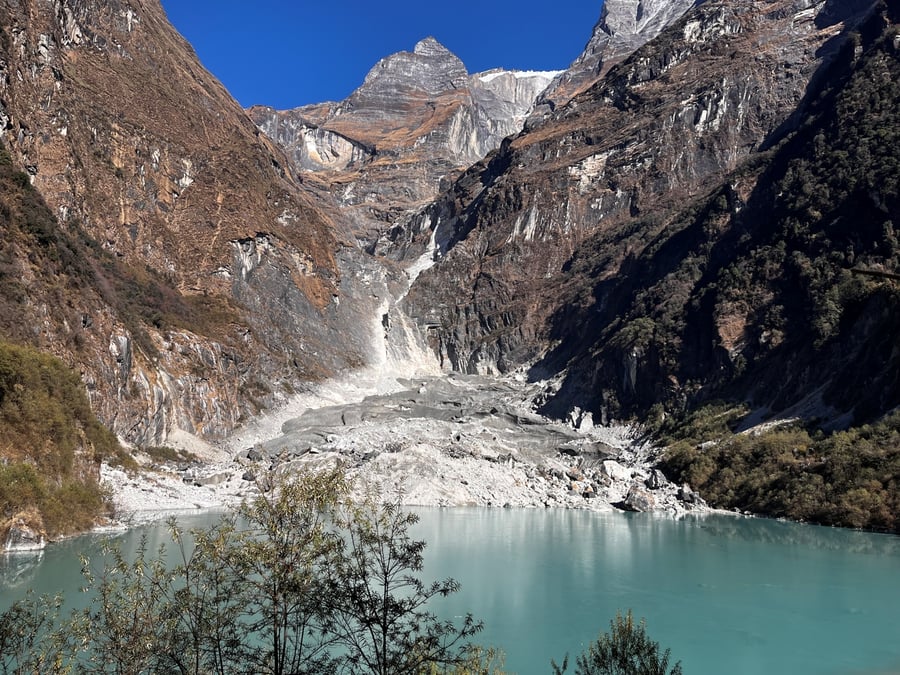
The Himalaya is melting twice as fast as the global average, and this is accelerated by air pollution. Called black carbon, suspended particles emitted by industries, vehicle exhaust, or forest fires accelerate glacial retreat in High Asia. Dark matter makes the ice melt faster (as seen in Kapuche Lake in Kaski, pictured above).
The snowline is already retreating up the mountains due to winter drought and global warming, and this process is quickened by black carbon and reduced snowfall.
The Cryosphere Report 2025 by the International Cryosphere Climate Initiative (ICCI) underscores these alarming trends. Between 2000 and 2023, mountain glaciers lost an average of 273 gigatons of ice per year. Even the higher central and eastern regions of High Mountain Asia are projected to lose up to 60% of existing ice under a 1.5°C warming scenario and only 15% may remain if it touches 3°C.
The Hindu Kush and Karakoram were relatively stable in recent decades, but may lose 40% of their ice under a 2°C future but only 15% under a 1.5°C pathway.
These losses are not merely physical or environmental. They translate into long-term water, food, economic, and political insecurity for millions. According to the report, such cryosphere-driven impacts should be considered permanent on human time scales.
“Frozen systems are highly sensitive to seasonal changes, and their degradation can dramatically increase hazards such as rockfalls and landslides, threatening communities, infrastructure,” Hugues Lantuit, Researcher at the Alfred Wegener Institute, told Nepali Times in Belém. “This is why we need collaboration between researchers, local governments, and communities that translate scientific knowledge into practical adaptation strategies.”
At COP30 in Belém, global climate negotiations faced widespread criticism for sidelining key science. Major emitter countries were held unaccountable, and progress on phasing out fossil fuels was delayed. Only 88 countries have voluntarily supported a roadmap to phase out fossil fuels. While the biggest emitters continue to delay commitments, countries in the Global South bear the brunt of climate impact.
Since science was not sufficiently prioritised, important topics like the cryosphere received limited attention. Most cryosphere related events at COP30 were organised at a pavilion jointly hosted by ICCI and Iceland, but attendance was low, reflecting how glacier and permafrost loss remain niche topics within broader climate negotiations.
Nepal participated in the High-Level Meeting on Global Impacts of Cryosphere Loss and Paths of Return from Overshoot, organised by Iceland/Ambition on Melting Ice (AMI) high-level group and Tajikistan. Pakistan’s Secretary of Climate Change Aisha Humera, noted that glaciers in the Hindu Kush and Karakoram region are melting rapidly, impacting livelihoods and requiring massive adaptation efforts.
AKM Sohel of the Bangladesh Ministry of Finance drew attention to his country being at risk from record-breaking cyclones, storms, and long-term coastal flooding.
“Achieving the 1.5°C target is essential, and climate finance is necessary to implement adaptation measures nationwide,” Sohel said.
The latest cryosphere assessments further underline the urgency of immediate and deep reductions in greenhouse gas emissions globally. Reports recommend aiming for global temperature targets closer to 1°C to preserve as much of the cryosphere as possible. This requires more ambitious climate action, combined monitoring of cryosphere changes, adapting to impact, and mitigating future damage.
The cryosphere is at a tipping point, and its loss has immediate consequences for water security, livelihoods, infrastructure, and climate justice. Across High Asia, melting glaciers and thawing permafrost threaten communities and those living downstream.
With support from Earth Journalism Network.