
 KIRAN PANDAY |
Earlier, the bodies of nine out of 12 Nepalis who were killed in a boat accident off the coast of Doha had arrived in the same flight that brought back Prime Minister Madhav Kumar Nepal from the Non-Aligned Movement summit in Egypt.
There was a slight delay in transporting the corpses from the airport as individual death certificates had to be shown to hire the hearse vans. Rules are rules: and no exceptions can be made for those who have no strings to pull in the capital's bureaucratic maze.
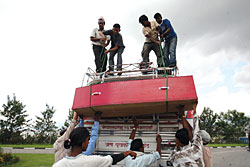
The red-coloured coffins began to arrive at noon. There were few mourners as most of the dead were poor peasants from outside the Valley. No politician considered it worthwhile to go and console the kin. There were many cameramen, but no reporter of repute to cover what has perhaps become a routine affair.
On average the bodies of three Nepalis arrive back home everyday at Kathmandu airport. Most victims are migrant workers in the 20-40 age group. Few of their families have the heart or the wherewithal to carry the bodies back to their villages for last rites. As the Doha victims were being cremated, another coffin arrived from Malaysia with only distant relatives present for the funeral.
Since the Doha victims were retrieved from prolonged submergence in waters 30m deep, their remains were unrecognisable. There was a strong smell as the coffins were opened to put the decomposing bodies on the funeral pyre.The Hanumani locket worn for divine protection had failed to save the life of a young man, but it helped in his identification. The gold image was consigned to the flames with the man who was wearing it.
At least 21 of the 30 victims on the ferry sinking in Doha were from landlocked areas who had never seen the sea before going to work on a ship to earn a living. In addition to 12 Nepalis, there were workers from Rajasthan and Bihar. A mourner couldn't control his tears when a female relative of a victim asked innocently, "Is the sea deeper than the Kosi during floods?"