
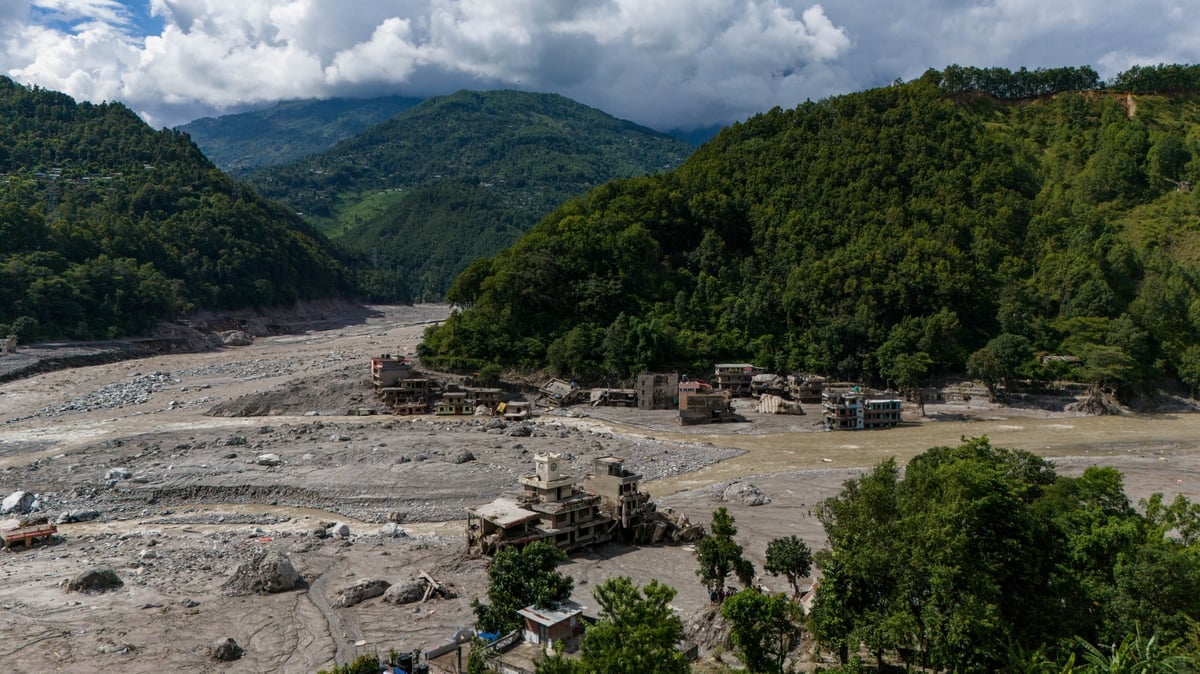
As this paper goes to press on Thursday afternoon, the unimaginable scale of the Central Nepal flood catastrophe is becoming apparent. With every notice about a bank branch that lost all its staff, a police station without a single survivor, buses full of Janai Purnima pilgrims swept away, and phone calls to this office from Indian families asking to locate their loved ones – we have had to come to terms with the tragically high cost in human lives.
Not since the 2015 earthquake has Nepal seen a disaster of this magnitude. In terms of economic damage to infrastructure and property, it is the worst in this country’s history. Remote sensing has enabled us to pinpoint the location of the avalanche on the north face of Langtang in Nepal that blocked the Lhende Khola which flows into the Trisuli in Nepal and which burst on Wednesday morning just before 9AM (page 3).
The debris flow at Timure on the border was nearly 80m high, and as the flood raced downstream it swept everything in its path. It spared nothing.
No one could have predicted this disaster would happen when it did. But anyone could have said it was bound to happen one day. In this paper, we ourselves have frequently reminded policy makers about the need to prepare for floods unleashed by extreme weather, glacial lake outburst floods, and transboundary climate calamities.
We said that after the Barun Khola flood of 2017, after the Melamchi disaster of 2021, and after the Teesta flood in Sikkim that swept away a $1 billion dam, we wrote in this space about lessons for Nepal’s own hydroelectric plants on the Arun, Marsyangdi and Trisuli. And the Bhote Kosi flood on 8 July last year was another alarm bell.
NOT JUST TALK
Arguing that this is not a problem we created, that we need to be compensated for historical carbon emissions, is for speeches at UN climate summits. There is no money coming for Loss and Damage. We are in this on our own, we have to craft our own strategy for survival.
This was not a ‘natural’ disaster. Nothing about it was natural – not the glacier melting due to greenhouse gas buildup due to fossil fuel burning, not the location of expensive hydropower plants on trans-Himalayan rivers, not designing highways to follow rivers, not the settlements that have grown around them, not the corruption and greed, not the poor governance.
Our ancestors knew not to live next to Himalayan rivers. Nepal’s townships used to be located along high ridgelines, and floodplains were only used to grow food or grind grain. Bridges were temporary, and designed to be rebuilt after monsoon floods washed them away.
Economic desperation, outmigration from rural areas and proximity to roads have pushed people to settle along river banks – despite full knowledge of the risks. Hazard mapping of settlements along river banks enforced by local governments could have saved many lives this week.
Early warning will be of no help if homes are located right next to rivers flowing down from the world’s youngest and most seismically-active mountain range, now feeling the full impact of the climate crisis.
We have repeated this ad nauseum after every disaster: let us not put all our eggs in one basket. Instead of taking huge loans to invest in cascades of expensive hydroelectric plants on trans-Himalayan rivers, Nepal should opt for smaller projects across the country and spread the risk.
In one fell swoop on Wednesday morning, Nepal lost 440MW from 12 hydroelectric plants – 10% of the country’s total generation capacity. Transmission lines and substations located along the river corridor were destroyed.
A culture of fatalism can explain the lack of interest in preparedness for disaster that we know will happen, and with greater frequency in future. But that is no excuse. Even if previous governments ignored this, Nepal’s new administration with its technocrats and PhDs must take measures to address seismic and climate co-hazards.
Winston Churchill once said, “Never let a good crisis go to waste.” This disaster also offers the chance for Prime Minister Balendra Shah and his government to demonstrate a proactive approach in search, rescue, rehabilitation and a preparedness strategy for the future.
We should not need a disaster to remind us to be prepared. By then it is too late for many people, as it tragically was this week. We failed to learn our lessons once again. This period of national mourning calls for Nepalis to be united, to show the same spirit of compassion and generosity that we saw in 2015.
Sonia Awale
If you are looking to support communities affected by the flood in Nepal, donate to the Prime Minister's Disaster Relief Fund here. Additional information here.