
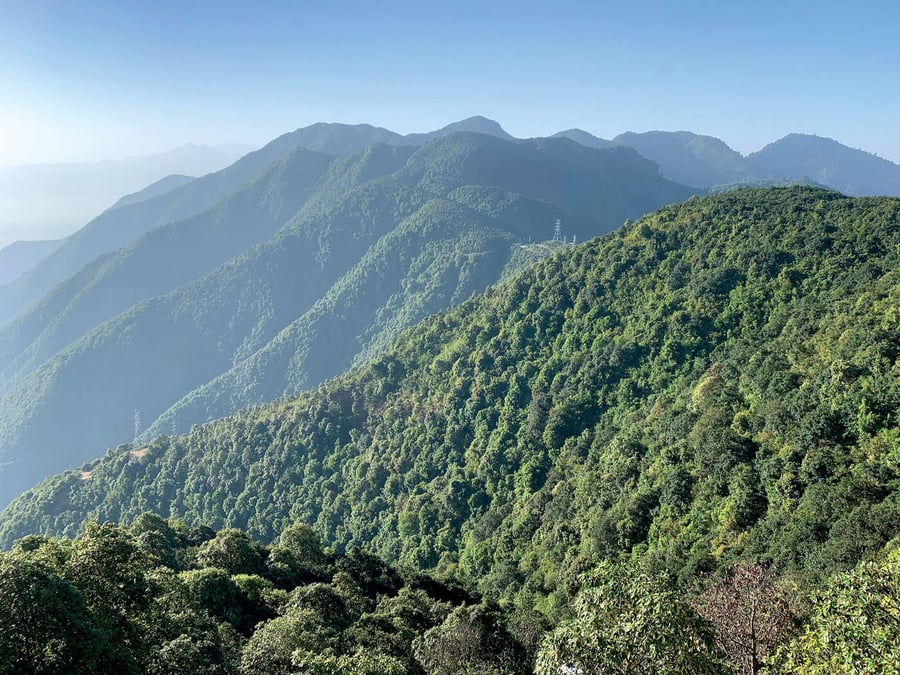
Money may not grow on trees, but much of our prosperity does.
Forests quietly support trillions of dollars in economic activity, millions of jobs, and essentials like the food we eat, the air we breathe, and the climate we depend on. In reality, the global economy cannot function without healthy forests.
Forests are far more than timber. They stabilise soils and regulate water vital for agrifood systems and industrial productivity, supply energy and a wealth of forest products, and create space for recreation and ecotourism.
The formal forest sector alone contributes an estimated $1.52 trillion annually to the global economy, while more than half of the world’s gross domestic product – some $44 trillion – relies on nature, including forests.
For more than 2 billion people, wood fuel is essential for cooking and heating, and hundreds of millions of people depend directly on forests for their livelihoods. Beyond wood, forests provide foods, medicines, resins, fibers, animal feed and ornamental plants that support around 5.8 billion people worldwide. These non-wood forest products are worth at least $9.41 billion annually and could grow much further.
By storing carbon, forests help protect economies from climate impacts that can cost billions. In Brazil, for example, converting tropical forests to farmland has reduced evapotranspiration – the movement of water from land to the atmosphere – by 30%, raising local temperatures and putting rainfed agriculture at risk. Without forests, global food production simply cannot sustain.
Forests are also part of the natural solution as the world starts to transition towards a bioeconomy based on climate‑friendly alternatives from more emission‑intensive materials such as steel, concrete and plastic. As populations grow, renewable, sustainable wood used in construction for housing can become a cornerstone of a low-carbon economy, while innovative products such as wood-based textiles, food packaging and even transparent ‘glass’ are already a reality.
This will mean increased demand for forest products which is already at record levels. For example, by 2050, the world may need 1 billion cubic metres of industrial roundwood, more than the 4 billion cubic metres currently being produced each year.
As it is, forests are already under pressure. They are home to up to 80% of biodiversity on land, yet they continue to be cleared for other economic uses, even if deforestation and forest degradation are slowing around the world.
As climate change intensifies, the global economy of the future must look different: more sustainable, more circular, and more closely linked with nature. To get there, we need to bring protection and production together rather than treating them as opposites.
The Food and Agriculture Organization of the United Nations (FAO) is working to promote the concrete steps needed to realise this vision of healthy forests that support livelihoods and deliver ecosystem services, including through sustainable products.
First of all, meeting rising demand does not have to mean taking more from nature than it can regenerate. Using wood more efficiently, smarter recycling and reusing wood products can reduce pressure on forests.
Long‑lasting uses, such as timber buildings, store carbon for decades, “stretching” each harvested log further. Sustainable forest management is vital to ensure that harvesting of timber and non-wood forest products stays within ecological limits and that forest ecosystems remain healthy.
International trade can also help balance global supply and demand, allowing regions with abundant forest resources to support those with fewer. But trade must be anchored in strong sustainability standards and governance to prevent deforestation and overharvesting of non-wood forest products and to ensure local communities benefit.
Incentive schemes and innovative financing can also help by rewarding those who protect forests and manage them responsibly, from smallholders to larger producers.
The growing bioeconomy, built on renewable materials like wood and bamboo, is ready to be scaled up and offers a promising path forward – as long as it remains firmly grounded in sustainable forestry. To that end, safeguards, clear rules and good governance are essential.
As we celebrate the International Day of Forests on 21 March, one conclusion stands out clearly: without forests, there are no economies. The decisions made now will determine whether we can protect forests and, at the same time, build strong, resilient economies for generations to come.
Zhimin Wu is Assistant Director-General and Director of the Forestry Division, Food and Agriculture Organization of the United Nations.