
Prime Minister Balendra Shah’s remark in Parliament on Sunday that Nepal had also encroached on Indian territory has stirred a hornet’s nest in both countries.
The aftershocks following the off-the-cuff remark by Nepal’s prime minister came a day before the chair of his ruling party, Rabi Lamichhane, left for a 5-day visit to India and will be reverberating while he is there.
The simplistic, almost flippant, remark came in an answer to questions from the opposition bench during a session in which PM Shah addressed the House for the first time since assuming office two months ago.
“I have only recently found out that it is not only India that has encroached on Nepali territory, but Nepal has also encroached on Indian territory in many places,” he said from the podium wearing his trademark shades. “Both countries should study the facts and resolve the issue as friends.”
The remark exploded on social media in Nepal and was picked up by the Indian press which featured it as ‘breaking news’. Aside from the hue and cry in political circles, it has dumbfounded the Nepali public which has always believed that India is the one encroaching on Nepali land.
Foreign policy experts and cartographers have added their voice to the criticism, saying such a statement from a sitting prime minister to Parliament was not just inappropriate but wrong.
“India itself has never officially complained about Nepal occupying Indian territory, yet our prime minister has raised the issue,” said Nepal’s former ambassador to India, Nilambar Acharya.
To be sure, PM Shah also had constructive ideas about resolving the longstanding border disputes between Nepal and India by forming a team of experts and the need for an evidence-based examination of historical facts.
Interestingly, although the Limpiyadhura dispute is on the tri-junction of Nepal, India and China, the prime minister also said that he had already approached the UK government for pre-1947 historical records.
“The problems that existed when British India left the region still persist, so we believe Britain also has a role to play in this matter,” he said, in a seeming reference to the 1816 Sugauli Treaty that Nepal signed with the East India Company at the end of the war.
After the ruckus in Parliament and a public outcry, the Ministry of Foreign Affairs (MoFA) tried some damage control by issuing a statement saying that the prime minister was only referring to ‘cross-border land occupation and encroachment’ along No Man’s Land along the open border between the two countries.
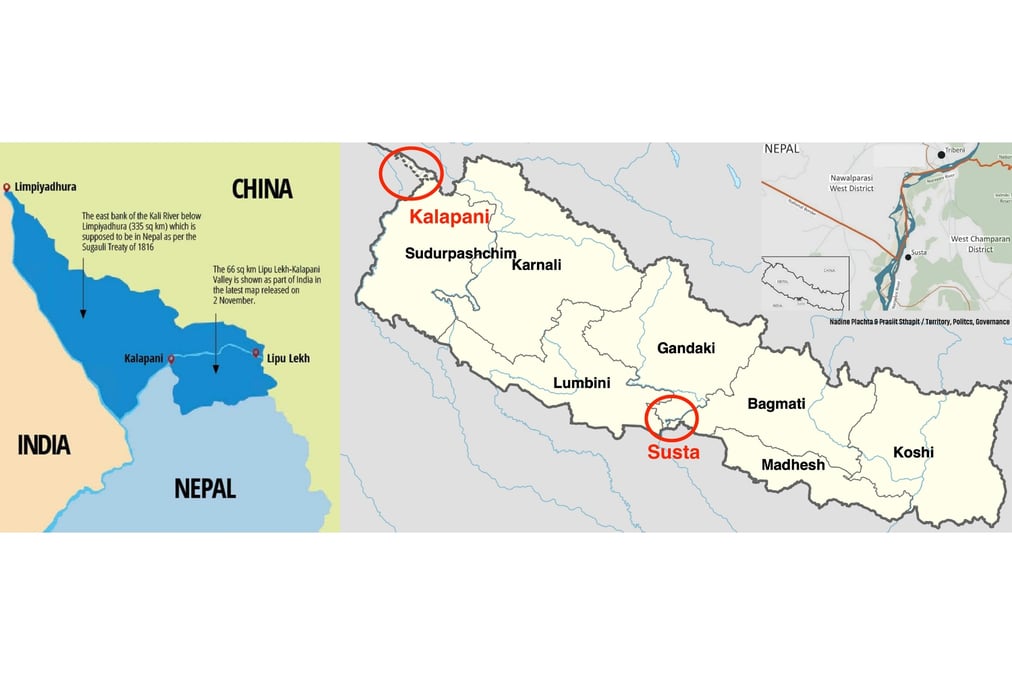
But the two major territorial disputes between Nepal and India concern Kalapani-Limpiyadhura-Lipulek and Susta.
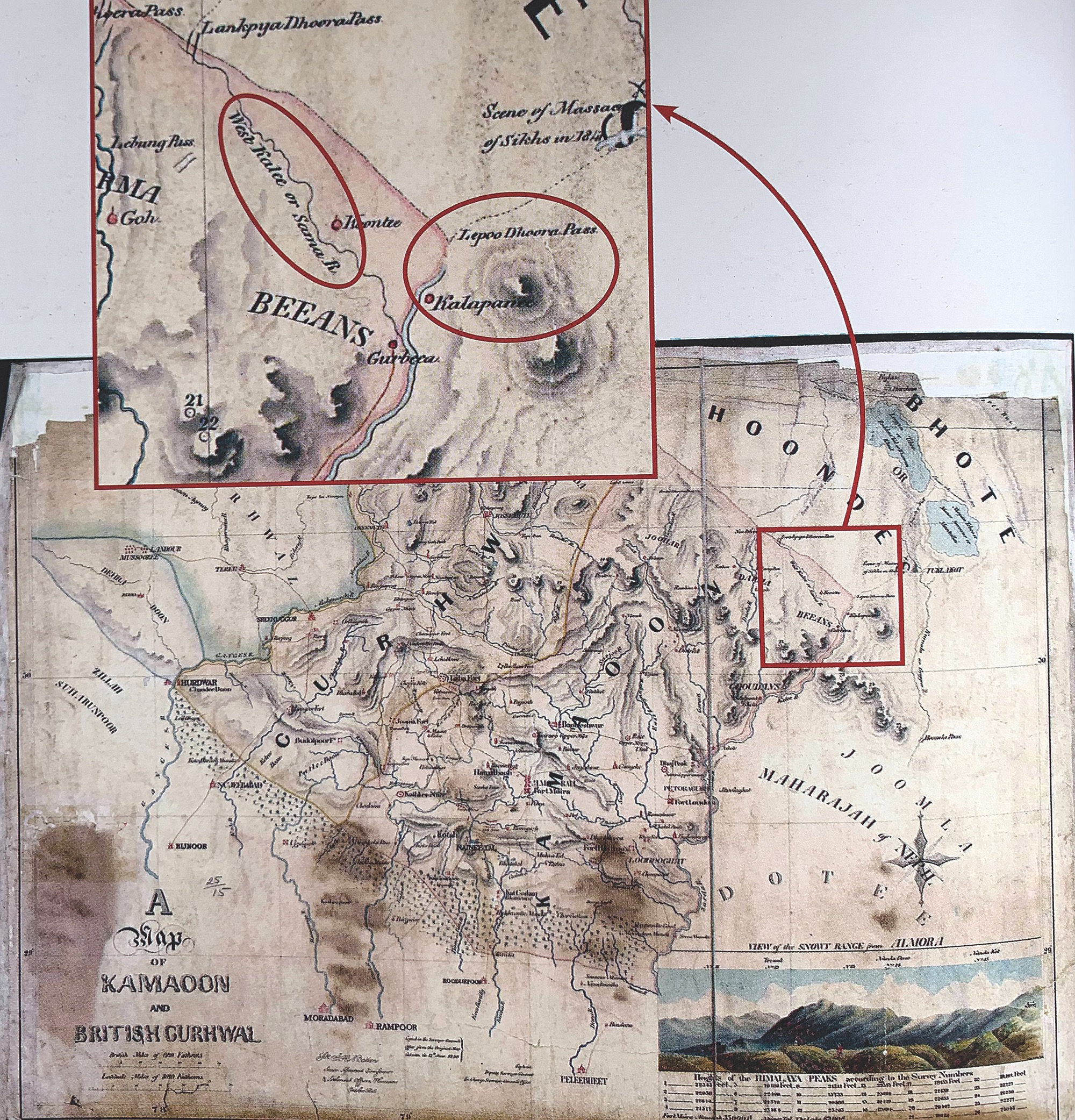
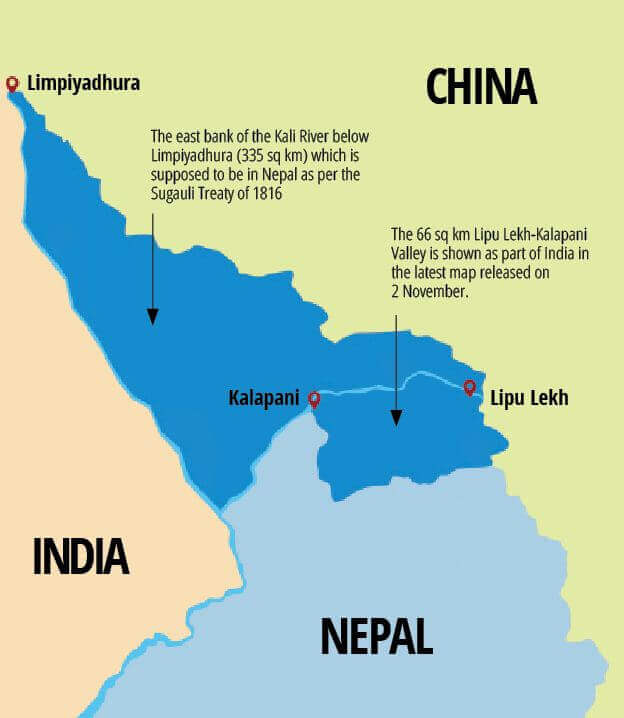
The Kalapani dispute concerns proper identification of the source of the Kali (Mahakali) River, since the Sugauli Treaty stipulated that territory east of the river was Nepal.
There are several interpretations as to the source of the Kali River in East India Company, British India and post-independence India maps. The Survey of India map shows a tributary going up to Lipu Lek pass into China as the main flow of the Kali River. Nepal maintains the main river is the longer one that originates in Limpiyadhura (see map).
Where it gets complicated is that Nepal also erroneously published its first map in 1975 with an undefined north-western boundary tri-junction. This was shortly followed up by another published map that showed Kalapani within Nepal’s territory.
After the publication of a new political and administrative map in 2020, Nepal’s boundary claim now extends to Limpiyadhura.
The Susta dispute, by contract, is along the Tarai and was caused by the Gandak river changing its course. The bone of contention is that in 1817, Nepal signed a treaty with the East India Company based on maps by Roger Martin. India wants the dispute to be settled according to the H C B Tanner maps of 1882-1887, which Nepal has not signed.
When he was mayor of Kathmandu, Balendra Shah had hung a map of pre-1816 Greater Nepal on his wall. And after he became prime minister, Nepal’s foreign ministry sent a note verbale to New Delhi and Beijing in March about Indian pilgrims using Nepal's Kalapani territory to go to sacred Mt Kailash and Mansarovar in China.
Indian foreign affairs expert and Nepal-watcher S D Muni promptly capitalised on Prime Minister Shah’s statement in Parliament on Sunday, warning him not to internationalise the border dispute as this would be counter-productive.
He also said Nepal was occupying some Indian territory there, perhaps hinting what was on the prime minister’s mind when he made the remark.
Meanwhile, on the ground, encroachments on Susta continues, as per the locals living there, and Nepal’s historical claim has been further pushed aside because of neglect by Kathmandu of the issue.
Previous Nepal governments, even while raising Kalapani-Lipulekh-Limpiyadhura and Susta issues, have persistently demanded they be settled through negotiations.
As a starter, the two countries should actively pursue active dialogue since quiet diplomacy does not seem to be getting anywhere. Both the countries need confidence building measures which the United Nations has used effectively in implementing, for example, the rulings of the International Court of Justice (ICJ) in the boundary dispute between Cameroon and Nigeria.
Considering the historical ties between India and Nepal, both sides should support pragmatic nationalism and resolve the issues amicably.
Prabhakar Sharma is an international border expert, researcher on border issues.