
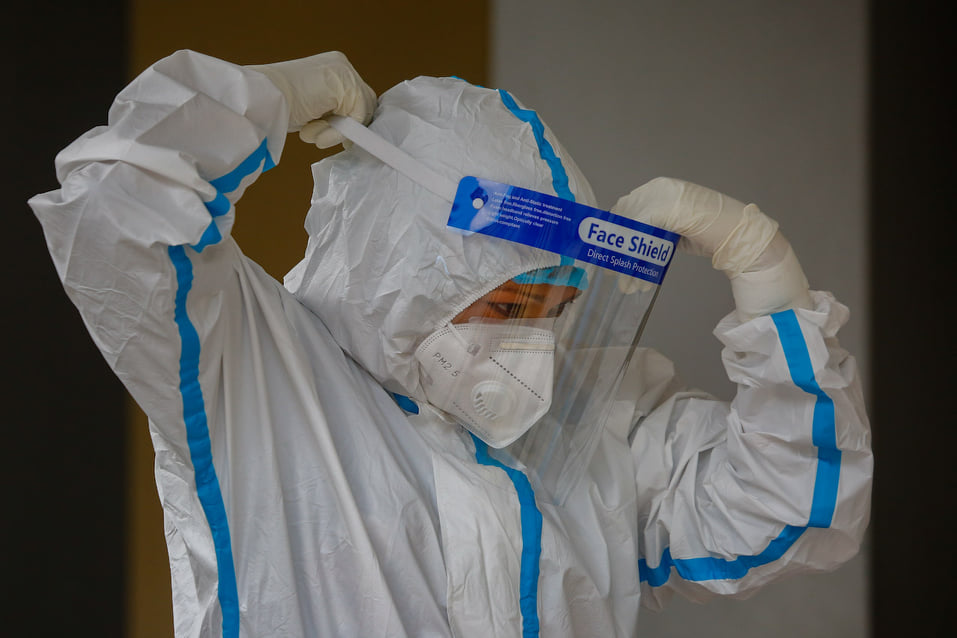
On 20 May, the Health Ministry released a condolence message for doctors including Ishwor Lal Acharya, Mukesh Chaudhary and Pujya Shree Karki who lost their lives to Covid-19.
Nepal doesn't yet have an exact figure on the total number of medical staff infected by the SARS-CoV-2 but the Nepal Health Research Council (NHRC) is currently conducting a study to find out.
“Majority of our frontline health care provides have been fully vaccinated, so even if they are being infected, they are only mild to moderately sick,” says cardiologist and chair of the Nepal Medical Council (NMC) Bhagawan Koirala. “This combined with a better understanding of Covid-19, they are now more confident and have a better sense of responsibility this time around.”
At the National Trauma Centre in Kathmandu, nursing staff Suman Chaudhary is back to work after recovering from the coronavirus herself and draws motivation from health workers who are battling the pandemic in major hotspots like Birganj.
“This is our chance to make a real contribution and having been infected myself has given me a new perspective on how patients feel,” says Chaudhary who was pursuing Masters in Nursing at Bir Hospital during the first wave. “It is difficult to work in a PPE all day without water or bathroom breaks. I still feel weak and have shortness of breath, but watching people recover keeps us going.”
Both Koirala and Chaudhary, however, agree that there is a chronic shortage of medical staff across the country. Hospitals outside Kathmandu and even Covid dedicated institutions are overstretched, and now doctors and nurses are themselves falling sick. In some hospitals, since patients and staff are all positive, nurses and doctors with mild symptoms have just kept working, since there is no one else to take care of the sick.
Last week, more than 47 of Dhading District Hospital’s emergency and ward staff were infected with Covid-19, with many of them in isolation and some requiring ICU treatment even as the facility was finding it difficult to source enough oxygen for existing patients.
“We are a hospital of only 8 doctors, 5 paramedics and 23 nurses and with no backup, we were very close to collapsing,” says Medical Superintendent at Dhading District Hospital Tribhuvan Jha, adding that everyone had to be called back to work after 10 days of isolation. “We are in this position due to a lack of preparedness, shortage of staff and limited infrastructure.”
At Charikot Hospital in Dolakha, which is also a Covid-dedicated hospital, the majority of coronavirus patients are critical and there is at least one fatality every day. The 17 nurses work three shifts a day, and are unable to handle patient inflow, so the hospital has brought in community nurses from outlying villages. The hospital is consistently reporting a 45% test positivity rate among those tested.
“If a majority of our health workers get infected and are in isolation, we have no Plan B and this is especially worrying because we are the sole care provider for Covid here,” says Binod Dangal of Charikot Hospital. “Medical staff are all overworked, and they do not have any insurance or allowances.”
As dire as the situation is in Nepal’s big cities and district hospitals, the pandemic has now infiltrated rural Nepal where there is just one doctor for every 15,000 people. Kathmandu’s doctor-to-patient ratio is 1:850.
In her village of Phediguth of Okhaldhunga district, Rita Khatri is the only skilled birth attendant. Despite the growing risk of the second wave, she is still performing deliveries and ante-natal check-ups wearing a mask and her single PPE suit. There are no tests of health workers and the public.
“We are working despite fears of transmission, I wish we had more PPEs, masks and gloves so that we could conduct more regular check-ups and make home visits,” adds Khatri. “At the moment many people in the community have high fever and are staying at home, but there is no way to test them.”
This time last year while in the grip of the first wave of a new pandemic, there was stigma associated with Covid-19 and people who were infected were ostracised in the community. There were many instances where healthcare providers were mistreated.
Doctors and nurses interviewed for this report say that is still the case, but there is also more praise for frontline medical workers risking their own health to save lives. However, there is growing concern about the worry and over-work affecting the mental health of nurses and doctors.