
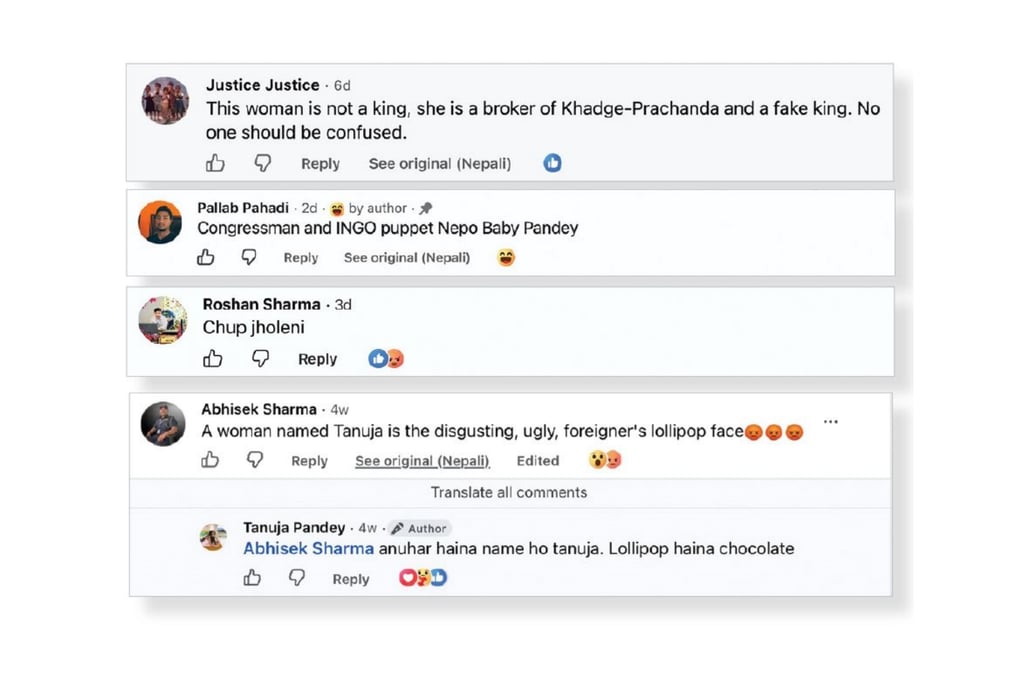
As Nepali women politicians and activists become more outspoken, they are being punished for it by an anonymous online community of hate mongers. Women are cyberbullied more than their male colleagues, and the comments are more vicious with threats of sexual violence.
This is not unique to Nepal, but the implications go beyond impacting on mental and physical well-being -- such trolling is a serious threat to democracy itself.
“Any post that is critical of Balen or the Cabinet seems to trigger a lot of trolling,” observes lawyer and activist Tanuja Pandey, who was at the forefront of the GenZ protests last year. “Maybe these are supporters of the government, or the government itself. RSP does not get as much hate speech.”
On a recent Facebook post, Pandey posted ‘Gundaraj’ to crticise the decision to park cars at the gates of media houses in an attempt to intimidate journalists.
Her post was greeted by howls in the comment section, including from a profile that goes by the name Pallab Pahadi: ‘Congressman and INGO puppet Nepo Baby Pandey’.
That was one of the politer comments. Most trolling contains personal attacks and threats of violence. Critics of the government are immediately labelled as lackeys of old parties and subjected to digital lynching.
“The assumption is that we are opposition supporters: I get called a ‘purano-party jholay’ or a ‘parichalit’,” says political science student, psychologist and activist Ansuda Poudel.
Jholay alludes to political sycophants and can mean anyone against PM Shah and RSP. ‘Parichalit’ refers to an operative.
“This is democracy, and there has to be a space for different opinions,” says Poudel. “YouTube reporters want the most polarised content possible, and they often try to corner us with questions.”
Poudel recounts feeling scared at a rally, when a crowd suddenly turned on her as she was trying to rescue an injured protester from an aggressive reporter.
Pandey and Poudel both receive rape and death threats, through Messenger or SMS. Indigenous activist Pema Wangmo Lama now only answers unknown numbers after running them through the Truecaller app. As a female voice for indigenous rights, Lama receives even more online hate with many even questioning her ‘Nepaliness’.
She says, “Trolls like to say that I don’t look Nepali, or my name does not sound Nepali, that I am Tibetan or Chinese, and I’m a foreign agent.”
Lama has dealt with this type of trolling since she was young, but social media has amplified hate speech. “It does make you question your belonging, and your drive to keep doing it,” she adds.
MISOGYNY
Another tactic often used by trollers is to spread rumours suggesting that a woman is in a relationship with someone. Trolls now use AI to morph photos in nasty ways.
Nepal still suffers from patriarchal and majoritarian mores, and social media does not just reflect those values but magnifies them with its instantaneous reach driven by algorithms of the attention economy.
While male leaders like Balendra Shah, Sudan Gurung, Rabi Lamichanne and others receive hero worship and are idolised, their styles emulated, women are disrespected every step of the way: from how they dress to marital status. Their opinions are dismissed as attention-seeking behaviour.
Lama estimates that the trolling is 50-50 from bots and real people. “Mass comments seem like a targeted thing, and the really nasty trolling I get is in my personal messages,” she adds.
Women are trolled even if they are with RSP. Critics of the prime minister often target his wife, Sabina Kafle. Women ministers and MPs from the ruling party also get disproportionately more hate than their male colleagues.
Ansuda Poudel blames this on internalised misogyny in Nepali society: “They believe that they can say whatever they want, make death and rape threats and think that they can get away with it.”
The PMO is rumored to have a bot army to curate and control online narratives.
“There is also inorganic trolling from newly created accounts that target multiple women in the same way. A real person would not behave like this,” says Pandey, who gets texts from real people who tend to be somewhat politer. She adds many women got off social media completely.
“My friends and family members are hurt by it, and they ask me if perhaps it would be better to just not speak up.”
Poudel agrees: “My parents are politically aware, and while they are supportive they are also very scared for me. I have developed thick skin, but it still gets to me sometimes.”
Younger activists have complained of feeling unsafe because of personal threats, and parents worried for their safety pushing them to give up their advocacy on social media.
LEGAL LIMITATIONS
Nepal does have laws against death and rape threats and online harassment, and the Cyber Bureau is supposed to investigate them.
Lama once reported rape threats made to an acquaintance on Discord. “They were very dismissive, and were not serious about taking down details,” she told us.
Instead, Police often blame victims, asking why they are activists in the first place, and if they have done anything to warrant such threats. Pandey and Poudel believe that this issue is best solved culturally, rather than digitally.
A good place to start would be for the political leadership to speak against it, and pressure Meta and other social media to take content moderation more seriously.
Female journalists are also trolled. Rama Parajuli at BBC Nepali Service once had a ‘Hate Page’ made about her. She says, “They would troll my voice, or the way I would ask questions.”
Khusbu Oli of the RPP, a former Miss Teen and model, faces heavy trolling. When Nepali Times approached her to comment, she did not want to talk about it “in the current situation”. Complaining about trolling seems to invite even more toxicity for women.