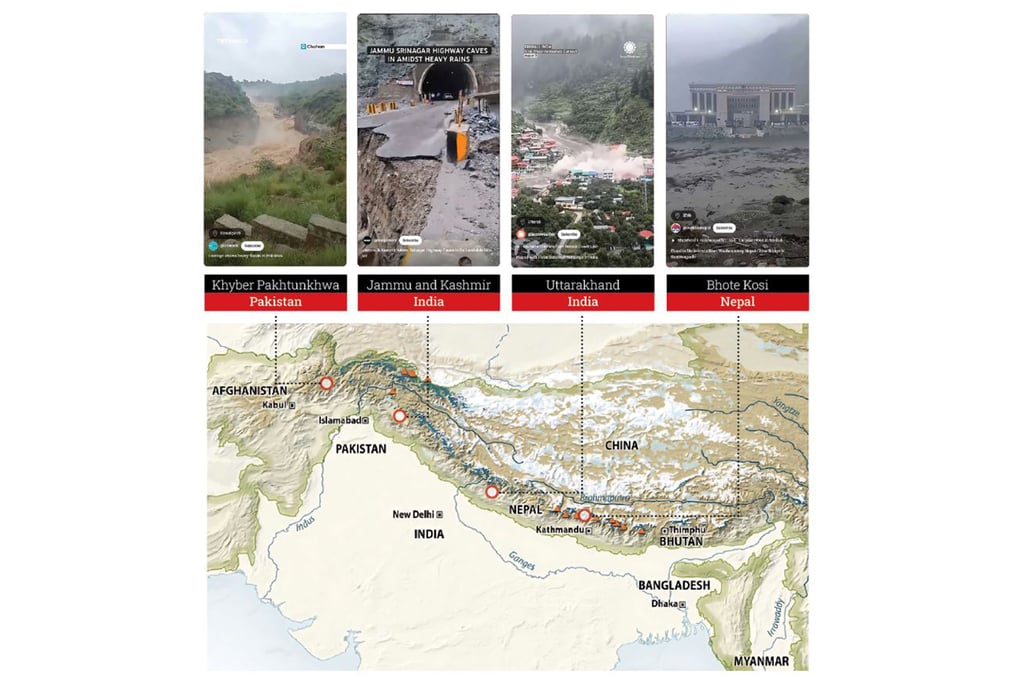
· At least 400 people are dead or missing after heavy rainfall lashed arid regions of northwestern Pakistan. Walls of mud and boulders engulfed entire villages in Khyber Pakhtunkhwa Province. More than 700 people have been killed in floods in Pakistan since June.
· Over in India’s Jammu and Kashmir at the same time, multiple slurry floods on 17-18 August killed more than 80 people
· A mudslide possibly caused by a glacial collapse upstream in Uttarakhand on 5 August nearly wiped the village of Dharali off the map. At least 70 people, 23 of them Nepalis are dead or missing.
· On the night of 8 July, glacial lakes in Tibet overflowed. By dawn the mudflow had demolished the Nepal-China border bridge killing at least 11 people, destroyed hydropower plants, swept away bridges, roads, over 100 cargo trucks and newly imported electric vehicles.
All these disasters have a common thread: a cascade of hazards caused by record-breaking rainfall on fragile Himalayan slopes destabilised by melting glaciers and permafrost, seismicity and poorly engineered infrastructure.
They are called ‘rain bombs’ — a heavy localised downpour measuring more than 100mm/h on a steep mountainside. As global warming heats the atmosphere, warmer air can hold more water vapour. The heavy rain then falls where there should be snowfall: on moraines and slopes that have lost the permafrost adhesive that held the debris together.
“Increasingly, there is now more rainfall at higher altitudes where there used to be snowfall previously, and this directly impacts loose material in that fragile landscape which moves down,” explains Mohan B Chand, a Himalayan Glaciologist at Kathmandu University. “Moreover, the rains these days are heavy and fall within a few hours. So even a small burst has bigger impact.”
The 2021 Melamchi flood and the Sikkim disaster in 2023 have been attributed to record-breaking torrential rain on a glacial moraine that collapsed, unleashing a catastrophic debris flow.
The Bhote Kosi flood this year happened even without torrential rain, and originated at rapidly expanding supraglacial lakes that overflowed, similar to what happened on the Mendenhall Galcier in Alaska last week. In Uttarakhand, the trigger could be in the upper catchment cryosphere, or a landslide dammed lake.
Basanta Raj Adhikari of the Centre for Disaster Studies at the Institute of Engineering also calls them ‘sediment bombs’. He clarifies: “There is lots of sediment up there from landslides or glacial activity, and when there is heavy rainfall and hotter temperature, they are unleashed downstream. One thing is for sure, these extreme events are getting more frequent and more destructive.”
Researcher Alton C Byers who has studied melting glaciers in the Himalaya and Andes names the eight most potentially dangerous glacial lakes in Nepal: Lower Barun, Chamlang North Tso, Chamlang South Tso, Dig Tso which burst in 1984, Lumding Tso, Thulagi, Tso Rolpa and Imja Tso (see map).
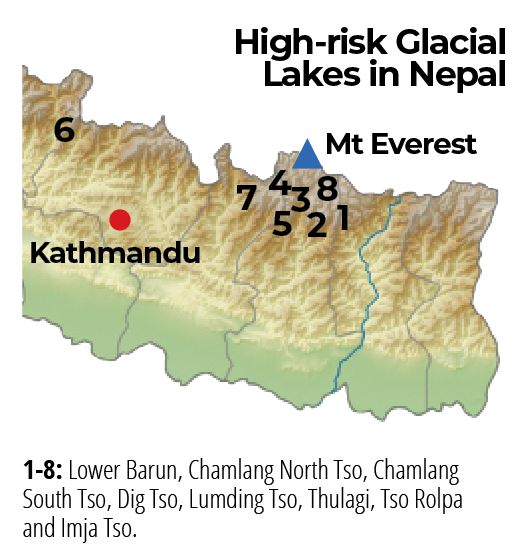
Of these, Tso Rolpa and Imja have been lowered by 3m each, while Thulagi, Lower Barun, Lumding Tsho, and Hongu 2 glacial lakes have been targeted for lowering by the Department of Hydrology and Meteorology as part of the recent Green Climate Fund grant of $36.1 million awarded to Nepal.
“These lakes have changed over the years as their debris-covered glaciers continue to recede,” Byers told Nepali Times. “When water volume in the lake basin increases, they become more vulnerable to flood triggers such as overhanging ice as glaciers recede further to their headwalls, and permafrost on their moraines continues to melt.”
These are not ‘natural disasters’
Scientists have given the current planetary epoch a name: the Anthropocene. And anthropogenic causes in this era heighten the risk of disasters.
Indeed, an analysis of recent Himalayan calamities (page 1) shows that there is much more at play here than climate breakdown. Haphazard encroachment of floodplains, quarrying and crusher activity exacerbated the effect of extreme rainfall on 28 September around Kathmandu Valley that killed 200 people.
The human cost of the 5 August catastrophe in Uttarakhand would have been high in any case, but the fact that the tiny village had expanded across a vulnerable alluvial fan to cater to a tourism boom meant more death and destruction.
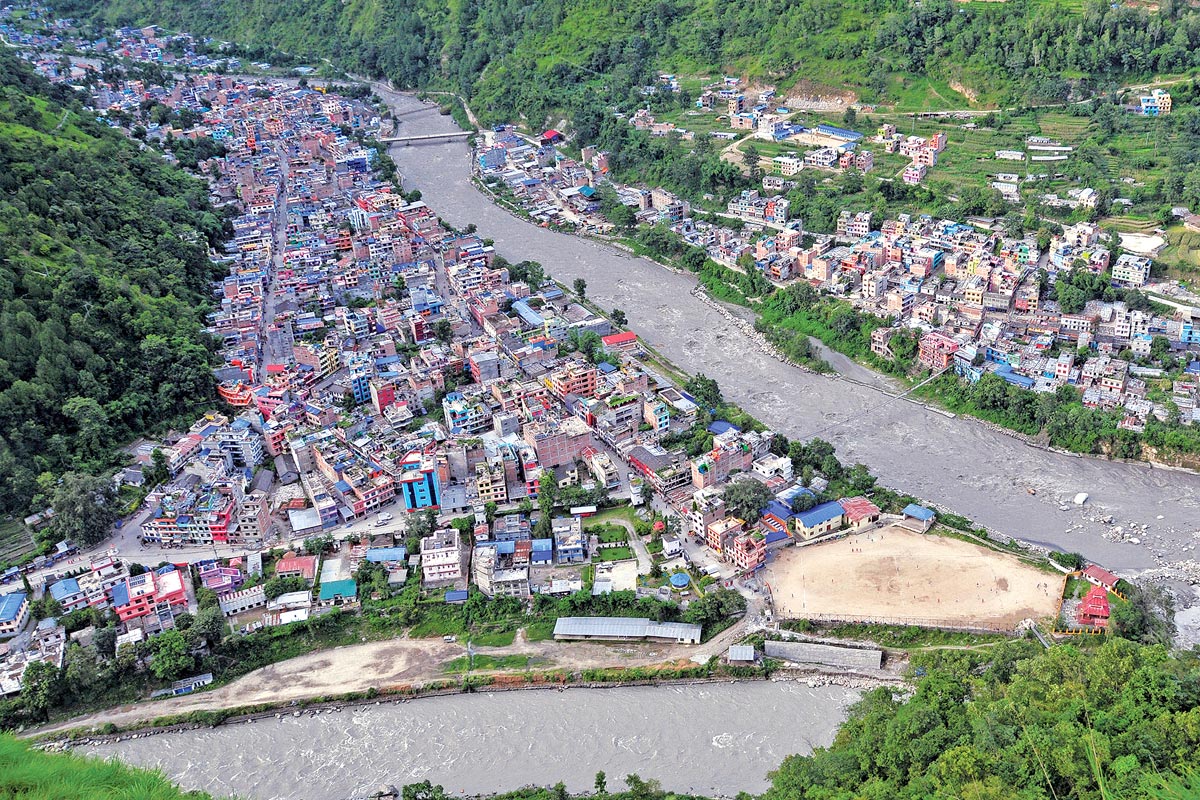
There are similar alluvial fans across Nepal, where small towns have expanded because new highways follow rivers, like Beni located at the confluence of the Myagdi Khola and Kali Gandaki. Other towns like Kagbeni or Damauli are located on the banks of rivers and tributaries that are directly downstream from rapidly expanding glacial lakes or unstable mountains.