

Heritage expert Rajan Khatiwoda in a recent report in this paper, described how families along the Trisuli asked whether an effigy woven from sacred grass could be used in funeral rites when the bodies of their loved ones could not be recovered.
That detail captures what disasters take beyond buildings. When a temple, shrine, or cremation site disappears, so do places where people have worshipped, mourned, and gathered for generations. Rebuilding a structure may be possible, recovering the knowledge attached to it is another matter.
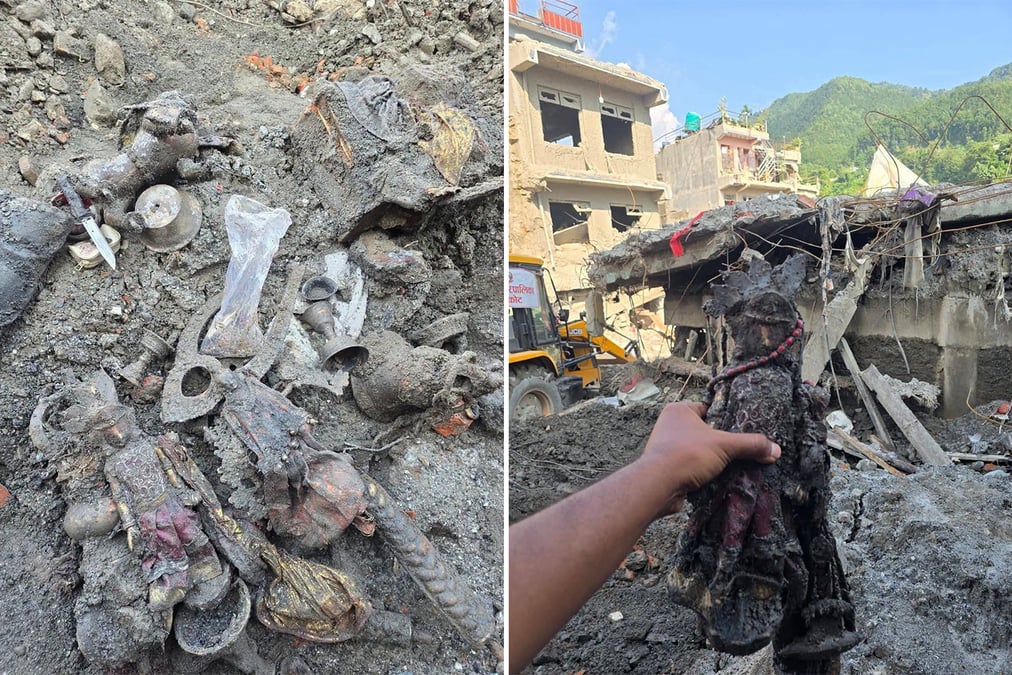
The Nepal Heritage Documentation Project (NHDP) of Heidelberg University has been listing monuments and living traditions across Nepal for the past eight years. Along the Trisuli corridor it recorded more than 80 temples, shrines, and cremation sites, 21 of them completely destroyed by the flood in August. Nationwide, there were 2,000 monuments. This first of its kind inventory can support research, conservation, and the identification of objects recovered after disasters.
NHDP has now winded up. The project had a timeline, but heritage does not. The records remain, and the responsibility now falls to the state — the Department of Archaeology (DoA) cannot carry it alone.
TRISULI CORRIDOR
Rasuwa and Nuwakot form part of a historic corridor connecting Tibet with India through Kathmandu. Trade brought people and ideas through, while Hindu, Buddhist, shamanic, and folk traditions shaped its religious landscape. The temples here are not just old buildings, their histories are intertwined with rivers, routes, communities, and rituals.
At Devighat, the annual Bhairavi Jatra procession travels from Nuwakot to worship Jalapa Devi at the confluence of the Trisuli and Tadi. Its significance lies in the destination and in the people who take part, the route they follow, and the ritual that brings them together. A photograph can record a shrine, but cannot convey what makes that journey meaningful.
The flood damage was a different challenge from the 2015 earthquake which damaged monuments while leaving it on its original site. The flood swept away entire temple complexes, displaced people who maintained it, and altered the riverbank. The physical and social landscape changed at once.
Engineers may identify a safer place to rebuild, but safety alone cannot determine whether a new location holds the same meaning for those who worship there. Some families may want to rebuild in the same area, others may prefer to resettle elsewhere. People may disagree about whether a temple should be rebuilt, relocated, or left alone while more urgent needs are addressed.
Nor is there necessarily one community view. A temple may be associated with a particular clan, maintained by a guthi, and used by a wider group of worshippers. Families, caste groups, religious practitioners, and local custodians may have different relationships with the same site. Community participation raises its own question: who speaks for a community, and whose wishes count when people disagree?
Rituals can help people process trauma by providing familiar structures when ordinary life has been disrupted. But rituals depend on people and places too. When their setting disappears, practices may have to change.
NHDP's conclusion raises a practical question: what happens when a time-bound project ends but the need for its work continues?
Nepal still lacks a comprehensive national inventory that can be reliably updated and used for conservation. The DoA operates the Cultural Heritage Information Management System (CHIMS), an online database intended to provide public access to information on monuments, interventions, documentation, and research. NHDP's datasets are meant to be mirrored there.
Rajan Khatiwoda says technical problems and bureaucratic obstacles have prevented planned updates. CHIMS is no longer functioning as intended, and parts of the inventory remain incomplete. The DoA could clarify the system's status, if datasets have been integrated, and how the inventory will be maintained going forward.