
Nepal’s graduation from Least Developed Country (LDC) status has been repeatedly deferred, and this time it may be postponed till 2029.
The country had already exceeded the Human Asset Index and Economic Vulnerability Index thresholds in 2015, 2018, and 2021 – evidence of sustained socioeconomic progress through time. Postponement will not alter GDP or per capita income.
What matters is that Nepal’s progress has been people‑driven: households, own‑account production, and women’s care work strategies sustained resilience through crisis after crisis. Analysis of the Labour Force Survey shows these invisible sectors already contribute over 40% of GDP and sustain nearly 59% of livelihoods.
Recognising and formalising them in mainstream planning would transform the growth narrative far more than waiting for statistical improvements that are unlikely to materialise within the given time frame.
Nepal’s socio‑economic progress was achieved despite weak GDP growth, averaging 4% over the past decades and dropping to 1.8% in 2023. Growth is projected to slow down to 2.3% in FY26 from4.6% in FY25. It is the households that absorbed shocks from successive crises in the past.
* During the conflict, families - often led by women - negotiated survival and education with Maoist insurgents/political actors.
* After the earthquake, communities rebuilt livelihoods through flexible labour and diversified farming, often avoiding government reconstruction support because of stringent conditions attached to receiving such support.
* During the 2015 border blockade, informal trade and subsistence farming sustained food security.
* In the pandemic, migration and remittances stabilised incomes and balanced trade – households sought outside jobs while the state failed to create employment opportunities at home.
Despite sluggish formal growth, poverty rates declined, health and nutrition outcomes improved, and education expanded. The Human Asset Index continued to rise even after the 2015 earthquake, when growth fell close to zero.
These gains underscore that household resilience and care work services — not market expansion — were decisive in Nepal’s graduation. To ignore this sector, which sustains nearly 59% of livelihoods, is a gross oversight.
The Finance Ministry’s recent White Paper sets an ambitious target of 7% growth through market liberalisation, private sector expansion, infrastructure investment, and digital adoption. While these priorities are not without merit, they privilege the formal market sector and ignore the informal household and the care sector that enabled graduation.
Postponement risks entrenching this blindness. Feminist economic critique insists that GDP could be increased by at least 40% annually by recognising and formalising own‑account work and care services without subsidised loans or trade preferences.
The White Paper’s silence on this contribution is a fundamental weakness in understanding people, and their reality of how the graduation was made possible. This omission connects to a wider debate on GDP as a sufficient measure of development and well‑being.
Economist Joseph Stiglitz has argued that macroeconomic models systematically exclude social, reproduction and unpaid labor by design. Financial journalist David Pilling critiques GDP as a measure of delusion, showing how it is structurally incomplete: ‘What we call the economy is not reality — it is a measurement system that excludes the very work that sustains life.’
Nepal’s graduation story proves this point. GDP alone cannot capture the resilience of households and care work that carried the country forward and the wellbeing of the people. From a feminist economist perspective, this reinforces the argument that household and care sectors must be integrated into national accounting and policy frameworks. Without this recognition, GDP remains a distorted measure that undervalues the very sectors sustaining resilience.
The White Paper’s narrow focus on market expansion also overlooks the potential of advancing green growth. Modernising agriculture and allied sectors could generate employment, enhance sustainability, and strengthen resilience. Agro‑processing, renewable energy, and eco‑tourism offer opportunities for rural employment and women’s enterprises.
The proposed Kosi Pride project illustrates how green growth can be linked to gender equality. By investing in sustainable river basin management, agro‑processing, and eco‑tourism in the Kosi region, the project could create employment opportunities for rural women and youth, strengthen local enterprises, and integrate care sector considerations into development planning.
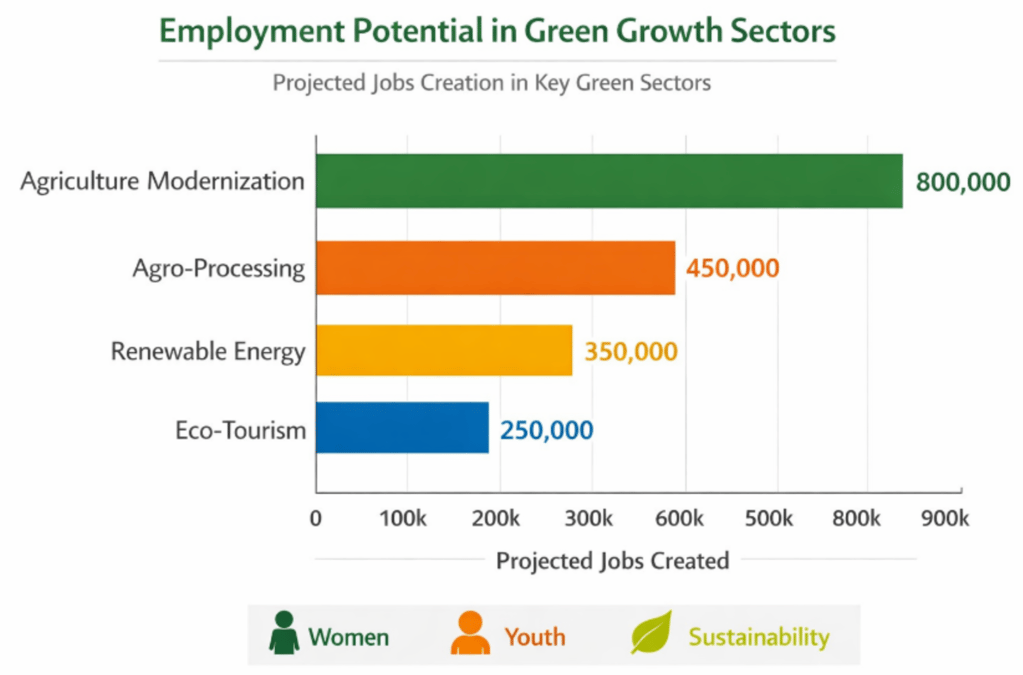
The employment potential in agriculture modernisation (≈800,000 jobs), agro‑processing (≈450,000), renewable energy (≈350,000), and eco‑tourism (≈250,000) demonstrates how green growth can generate millions of jobs. Integrating women and youth into these sectors would not only expand livelihoods, but also attract migrants back home, easing dependence on remittances and stabilising local economies.
By embedding feminist priorities, Nepal can transform green growth into a pathway for resilience, gender equality, and inclusive prosperity as well as achieve the income criteria.
Investing in green growth would not only create jobs but also align with global sustainability commitments. It would absorb youth and women into productive sectors, reduce migration pressures, and strengthen local economies.
A feminist economic reframing of Nepal’s graduation calls for:
*Recognition of households as economic units: Integrate own‑account production and care services into GDP and policy frameworks.
* Reject deferment as a solution: Graduation has already been achieved; postponement distracts from structural reforms.
* Green growth strategy: Modernise agriculture and allied sectors, invest in renewable energy, and promote eco‑tourism with gender equality at the centre.
* Inclusive digital governance: Ensure rural women and youth access e‑services and link digital transformation to enterprise support.
* Enterprise development: Provide credit, training, and market access for women’s SMEs, protecting small producers in trade agreements.
* Employment creation: Expand vocational training and rural industries, recognising care work as a sector that sustains labor supply.
Nepal’s graduation should be celebrated as the achievement of households, unpaid women’s labour, and care strategies. Repeated deferments will not raise GDP or per capita income. Nepal’s economy is people‑driven. Despite poor formal performance, failing governance, corruption, and repeated crises, households and care work carried the country across the graduation thresholds.
Green growth could create millions of jobs at home — enough to bring Nepali migrants back and make graduation truly inclusive.”
Speaking at a Social Progress conference, Finance Minister Swarnim Wagle had said: “Social progress can be pursued even in the absence of high GDP. That is the story of Nepal.”
Bina Pradhan is a feminist economist and independent researcher. Founder and Board Director of the BEES (Business, Enterprise and Employment Services) Network for Women in South Asia.