


A dystopian motherland
In his big new novel Samrat Upadhyay imagines a Nepal that could be wildly realSamrat Upadhyay’s newest novel Darkmotherland imagines a Kathmandu in political turmoil after a large earthquake. In the aftermath, Home Minister Giridharilal Bhagirath Kumar stages a ‘koo’, and has convinced people that he is the answer to the crisis.
He is now known as ‘PM Papa’, and picks up classic dictatorial ways — propaganda, statue-making, history-revising, and a gang of Shiva-worshipping ‘Fundys’.
We are introduced to two complicated protagonists. The first is Kranti, a fetching young woman and ‘Madam Mao’, her Communist professor mother. The chef father loved classic rock and died by gas cylinder suicide. Kranti hates her mother, and the Communist group which congregates at her home to plot against PM Papa, although they seem to take forever to get anything done.
Kranti has a complicated relationship with the handsome Bhaskar, the middle son of the Ghimirey family oligarchy that is aligned with the dictator. She loves him, but as Bhaskar gets more and more involved with her mother and the Communist group, finds herself heading out to the ‘Bhurey’ (Bhu-kampa Rey-fugee) tents, to spend time with poet Kabiraj.
Kranti is also given to delusions, paranoia, and psychosis, convinced that Bhaskar’s family is spying on her, and that one in the Communist group has supernatural powers of suggestion that led to her father’s suicide. Despite mental issues, she marries Bhaskar and into the Ghimirey clan, and the complex nexus between business and politics.
The second is Rozy, initially the genderqueer lover of PM Papa who he discovered in the streets, and is described as a ‘gorgeous homosexual’. She turns heads due to her sexuality and beauty, and gets more and more politically powerful as the story moves along.
Upadhyay tells us Nepali writers writing in English often feel a pressure to create an “all-embracing world” (interview), but that is what he seems to be getting at with the monumental plot of his novel. Unlike the realism in his previous novels, this one drifts off into magical realism.
His narrative blends the ever-present risk of a big earthquake and the actuality of political tremors. The speed of political upheaval seems a little unrealistic for anyone who lived through the 2015 earthquake, although the GenZ protests showed just how quickly a regime can be reduced to a heap of rubble. The age-old question: oppression can be overcome, but what comes after?
The PM Papa character is a Gyanendra-Oli-Deuba-Prachanda-Modi-Trump-Papa Doc composite who is good friends with the not even thinly veiled President Corn Hair.
Through the character of Kranti, Upadhyay conveys the dynamic between a parent and a child who is now a full adult, on relationships in Kathmandu as marriage looms, on pervasive corruption which one might denounce but have to take advantage of to get things done.
Through Rozy, Upadhyay brings attention to the non-binary identity, one that has existed forever in Nepal, and although is discussed a lot in the West lately but not so much here. Upadhyay explores the origins, the present, and the various advantages and disadvantages of the queer.
Storytelling in the early parts of the book oscillates between the real and absurd fantasy amidst the physical and political backdrop that does not have to be Nepal -- it could be Modi's India or Trump's America.
The reader sees the world through Kranti’s psychosis, or PM Papa’s displays of power, such as when a ‘Sweej’ wrestler is beaten to death with a mace in a wrestling spectacle.
These elements coagulate in the novel, and Upadhyay has all the pages at his disposal to prod and push them against one another to see what happens. The novel is still at its best and most engaging when describing vulnerable scenes, of Kranti and her mister, or of Rozy’s messed-up childhood.
Any Nepali reading his weighty novel can recognise the allusions and nudges such as the Tourist Area: Thamel, Open Stage: Khula Manch, Tri-Moon: Tri-Chandra etc. But anyone not from these parts may have a tough time keeping track. Keeping a notebook handy may be useful.
Ultimately, the novel does work, it provokes and entertains. For best results, serialise the reading over 30 days, not 3 like this reviewer.
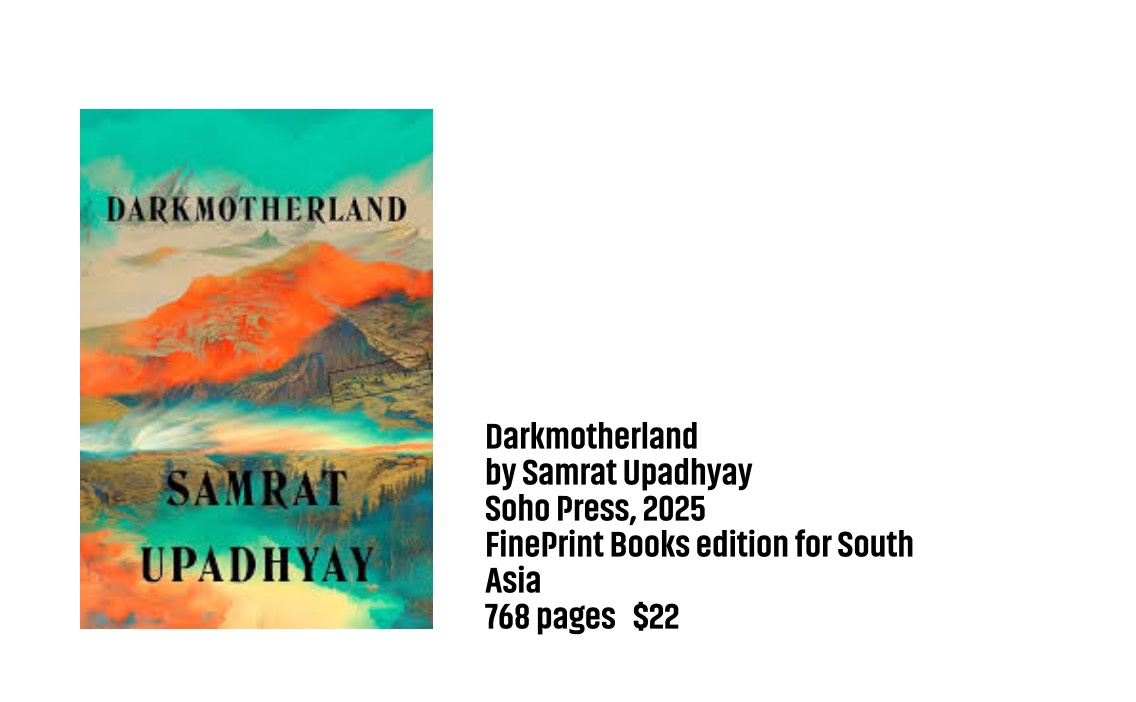
More things change, more they remain the same
First US-published Nepali Samrat Upadhyay is the award-winning author of novels and short story collections like Arresting God in Kathmandu, The City Son, Mad Country, and Buddha’s Orphans. Upadhyay is also the Martha C. Kraft Professor of Humanities at Indiana University, where he teaches Creative Writing.
Recently in Kathmandu, he talked to the Nepali Times over coffee in Boudha about his writing, his teaching, and his newest novel, DARKMOTHERLAND.
Nepali Times: Darkmotherland is 732 pages long. What was it like writing a much longer book?
Samrat Upadhyay: Torturous Ha ha ha. Around 2014 I started a story. I knew it was going to be a novel. It was about this woman who is accused of being a Mangalik. Then the big earthquake happened in 2015. I was in the US but my parents were still here, they were living in tents. Then I started thinking, what would happen if a dictator came to power. That’s how PM Papa was born. I think mostly because of his character the novel exploded.
I had never written a character like him before. I don’t do any plot outlines when I write. Let’s see where it goes. I like the process of writing to lead to discoveries. If I knew everything then I’d get bored. Not knowing where the storyline might go is very exciting.
All these different threads started coming in, the character of Kranti started taking on a big role. Her mother, a Communist-leaning professor, started taking shape. Kranti also had a love-interest from an oligarchical family.
The novel just took off and I just continued writing. A novel is as long as it needs to be. The initial draft was 1,700 pages. I was writing pretty fast. I don’t pause to see if the sentences are pretty. I whittled it down, and by the time I sent it to my agent it was 1,100 pages.
He was able to sell it to Soho Press. I worked with an editor who suggested some further cuts and expansions. The editing part was even harder than the initial writing, because by that time I was tired of looking at the novel.
There was a bit of a delay because of Covid, then we got back on track.
What’s your daily process of getting the words on paper?
I am a morning writer. I get up in the morning and start writing. You can have all kinds of theories but there is this saying, Shut Up and Write. The writing is where the meat is.
You encounter difficulties in writing that you may not encounter when thinking about it. I see this in my students.
I knew this was a big project so I knew that if I wanted to get it out I would need to write a lot per day. I got a couple fellowships in the university that gave me a few semesters off teaching. I would write for about 4 or 5 hours. Sometimes I would give myself a 1,000 word deadline, but I’m flexible with it if I don’t get there. You have to be kind and patient.
What is your inspiration behind the gender-queer character, Rozy?
I’ve always been a strong supporter of LGBT. I would say that at this point half of my students are non-binary or on the gender spectrum. Some of them are going through transitions.
In some ways Nepal has become more accepting, but in other ways not. I did a workshop with Blue Diamond Society, and heard pretty harrowing stories. I didn’t intend to create a gender-queer character, but it seemed like the novel was demanding that.
Especially in terms of the tyrannical stronghold that PM Papa has over the entire country, it made sense that there would be a counterpart, I wanted to put these things in motion and see how they interact. As I was writing Rozy, her character became very formidable.
How much do you draw from Nepali politics? Do you form characters off people you know?
Not in a very concrete sense, but I’m always drawing from them. I grew up in the Panchayat System, and lived in Lainchaur. The palace was there. The monarchy was such an institution. But then I was in the US, so I wasn’t here when the pro-democracy movement happened. In some ways it felt like things had changed, but were the same in other ways. I feel the same way now.
I do draw upon people. I think my father makes an appearance in my work in various forms, I disguise him, of course.
You’ve taught creative writing for a while now, how is literature changing?
My students are also writing non-binary characters, because they want to be reflected in the stories. This is something new that we didn’t have. White authors, characters were the default. People of Color on the margins. African American and then Hispanic, South Asian authors were always pushing back on this status quo.
When I was growing up in the classroom we were reading a lot of white male authors, but in my own life I was reading Salman Rushdie, African, South African friends and writers.
My students have a lot more interest in fantasy, many are writing dystopian. One student is writing a novel where the characters start playing a game, and then they enter the game, and an entire new world opens up.
On the one hand there are complaints that students aren’t reading enough, which is true, but my students are producing smarter work. Writing that is a lot more insightful. The calibre of discussion in my graduate-level novel writing classes is mind-boggling to me, and makes me want to keep on teaching.
Do Nepali writers who write in English feel a certain pressure, from the market or self-imposed, to make their stories more Nepali?
My experience for a long time was that there was a pressure, I felt it true in my case, I was supposed to be the representative of every Nepali. But Nepali writers writing in Nepali are not asked, how are you representing Nepal. At that time there was a lot of pressure to write a novel that is all-embracing, that is supposed to speak on all aspects of the country. Politics felt like an integral part of it, that these novels had to make big political statements.
I always felt like this was wrong. I mean, people have to write what they want to write. You write what you want to write, and if it resonates with readers, that’s great. If it doesn’t, that’s fine too. Art isn’t going to speak to everyone. We do a competition every couple of years called Writing Nepal. We make a call for stories, and we decide the best ones.
I find it refreshing now that the writing isn’t all about Nepal. The best stories are quite varied.
What are Nepalis writing about?
Several of the stories are about the role of women in our society, done with a lot of nuance, about the sort of multitasking they have to do. Some of it was deeply historical, some dystopian, the coming of AI. Some of them have an old-timey type of feel, and some of them are very modern, contemporary.
The general level of art in movies, TV shows, and novels seems to have regressed compared to say the 90s.
I don’t think that’s entirely true. Publishing has been harder, for sure, but there are a lot of novels being published every year. My writing workshop had always been a good vehicle for short stories, but a lot of my students now—even undergraduates—are working on novels.
I haven’t formulated my thoughts on AI, it is so new and has hit us so hard. Many of my students are using AI, especially when writing response papers to works of literature or peers, which I find appalling. That’s going to be a struggle. I tell my students, who are you fooling? If you feel that you want to be an artist, or a writer, then what’s the point of using AI?
AI-generated stories are also just not that good. They’re almost too perfect, too well put-together, making moves that are easy to detect. There is something about human-written stories that are messy and exciting. But there are also plenty of students who want to do original work and don’t want anything to do with AI.
writer