

Coffee guff from Korea
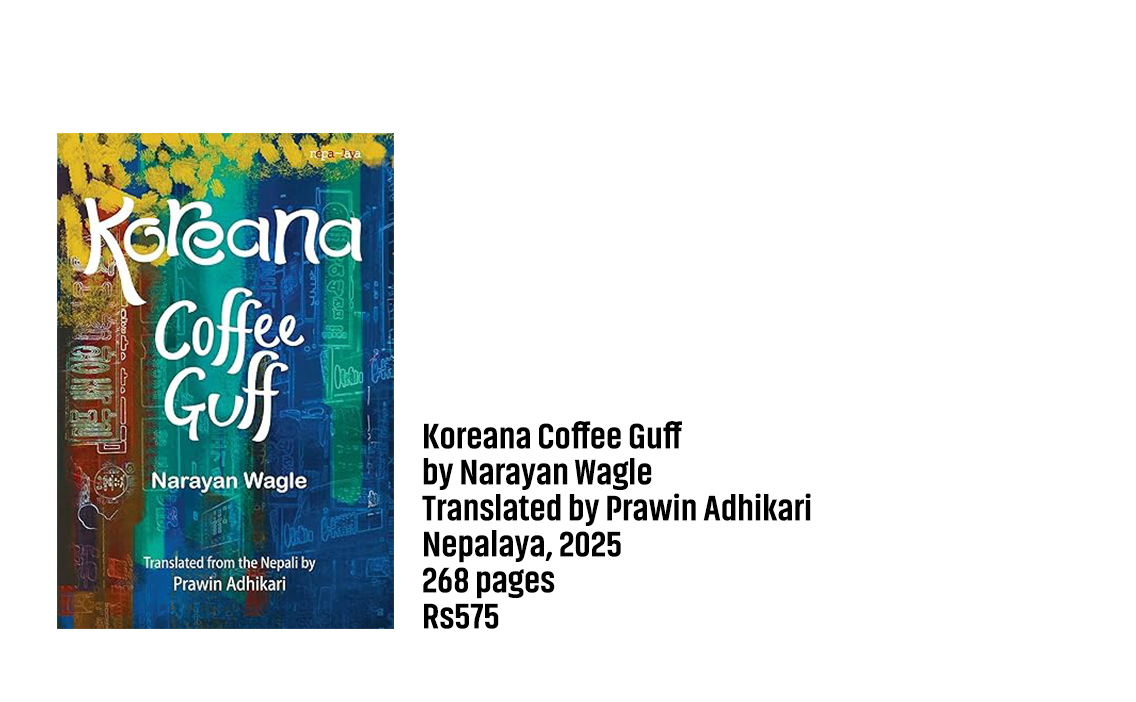
Prawin Adhikari’s translation breathes new life into the book on Narayan Wagle’s writing lifeKoreana Coffee Guff begins with a scene where Narayan Wagle, the editor-turned-farmer, appears in reverse cameo, as a character in a novel. He has just landed at Incheon in the dead of winter.
The opening premise reminds one of Tolstoy’s saying about how stories begin either when someone goes on a journey, or when a stranger comes to town.
‘The winds of each city are its original inheritance, shaped by its local language, its specific topography and the buffets of the airborne wings of birds and airplanes,’ Wagle writes.
The author is both on a journey and a stranger to the town. The word ‘stranger’ might need to be redefined here, as he has visited Korea several times before. But if every journey is new, then he is a stranger of sorts — stranger to the people he meets for the first time in the book, stranger to the reader who will encounter him for the first time like I did in high school reading the English translation of his 2005 Madan Puraskar winning novel Palpasa Cafe.
Koreana is non-fiction, and was first published in 2017 in Nepali, and recently rendered into English by Prawin Adhikari, who specialises in translating Nepali works into English in such a way that they do not read like translations at all.
Even so, I turned to a few chapters from the original text, curious to see how ideas have morphed. Take Wagle’s journey to Ansan Mountain. It is the same mountain, but something different happens in the two languages. The inexplicable feeling is that the translation has to conquer the mountain itself.
At its best, the book gives the reader a peek into Wagle’s mind, his internal monologues, his writing ideas, his thoughts on the people around him, his deep yearning and respect for nature, his exploration of Seoul and Korea, where he is attending the Asian Literary Creative Writing Workshop in 2017.
BACK TO THE LAND
‘All cities appear the same everywhere,’ he writes of Seoul, speaking of how ‘development’ has masked the original charm of a city rebuilt after war. In recent years, Wagle has moved on from being the editor of Kantipur, to activism, and has now returned to his ancestral land in Tanahu to farm.
Clues to this metamorphosis can be detected in this book, which was written nearly ten years ago and before his transition. Wagle used to write a column called Coffee Guff, and the book carries that conversational style.
But not all monologues land. Thoughts rooted in a specific time and space like the hike to Ansan where the author reflects on buildings, birds, and trees feel connected with a context and background. Then there are those that bring in a new metaphor, a new reflection, a new connection in almost each new sentence which make it difficult to follow the author’s stream of consciousness.
Halfway into the book, we finally meet the writers who have come from different parts of Asia for the workshop. Not speaking a common language, the writers have to rely on interpreters and Google, which turns their exchanges into quirky moments of laughter.
Writers are an important part of the book, the lens through which Wagle invites us to see the world. Poets Manjul from Nepal and Shiva Ryu from Korea make guest appearances. Through two Korean writers who share the surname Kim, we get a glimpse into Korean history and society, and how writing is intertwined with politics.
This Korea is different from the Kpop idols and skincare routine that has dominated recent imagination of the divided peninsular nation. Wagle writes, ‘Literature attempts to unite, politics impedes it. They are being continuously thwarted by the conflicts ongoing in the nation’s politics.’
One of the Kims is Kim Min-jung (김민정), author of The World’s Most Expensive Novel, that explores what it means to be a writer in Korea.
Reading Koreana feels like a hike through a jungle. If one is able to move past the tangled and stretched monologues, the book can hold moments of awe and wonder. But there is always a desire for a clearer trail to follow.
Narayan Wagle’s characteristic witticism is there aplenty, his observations are astute. Writers exploring their craft and readers curious of what is churning inside Wagle’s mind will find treats -- sometimes well-crafted, other times to be searched between the lines.
Alfa M Shakya is a writer, researcher, and podcaster. She runs and hosts ‘How’d You Create That?’, an art podcast about the creative process.