


Looking at Nepal from Venice
Italian artist's exhibition of 30 years of works based on Kathmandu's evolutionWe often see ourselves reflected in the other. For someone who grew up in Kathmandu Valley in the eighties and nineties, this maxim comes alive with an even greater force.
Nepal’s media ecosystem was dismal, the school curriculum was narrow and did not provide opportunities for creative expression. Perhaps that is why I became obsessed with MTV videos and Bollywood films. I saw my developing self reflected in these story-lines and razzmatazz.
When the media and education system do not engage the public and reflect myriad interests, aspirations and lifestyles of the population, citizens get detached and disconnected from their roots.
I left for America for further studies, and was somewhat determined to never return to Nepal. It was a country full of potholes and black-outs. But foreigners have been fascinated with our country for decades.
In the early 19th century, Francis Buchanan-Hamilton led a pioneering expedition and documented more than a thousand species of plants native to the region. Almost a century later, in 1905, Frenchman Sylvan Levi published ‘the first attempt to produce a comprehensive study of Nepal’, drawing on not just indigenous but available Chinese and European sources as well.
After Nepal opened up in the 1950s, different kinds of foreigners have traveled here -- most notably, cold-war era spies disguised as diplomats, and later came the hippies.
I returned to Nepal in 2013 and was primarily struck by two major demographics - the artists and the expats. Energised by the recent revolution, the creatives were making vibrant, powerful works. The expats, on the other hand, demonstrated a different way to navigate life in Kathmandu Valley.
These two groups of people re-introduced Nepal to me and I began seeing my country and my hometown with a renewed perspective. Which is why one particular image from Giovanna Caruso’s ongoing show at the Kalā Salon curated by Sophia L Pandé instantly caught my attention -- rather, it called out to me, as if it was composed for me, framing a key moment from my own life.
Its title is, coincidentally, 2013. Like most of her other works, the pen-and-ink drawing is punctuated by an explosion of watercolour: a woman standing confidently in front of a Newa-style house, a leg arched up, as if she is fixing a strap around an ankle before stepping out on an adventure.
The watercolour depicts a rainbow streaming out of a pot through a second-floor window. The rest of the details are rendered in realism – clusters of garlic and onion hanging to dry from the rafters, and further down a stack of corn. There are towels drying, even an old water pump.
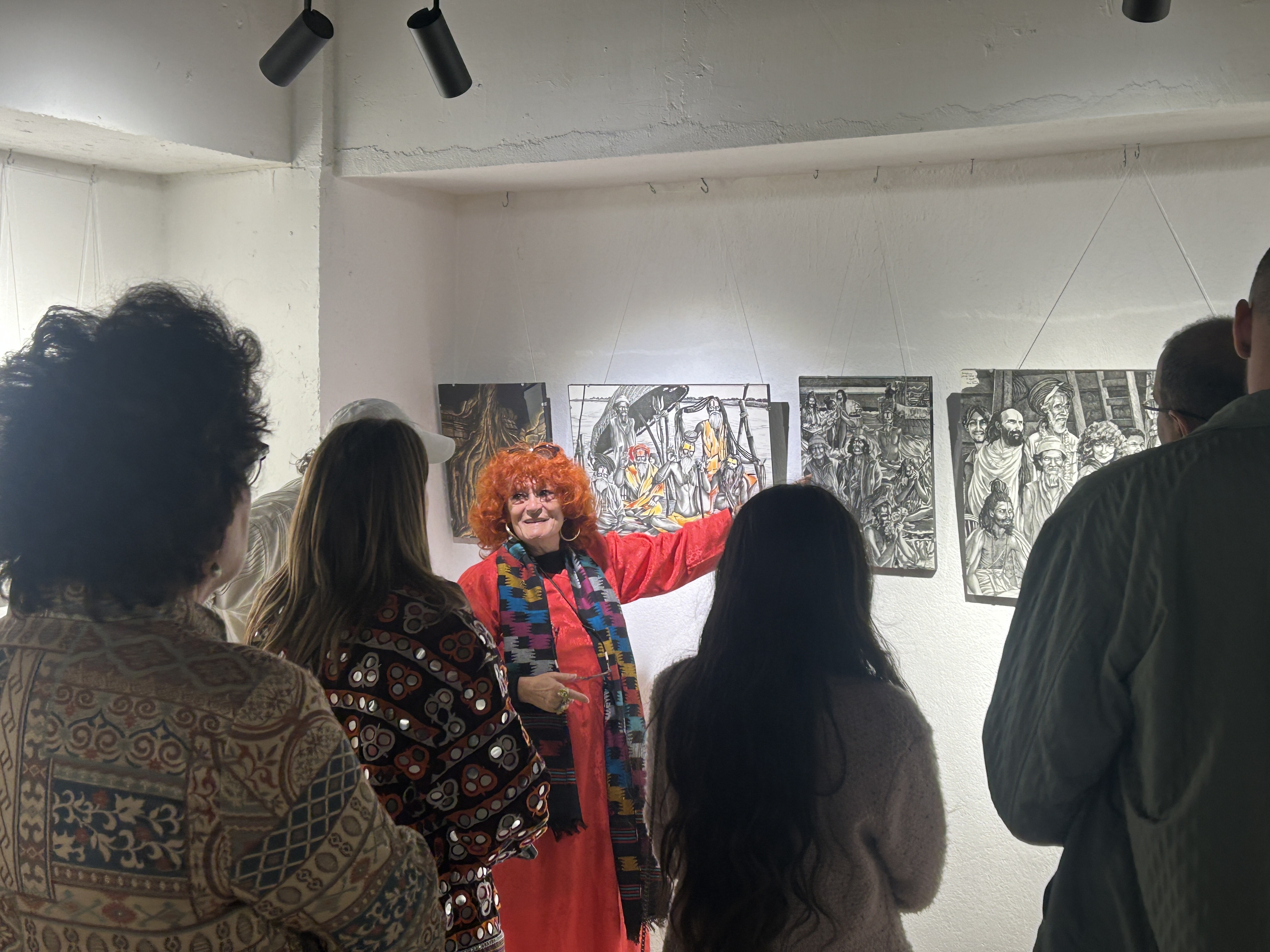
When I walked over to this artwork with Caruso, she chuckled, “Ah, this work is a celebration of my 30 years in Nepal.” It was while trying to calm a restless group of students during her teaching days in Italy that Caruso first came across an iconic image of Kathmandu Darbar Square.
She had found an old box of slides and while projecting images from the Himalaya to engage her students, the artist was determined to travel to Nepal. The first flat she rented was close to the square and the view from her rooftop was the same as the one she had encountered inside her classroom.
She has been traveling to Nepal every year since. Some of her favourite drawings depict Khokana in morning fog. From 1993-2006, she drew murals at Ram Mandir and Pashupatinath, asking sadhus to guide her and correct her depictions.
Caruso received a classical education, which means she was trained to focus on perspective and geometry while capturing mainly portraits and still lives. She is influenced by M C Escher and his explorations of mathematics and symmetry. No wonder she finds the Darbar Square architecture so compelling.
She also names as inspiration Gustave Dore, whose style is different from Escher’s and I can see how she has fused these influences in her body of work: Escher’s austerity complimented and slightly dislodged by Dore’s comics and caricatures.
“Before starting, the painting needs to be complete in my mind,” she explains as we pass a series of portraits titled Saraswati, Lakshmi, Kali Dancing, and Durga dominated by a roaring tiger. “These are all real people, I ask my friends and family members to sit for me.”
The Kali in the drawing has the artist’s fiery copper red hair and she is dancing, surrounded by various men with flowing hair. The artist seems to have experimented here, drawing the revelers from above, and indulging in playful abandon.
Depictions of Nepal are often in danger of being exoticised. But Caruso is familiar with her subjects, knows our alleys and temples intimately. Her colours and compositions are passionate and dense. In an essay, Anirudh S Chari writes the artist’s work is splashed with rapturous energy and most drawings have a carnivalesque element.
‘Kali Dancing’ illustrates this idea perfectly in that she has turned Kali’s usual fearsome portrayal on its head by depicting and embracing another feminine principle - the capacity to celebrate and create joy.
Apart from drawing inspiration from Hindu goddesses and Nepal’s multi-colored rituals, Caruso has also drawn the Sumerian Ianna and Lillith and the Egyptian Nut. She enjoys drawing Nataraja, and says it is because “Shiva is a good husband”.
We stand another painting titled 100 Days a Lion. “There is a saying in Italian, Better one day as a lion than a hundred days as a sheep, but I thought why not 100 Days a Lion?”
This sentiment captures this nomadic artist’s spirit spanning four decades, in which she has captured urban energy as well as the sacred imagery of ‘life diaries on canvas’.
From Venezia to Kathmandu and Journeys In Between
Giovanna Caruso
The Kalā Salon
Chhaya Centre Mall, Thamel
Till 12 December
10am- 8pm