When Winston Churchill addressed the Canadian Parliament in December 1941, he recalled that generals of Nazi-occupied France had said that England would “have her neck wrung like a chicken”.
Churchill went on to quip: “Some chicken.” As the laughter and applause subsided, he added: “Some neck.” (Even longer laughter and applause)
We do not know who first started calling the narrow corridor that joins India to its northeastern states a 'Chicken’s Neck', but there also was the hint of a Churcillian connotation.
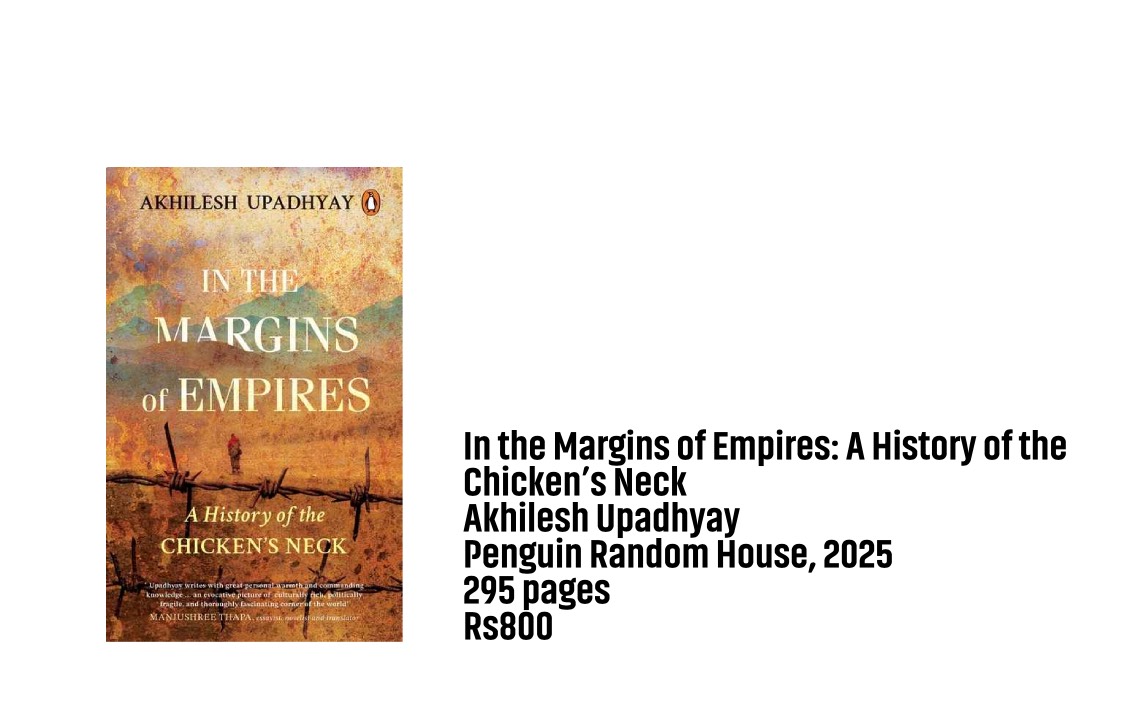
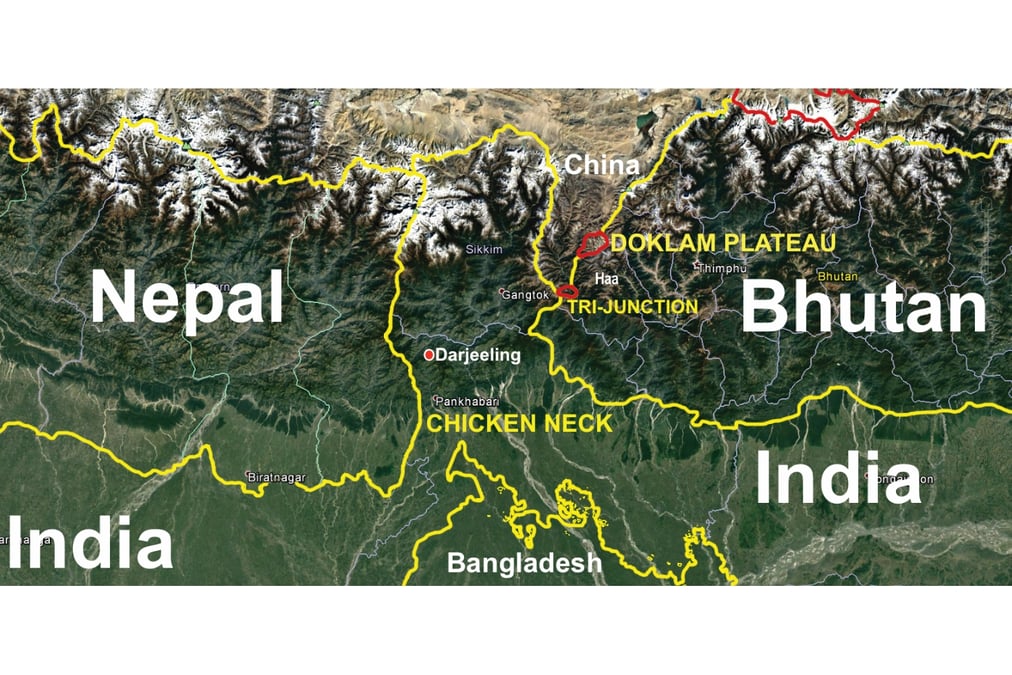
Akhilesh Upadhayay in his new book In the Margins of the Empires: A History of the Chicken’s Neck, uses this strip as an entry point to explore a region adjoining Nepal, Bhutan, China, Sikkim, Darjeeling, India’s northeast and the tectonics that shaped its geo-strategic terrain.
Upadhyay’s Chicken Neck is an organic whole, connected through centuries by transboundary traders, travellers, monks, spies, missionaries, mountaineers, and more. And as infrastructure and connectivity improves, smaller countries like Nepal and Bhutan (and earlier Sikkim) are caught up in the region’s rivalries.
The tri-junction of the Chicken’s Neck is a potential flashpoint that has obsessed India’s military strategists ever since Partition in 1947 and the formation of East Pakistan, and the Chinese annexation of Tibet.
India found itself squeezed between Chumbi Valley in China to the north and Pakistan to the south. So, when Sikkim started acting too independent for its own good 50 years ago, India engineered its annexation and turned it into its 22nd state.
The 1962 Sino-Indian war elevated its strategic importance even more. Alarm bells ring in New Delhi each time there is trouble around the Chicken’s Neck: the Naxalite uprising had to be swiftly crushed, the Indian military moved in to liberate Bangladesh, Gorkhaland and ULFA activities were dangerously nearby, Bhutan had to be appeased. Every once in a while things would flare up between India and China, as in the 2017 Doklam standoff.
And last year’s regime change in Bangladesh has rattled New Delhi enough to deploy its Rafael fighters and BrahMos cruise missiles in the Chicken’s Neck. It is now the most densely militarised strip of real estate in this part of the world.
As a journalist and former editor of Kathmandu Post, Upadhyay also peers at the Chicken’s Neck through Nepal’s perspective. After all, Jhapa (where the author is originally from) sits right there astride India’s strategic lifeline.
Geopolitics is at the front and centre of the book that takes readers back to the time Nepal was a closed Himalayan kingdom.
Nepal may be a yam between two boulders, but it may just as well be a thicker Chicken’s Neck as far as New Delhi and Beijing are concerned. Nepal’s rulers have always had to walk the tightrope between China and India. Khampa guerrillas, covertly helped by American and Indian intelligence, raided Chinese military convoys from bases in Nepal, and King Mahendra had to do some intricate diplomatic footwork.
India is often described as Nepal’s closest friend, but our relations with China go back as long in terms of the Lhasa trade, Bhrikuti and Arniko, religious exchanges and people-to-people relations.
While Nepali researchers are wary of touching on Chinese, Indian or American sensitivities, Upadhyay’s journalistic background means he has no qualms about tackling the subject head-on, and objectively. He spent more than a year researching the book, sniffing around Siliguri, Bagdogra, Naxalbari, Darjeeling and the villages on the Jhapa side. Then he travelled to Olangchung Gola to listen to ordinary people of the Himalayan rimlands.
Despite the perception about rigid frontiers between nation states, the book hints at how absurd the notion is. The Chicken’s Neck is also a wild elephant migration corridor, disturbed by the India-Bangladesh border fence, new expressway embankments, airport runways, and expanding cities.
Similarly, the people on the Nepal-tibet border used to cross over to graze yaks — this expanded the gene pools of not just the yaks but also the nomadic humans who moved with the herds.
Despite the hard borders, trade flourishes. Upadhyay marvels that a shop in Phungling in Taplejung has embroidered saris from Siliguri and fluffy jackets from China. he finds that residents in the northeastern and southeastern tips of Nepal have more in common with kin across the border in Tibet or India than with someone from Kathmandu.
Nepal was once one of the biggest trade hubs in ancient times, and our products were treated as equals in Indian border cities. People too, could move freely, especially if they were and are from bordering Tarai cities.
Nepal’s rich history and culture was shaped by the proximity to neighbours, and despite borders it is still cemented by marriages and trade — especially in the Nepali-speaking lands to the east. Its geographical positioning makes Nepal not landlocked but land-linked, adjacent to the largest emerging economies of the world. Nepal needs to deploy its soft power with effective diplomacy to take advantage of these two empires, and not be choked by their rivalry.
The book was going to press when the GenZ protests ignited in September, but Upadhyay nevertheless managed to insert the current political transition into the pages with deft editing.
The final section of the book examines at least three possible scenarios that may unfold as South Asia continues to be shaped by great power rivalries and imperial contests that have weakened the unilateral influence of the west.
Akhilesh Upadhyay extrapolates from the Chicken’s Neck, zooming out for a wider perspective on the Subcontinent.