


The sins of our mothers
Arundhati Roy’s memoir is a powerful account of her tumultuous relationship with her birth-giver and birth-place‘Get out of my house.’
‘All my sickness is because of you.’
‘You’re a millstone around my neck.’
Arundhati Roy heard these admonitions from her mother over and over throughout her life.
This must be a singular, yet universal experience. There must be very few daughters who make it through life unscathed by their mothers. And vice-versa.
How many of our mothers look at us and see in us the potential of all of the lives they could have lived? How many resent us for it, or want us to live those lives in their stead? And how many of us look back at our mothers and imagine what they would have achieved had they not been expected and assigned to play the role of wife, daughter-in-law, mother — had we never existed in their lives?
How many mothers project their experiences onto their own daughters and continue the cycle? No daughter seems to escape it — no matter how well-behaved, docile, unruly, or rebellious. Certainly not the child who would go on to become a Booker prize-winning author.
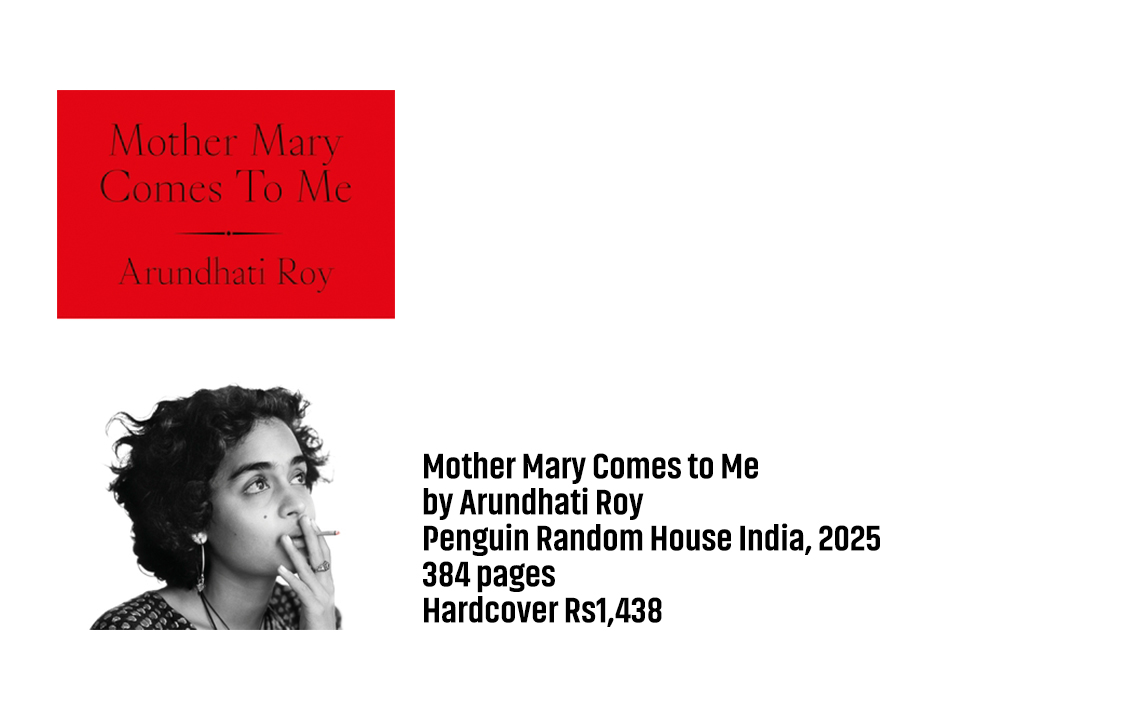
Arundhati Roy’s memoir Mother Mary Comes To Me chronicles her complex relationship with her mother Mary, or Mrs Roy, as her educator mother had her two children refer to her.
In December, Arundhati Roy was in Kathmandu to sign books and briefly interact with readers at two bookshops in the city. She describes a childhood overshadowed by her mother’s volatility towards her and her brother.
Mary herself was raised by an abusive father to escape whom she married the first man who proposed — Arundhati’s father who in her mother’s words turned out to be an alcoholic ‘Nothing Man’.
Mary left her husband in Assam and eventually wound up with her two children in her town of Aymanam in Kerala, encountering other family members along the way who did not treat her, or her children with respect.
The trauma and cruelty her mother endured could not be contained in her body, and spilled out onto her two children, towards whom she was physically, verbally, and emotionally abusive.
While she treated her children with disregard, she would build a school in the nearby town of Kottayam from the ground up, educate thousands of children, take up a legal fight that led to the Supreme Court granting Syrian Christian women in India equal inheritance rights, and uplift many orphaned children and women in Kerala.
Arundhati lived with both her mother’s brutality and brilliance. And like her daughter, readers must reconcile the indefensible parts of Mary Roy’s personality — the cruelty of calling her nine-year-old daughter a bitch, or shooting the family dog that mated with a stray — with her unyielding drive to educate thousands, fight for equal rights, and challenge the way her world viewed women.
Mrs Roy had little kindness for her own children, but plenty for the students, children, and women whose lives she shaped, and made better. And her kindness was not rooted in empathy, but in anger at the hand she had been dealt in life.
Eventually, Arundhati decided to temporarily cut all contact with Mrs Roy — not because she did not love her, she writes, but so that she could continue to love her. Her desire to get away from her abusive mother, and her fascination with the ideas inspired by the architect who built her mother’s school, would lead her to the Delhi School of Architecture at age 16.
In Delhi, Arundhati became roommates with Hisila Yami before she and her Maoist ideologue husband Baburam Bhattarai went underground to lead Nepal’s decade-long armed struggle.
But architecture was not her calling. In Delhi, the heart of India’s statecraft, Arundhati came into young adulthood against a backdrop of the country’s changing socio-politics, which began to take a turn for the hyper-nationalist, Hindu supremacist community that it has now largely become. The winds of those changes have now blown into Nepal.
In the city, far from her mother, Arundhati met the man who would become her partner of many years, collaborating with him on several films and screenplays before finding the language (‘I needed to hunt [language] down like prey,’ she writes) she needed to become the writer she is now.
She went on to write her Booker prize-winning novel The God of Small Things, but the wealth and status the book brought her did not sit comfortably. So she smashed her newly-built gilded cage, as she describes it, and became more political. Contrary to norm, she published several works of non-fiction, and would only publish her second novel, The Ministry of Utmost Happiness, in 2017, 20 years after The God of Small Things.
Her fierce opposition to India’s nuclear policies, to a dam that would displace millions of indigenous people and ecologically damage the Narmada Valley, her championing of Kashmiri self-determination, and her time spent with Maoist rebels in the forests of Chhattisgarh as they took up arms to defend their land and resources against corporate interests made her an enemy of the state.
Meanwhile, being raised by a single mother had never sat well within her Syrian Christian community. ‘I wasn't Christian enough. I wasn't Hindu enough. I wasn't communist enough. I wasn't enough,’ Roy writes in her memoir. For all her love for India, the nation did not seem to reciprocate.
The circumstances might be different, but it might strike a chord with readers in Nepal, many of whom marched on the streets in September hoping for a better tomorrow, but were gunned down by the very institutions meant to protect them. It might resonate with those who are not seen as citizens of this nation simply because they might not fit into an imagined idea of Nepali nationhood.
Arundhati’s relationship with her mother, who was simultaneously proud and disdainful of her daughter’s accomplishments, continued to be tumultuous until the end of Mary Roy’s life.
One of Mrs Roy’s last messages to her daughter before she passed was: ‘There is no one in the world whom I have loved more than you.’ Arundhati muses that her lifelong refusal to stop loving her mother must have finally breached her barriers. One wonders if that final declaration of love was solace enough, apology enough, for all the pain caused.
But for Arundhati Roy, her love for her mother and her motherland outweighs the cruelty both have shown her. This, too, must be a singular, yet universal experience.
writer
Shristi Karki is a correspondent with Nepali Times. She joined Nepali Times as an intern in 2020, becoming a part of the newsroom full-time after graduating from Kathmandu University School of Arts. Karki has reported on politics, current affairs, art and culture.