


Time, transience, transition
Artists depict ever changing realms of society from folklore to artificial intelligenceWe walk past familiar neighbourhoods and wonder how much it has changed. An ongoing exhibition at The Kalā Salon titled Changing Times by The Pagoda Group aims to do just that -- capture ever-changing society within a captivating display of colourful canvases.
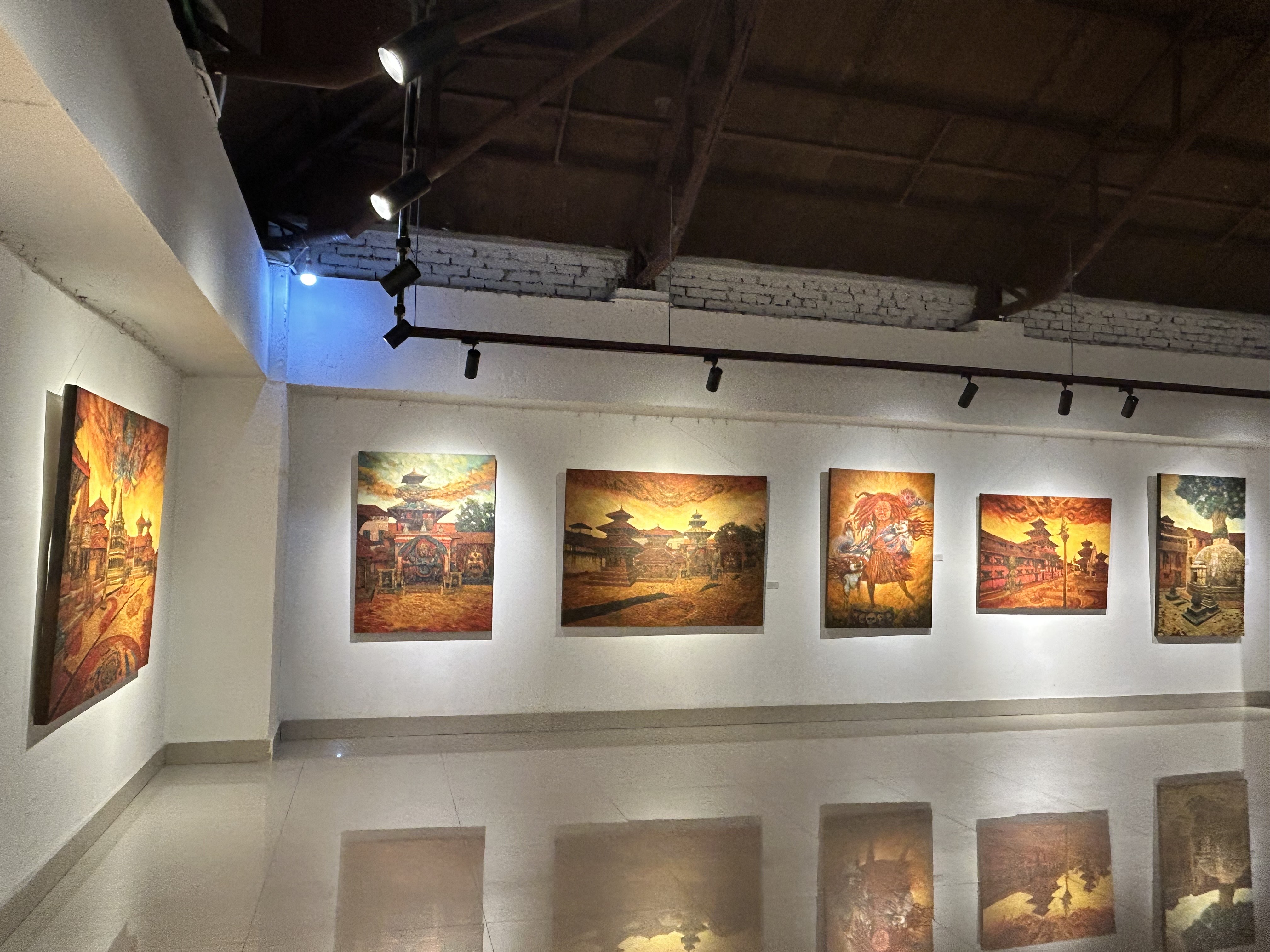
Brick-lined houses, local tea shops, ancient temples, quiet devotion are themes in Pradhumna Shrestha’s series Shangri-La, much of which is an imagined past filled with nostalgia of the place he grew up in. By keeping people out of the frame, he allows space for what he calls a divine aura to surface.
“I was born and brought up here and my canvases echo the nostalgia of cities like Kathmandu, Bhaktapur, and Lalitpur which are dense with myth, folklore, religion, and an ever-present divinity. All of this is truly what is ours, and we must treasure it,” says Shrestha. “Whatever I truly felt in my heart, I translated it into my work.”
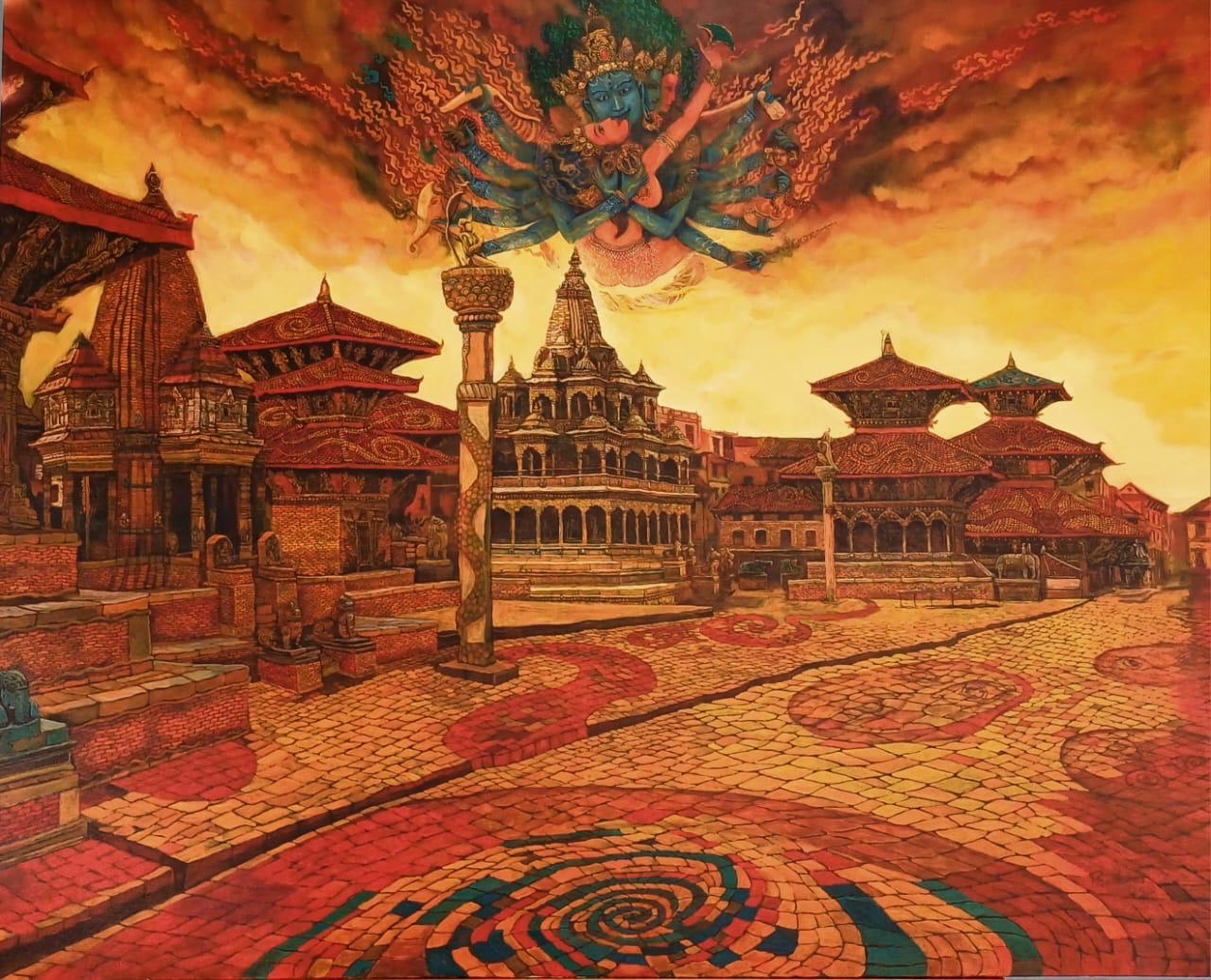
The swirling clouds that drift across Shrestha’s canvases borrow from thangka and paubha traditions, lending the scenes a sense of mysticism and otherworldliness. Within this dreamscape are red circular forms which represent wheels of chariots. The presence of divinity dominates from above, its presence asserted in soft blue brushstrokes below, as if the deity’s gaze itself has seeped into the land. Gods linger as guardians and temples hum with enigma in his paintings.
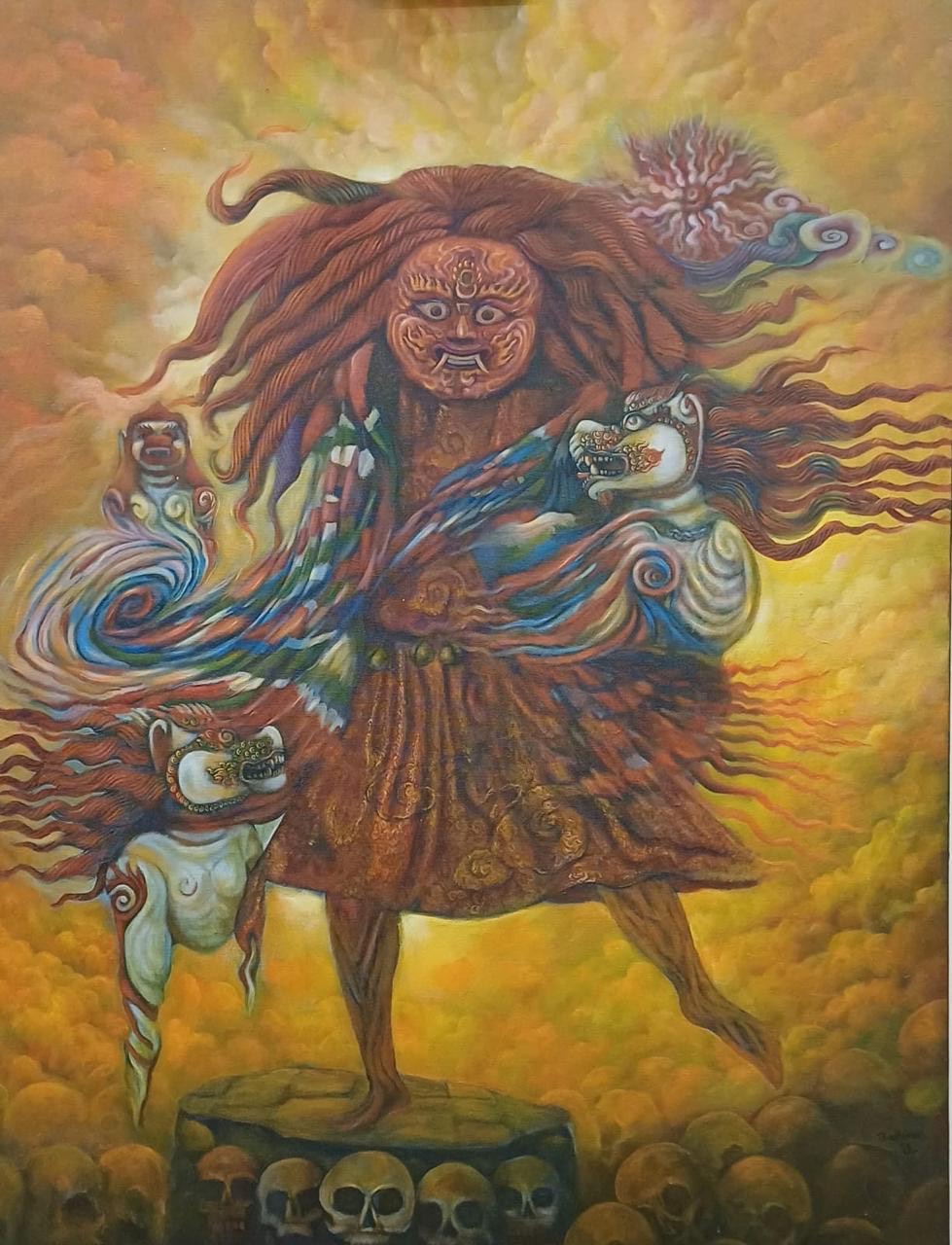
In his much earlier work, Cultural Bond, a lakhe masked dancer bursts forward in vibrant red, dancing against a backdrop of molten gold clouds. The lakhe’s trance signifies protection and where it steps, the evil cannot follow. Hence, the skulls that surround but never fall beneath its feet but, one leg hangs suspended in midair, suggesting uncertainty, raising questions.
Is this a symbol of culture and tradition, secure, or is it endangered by modernity? The work captures a society at a crossroads, honouring tradition while grappling with the risk of drifting away from it.
In Panchatatva Mandala, Pasang Bikram Lama fuses two mandalas into a single visual meditation, suggesting unity where each colour carries symbolic weight: yellow evokes the soil of the earth, blue flows as water, red burns with fire, and black opens into the vastness of the spatial sky. Together, these elements form a quiet cosmology that speaks of creation and dissolution, of life folding endlessly into death and returning again. Says Lama, “Everyone has a mandala of their own being, and the elements represent their cycle of life.”
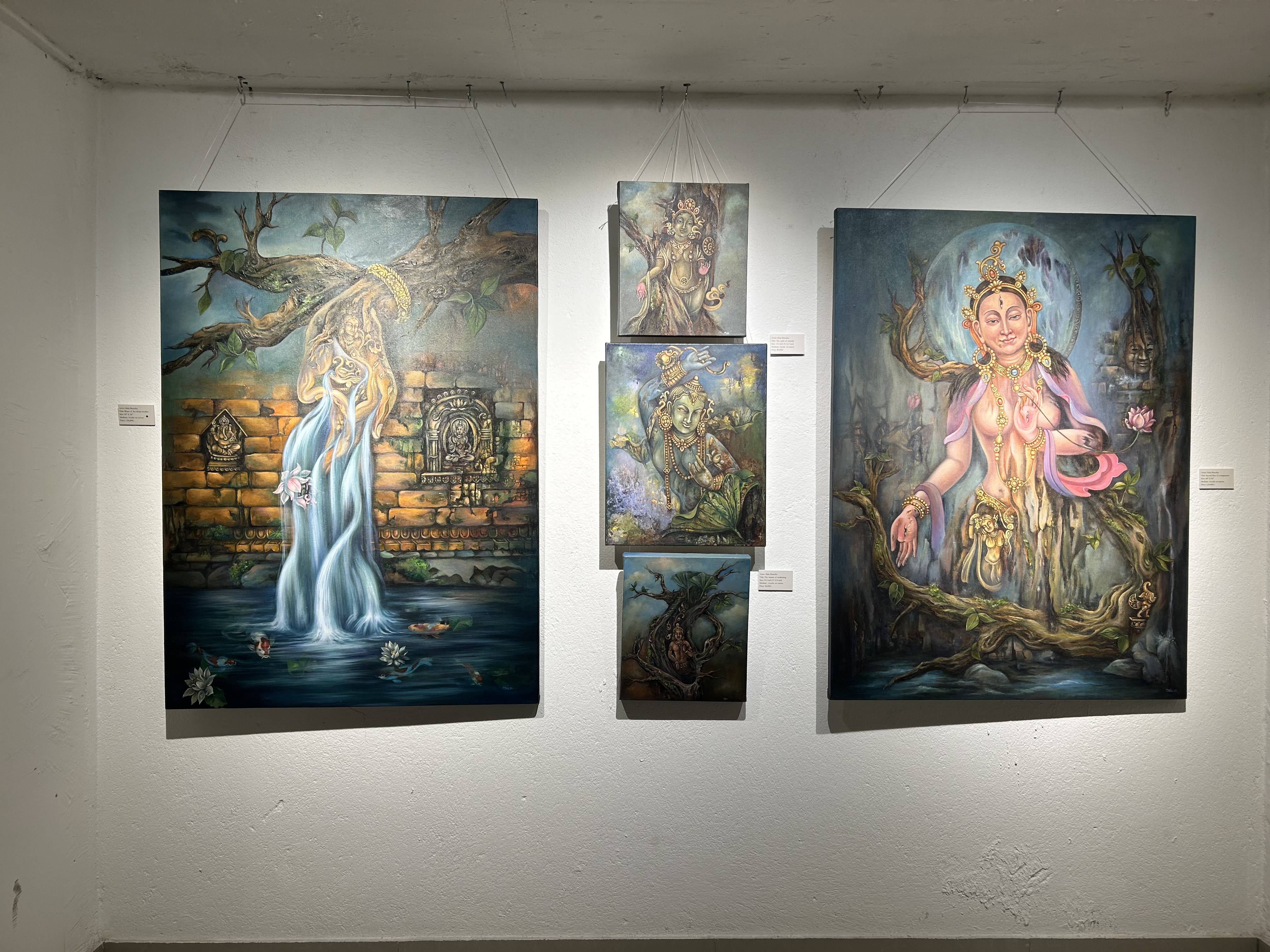
Mala Shrestha’s works Water of the Divine Mother and The Spirit of Serenity unfold in a dreamy and delicate fusion of nature and religion, suggesting that divine forms are not separate from the natural world. Trees and branch-like motifs appear as origins of sacred sculptures and spiritual presences.
Her goddesses, adorned in alluring ornaments, emerge from trunks and streams, painted in aqua green, pink pastels, and rustic browns, as if grown rather than created, affirming that the divine is inseparable from nature and present everywhere.
Kishor Nakarmi’s Essence of Nepal, where Gautam Buddha appears embedded within leaves, brick walls, birds, and wilderness, dissolving boundaries between the sacred and the earthly. These canvases radiate calm and their subtlety is enriched by finely observed details.
Similarly, Rudra Bahadur Pun captures the vitality of mask dances and ritual movements found in the monasteries of Mustang, weaving together tradition, landscape, and daily life.
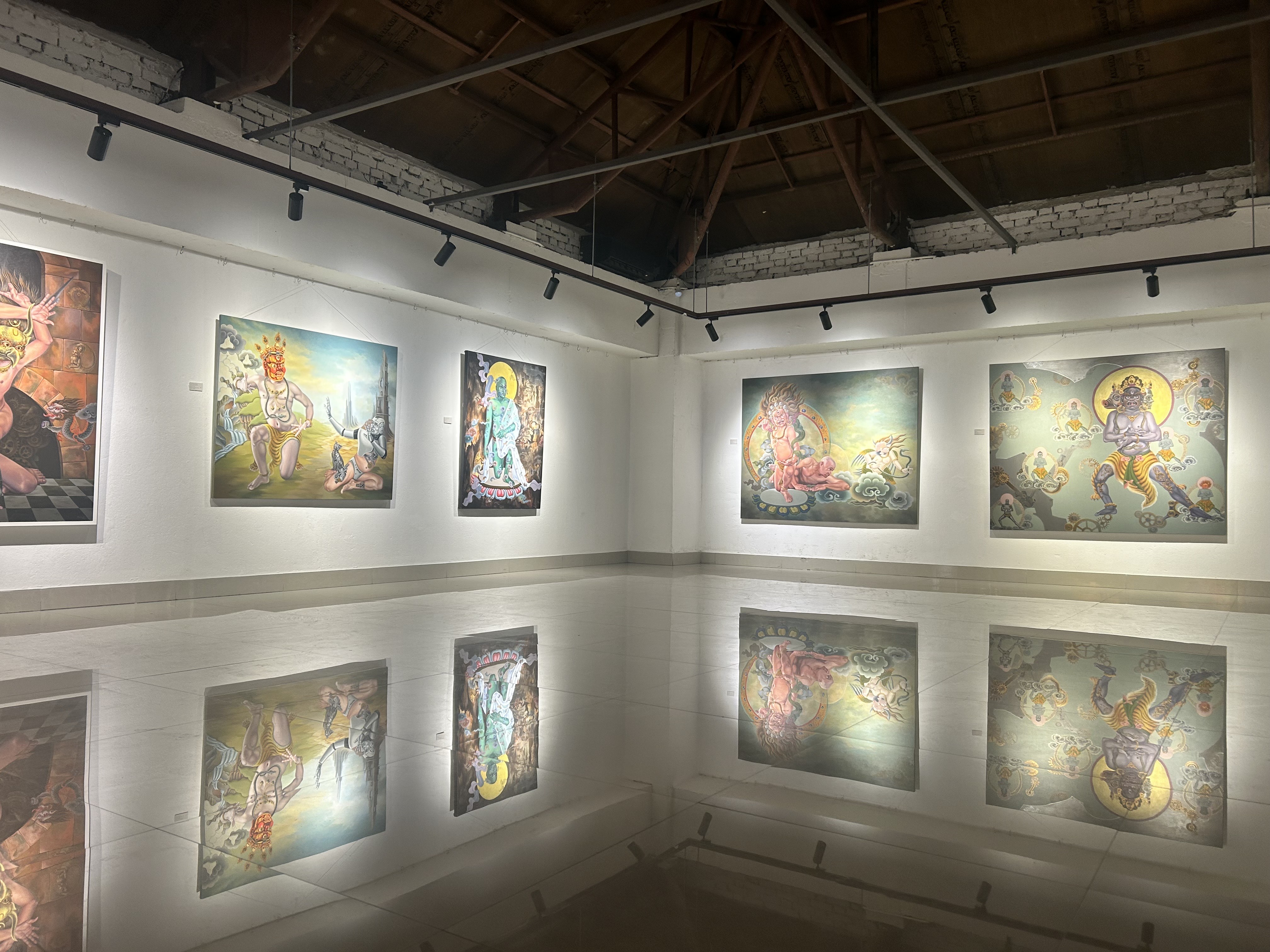
The essence of the exhibition comes together in Roshan Pradhan’s works. His paintings reflect a contemporary tension where technology collides with ancestral myth and the power of tradition. A fierce Garud rises within a landscape saturated by technological apparatuses, while at its feet a human form representing AI clings tightly, attempting to assert control.
In another work, Bhairab confronts a human embodiment of AI in a theatrical standoff, with the deity ultimately prevailing, reaffirming endurance over technological dominance. The human figures in Pradhan’s paintings are drawn from life with his friends volunteering as models, photographed and later translated onto canvas.
“Technology has taken over our lives. Many can probably not even imagine life without it now. But, culture, too, is integral to human existence. Our life would be much different without our culture; it is a part of us,” notes the artist.
Rather than framing technology as purely antagonistic, Pradhan explores coexistence, and while acknowledging its destructive potential, he affirms his belief in the power of our myths and traditions.
Pradhan adds, “These paintings are also an archive of its time. Viewers centuries from now may read these paintings as records of the age we inhabit. While technology is important, cultural continuity must walk alongside it. Festivals must still be celebrated, oral traditions must be sustained, and our roots must be remembered, especially by future generations.”
Curator Sophia L Pande says the exhibition took more than a year to put together:
“It responds to a shifting world, seeking to capture both transformation and the quiet fear of loss. Its themes move fluidly across environment, technology, artificial intelligence, and climate change, reflecting the diverse yet interconnected practices of the artists, providing a glimpse into the evolving landscape of contemporary Nepali art.”
Changing Times
The Kalā Salon
Chhaya Centre, Thamel
11AM-8PM