
As a record number of climbers head up Mt Everest this week, there have been calls in some quarters for Nepal to change strict cutoff date of 31 May for the spring climbing season.
The rules were made when long march-ins from the foothills were inconvenient when the monsoon set in. But with climate breakdown making monsoons more erratic, and better access to the base of mountains, it is not as compelling to set a date for the end of the spring climbing season.
The industry would also generate more revenue if mountaineering was open all year around instead of seemingly arbitrary closure dates in the spring and sometimes in the fall. There is proof that off-season summits are possible, if not on Everest right away, then at least on other lesser peaks.
Ultimately, the weather windows are rooted in nature. The monsoon is when the jet stream moves north to the Tibetan Plateau, allowing in moisture-laden winds in from the Bay of Bengal. Although there is more snow on mountains, there is almost no wind higher up from mid-June to end-September.
It may be time for the Nepal government and mountaineering industry to re-evaluate strict season demarcations — if only to reduce the spring rush on the world’s highest mountains.
Thursday and Friday could see some of the highest single-day summits since the previous record of 354 on 23 May, 2019.
After a record late start due to an ominous serac which slowed down rope-fixing on the Khumbu Ice Fall, climbers on Mt Everest are seizing narrow weather windows.
“Climbers were summiting in great numbers from 3AM in the morning to 2PM,” mountaineer Khim Lal Gautam told us on the phone from Base Camp “Due to the high numbers, there were some rescues and some developed snow blindness.”
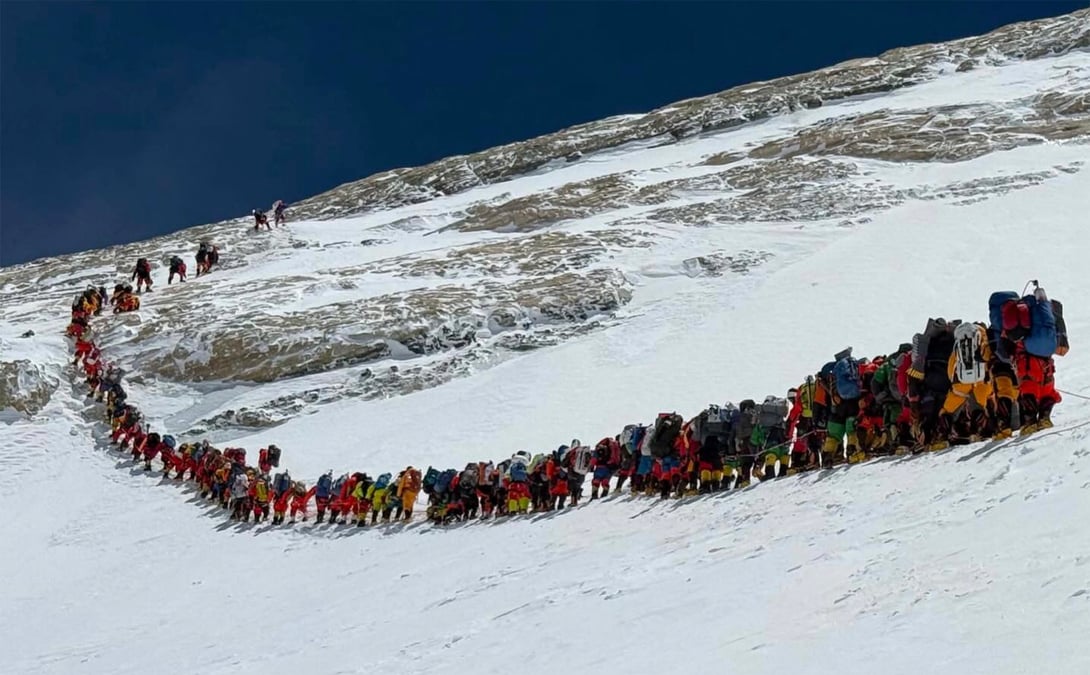
Given to the volume of climbers and the rarity of friendly weather on the mountain, Everest has developed her classic traffic jam as people inch up along the ropes, sometimes getting stuck in the ‘death zone’ for as long as five hours. This year, too, there have been images posted online of long queues of climbers inching up the Lhotse Face towards Camp IV on the South Col.
Nepal rakes in $8.3 million from the mountaineering economy, and Everest accounts for 85% of that. Of the 1,134 permits issued, the Chinese topped the list.
“Right now most expedition companies are dealing with crowd control, managing summits,” says Ben Ayers of Outside magazine. “Despite the delay at the start of the season, the vibe is pretty good. There is nothing that scary. While there were some drama and hiccups with the heavy lift drones and exiting the icefall, people are still getting what they came for, which is Everest summits and the companies are delivering on it.”
This season also saw climbers attempt some unique feats. One of them is Bartek Ziemski, 31, from Poland, who summited Lhotse without bottled oxygen, ropes, or Sherpa support, then skied down to Base Camp, stopping at each camp only to retrieve his tent and gear.
Ziemski said that he just changed into his skis and headed down from the summit, since he doesn’t enjoy lingering. Caught in a whiteout storm during the descent at the icefall, he waited 45 minutes and decided to resume. “I had skied there a few times already, so I knew my ski line and its location very well,” he said.
A week later, Ziemski repeated the feat — this time on Everest. His own forecasting told him that winds would be lowest at 2AM on 17 May. Weather had been rough a day ago, so other climbers held back, which gave Ziemski a relatively crowd-free climb up Everest.
After breaking briefly at Camp 4, Ziemski summitted around 1PM. He skied down to Camp 4, packed up, and skied non-stop to Camp 1.
Earlier in the season, while the serac had delayed climbing, Ziemski helped a group of five Sherpas from different expeditions fix ladders and ropes to Camp 1.
As has been the norm, drones were used to send ropes to set up from above the ice fall to the summit. Helicopters also took ropes to Camp 1 as Sherpas rushed to fix ropes to the summit in time for the climbers, trying to catch up on a two-week delay.
However, there is pressure on the government to allow climbers in future to fly to Camp 1 by helicopter, avoiding the precarious Khumbu Ice Fall, getting more dangerous by the season due to rising temperatures.
Meanwhile, Tenzing David Sherpa became one of just a handful people in the world to complete a rare Triple Crown achievement by summiting Everest, Lhotse (8,516m) and Nuptse (7,861m), all in the same season.
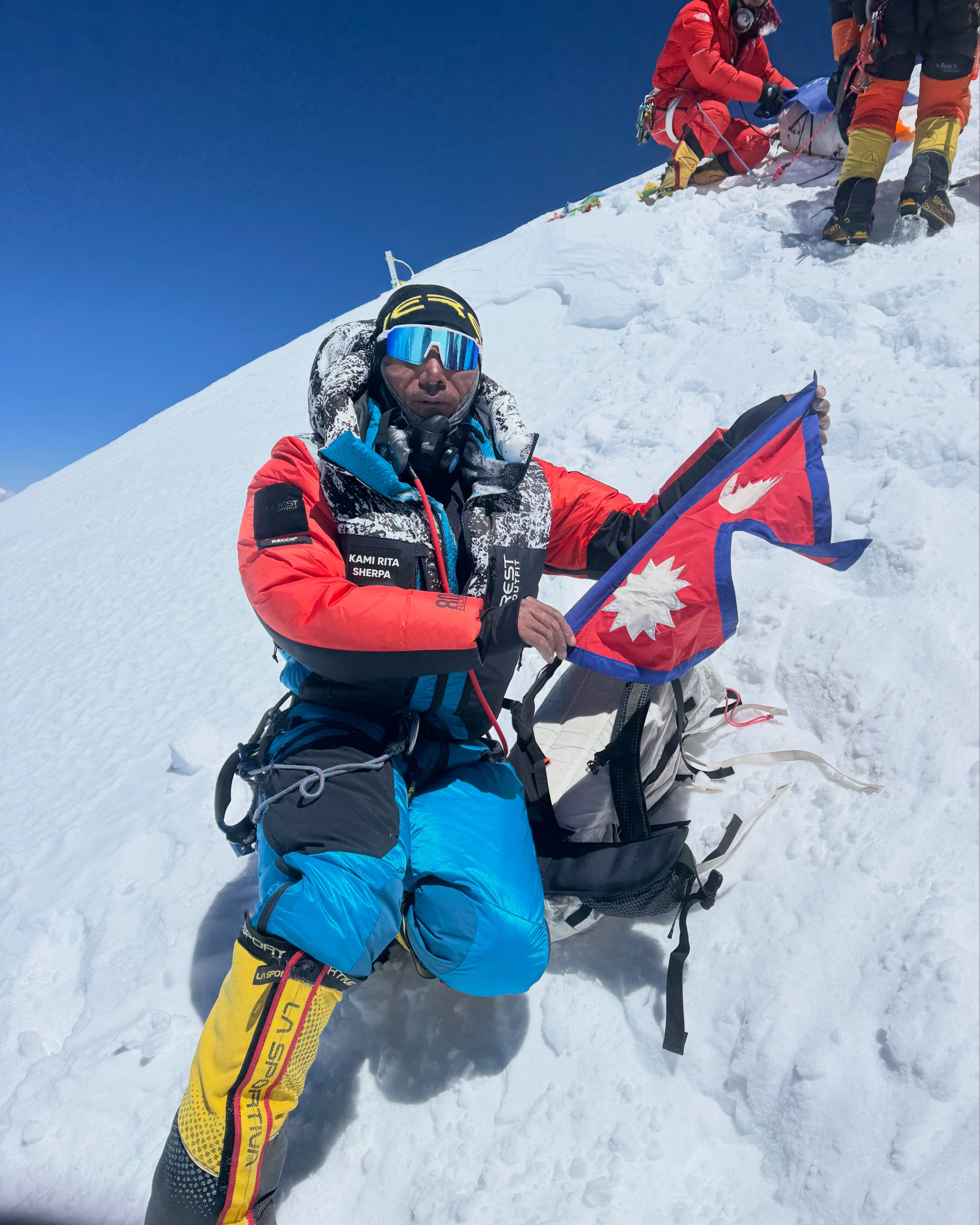
Other notable feats include Kami Rita Sherpa’s 32nd summit (pictured below), breaking his own record, and Lhakpa ‘Mountain Queen’ Sherpa’s 11th, a record for women. “There were so many people at Everest this year. Some people were incredibly skilled and others were very new to mountaineering,” said Kami Rita, who noted that the summit had now turned into “the face of a cobra” due to overhanging ice.
Bianca Adler, 18, became the youngest Australian to get to the top of Everest as her family watched from Base Camp, while 75-year-old Viorel ‘Wally’ Stirbu, a Romanian refugee then Chicago firefighter also reached the highest point in each of the seven continents.
OTHER MOUNTAINS
The Japanese trio of Masayuki Takenaka, Tatsuro Sugimoto, and Ryota Nomura did the first ascent of Jarkya Himal’s main peak (6,473m), near Manaslu, on 11 May.
Meanwhile, Ukrainian Alexandr Moroz and Russian Mark Ablovacky took on Manaslu, climbing without bottled oxygen, no guides, no fixed ropes, and even no base camp.
As a short weather window opened up, the two decided to scrap plans for an acclimatisation rotation, instead going for the summit. Ablovacky turned back at a point, while Moroz forged on, resting in the open at 7,450m, often climbing on large stretches of bare ice, before reaching the summit alone at 8AM on 28 April.
While Everest gets a climber gridlock, Manaslu, despite also being an 8,000er, only got two permits for the spring. Smart marketing and good logistics will get more commercial climbers to take a liking to Manaslu and other 8,000ers.
And extending the spring season could be a way of reducing rush hour traffic on the mountain.