
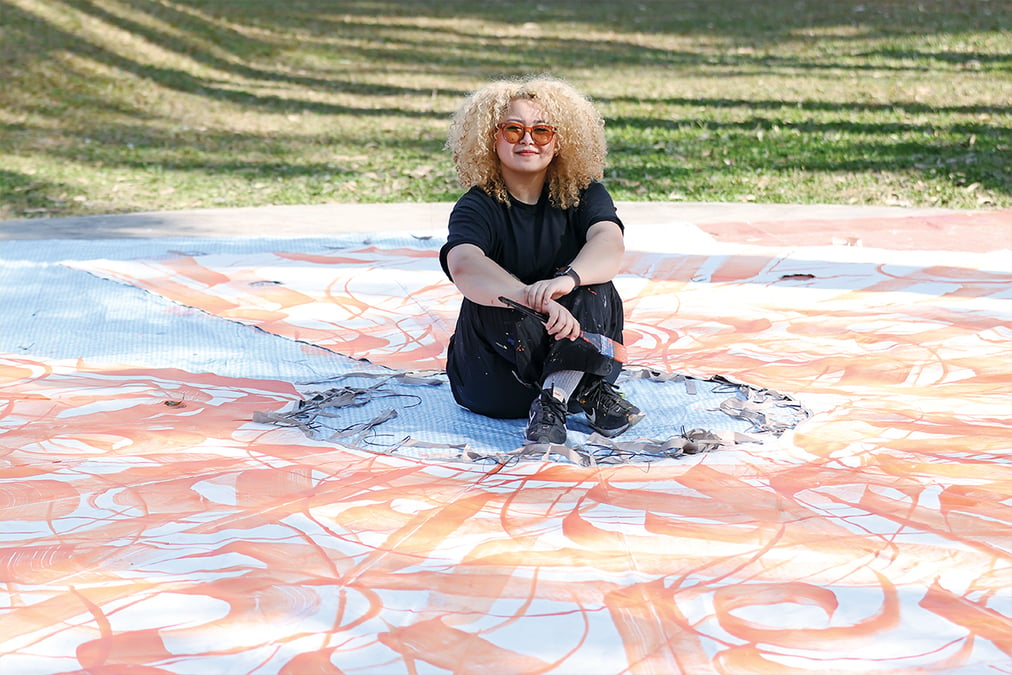
After literally making her mark in American cities with ‘calligrafitti’, artist Sneha Shrestha is back home to rediscover her roots and give new meaning to her murals.
Shrestha is in Nepal to complete an installation named ‘Traveling Chautari’ in Lo Manthang which is a large portable bamboo tent on which Shrestha painted the roof (pictured, right). The project is a collaboration between an Italian art collective, Abari architecture, Siddhartha Art Foundation, among others.
“I am interested in what makes a place feel sacred, what goes into creating an immersive atmosphere,” says Shrestha, a feeling she finds in Nepal’s mandir and gumba but also in mosques in Türkiye. “The Lo Manthang project draws from the idea of a Chautari as a place of informal discussion in Nepal.”
In Mustang, Shrestha also came across ancient Luri cave paintings, perfectly preserved in the dry thin air at 4,300m altitude.
For Shrestha who has gained acclaim in the United States for her unique combination of calligraphy and graffiti (calligrafitti) this is a homecoming in more ways than one. She says, “In those caves I saw letters and realised that I am just continuing a traditional art form that is centuries old.”
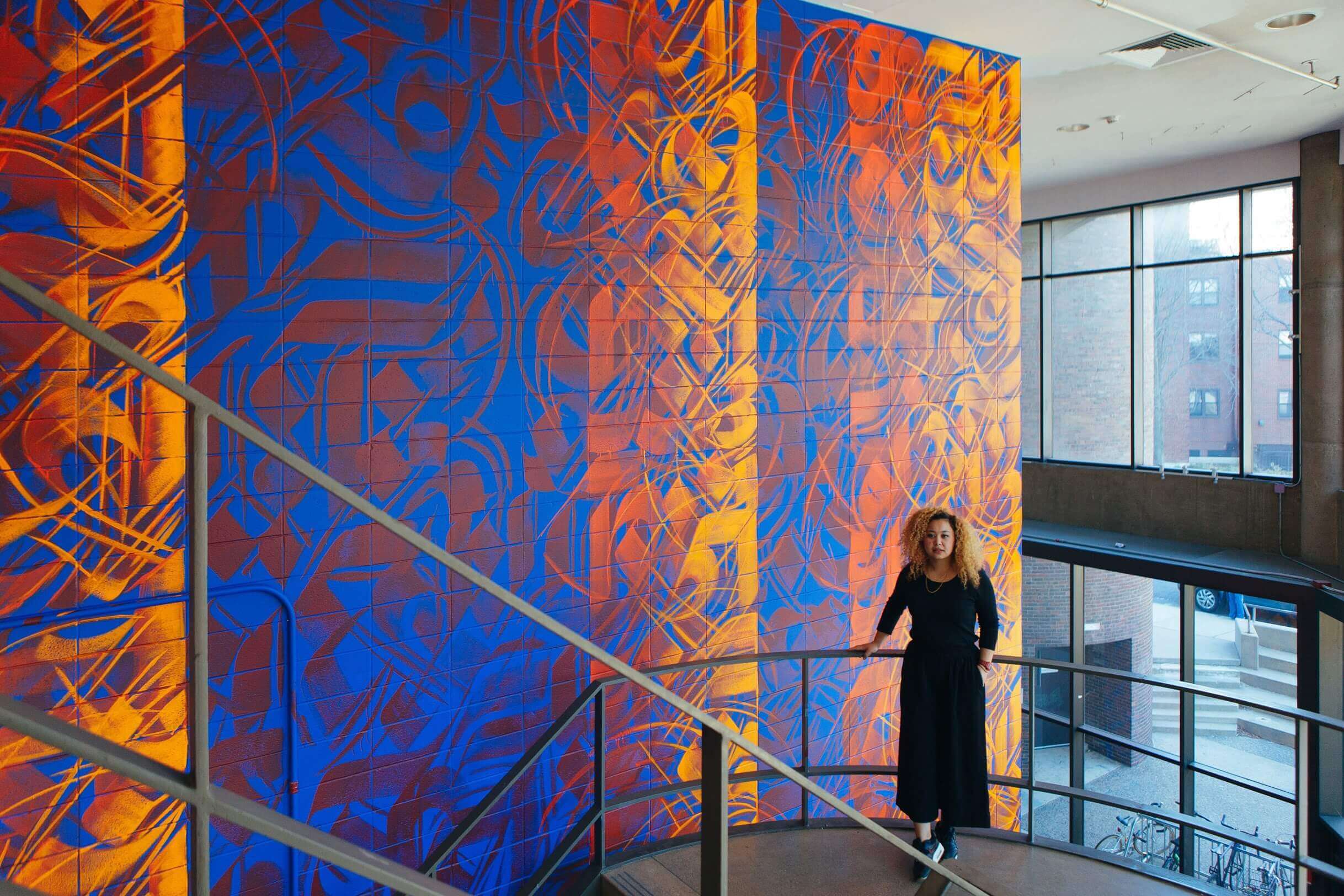
Based in Boston, Sneha Shrestha’s paintings, sculptures and large scale public art and murals use spray-painted Devanagari and Ranjana scripts from Nepal. She aims to preserve culture, ritual and memory, especially for the diaspora by transforming letters into visual experiences.
Shrestha has been commissioned by Google and Facebook, Northeastern University, and her work has been acquired by Harvard Art Museum and the Museum of Fine Art in Boston. She also featured in an exhibit at the Rubin Museum in New York.
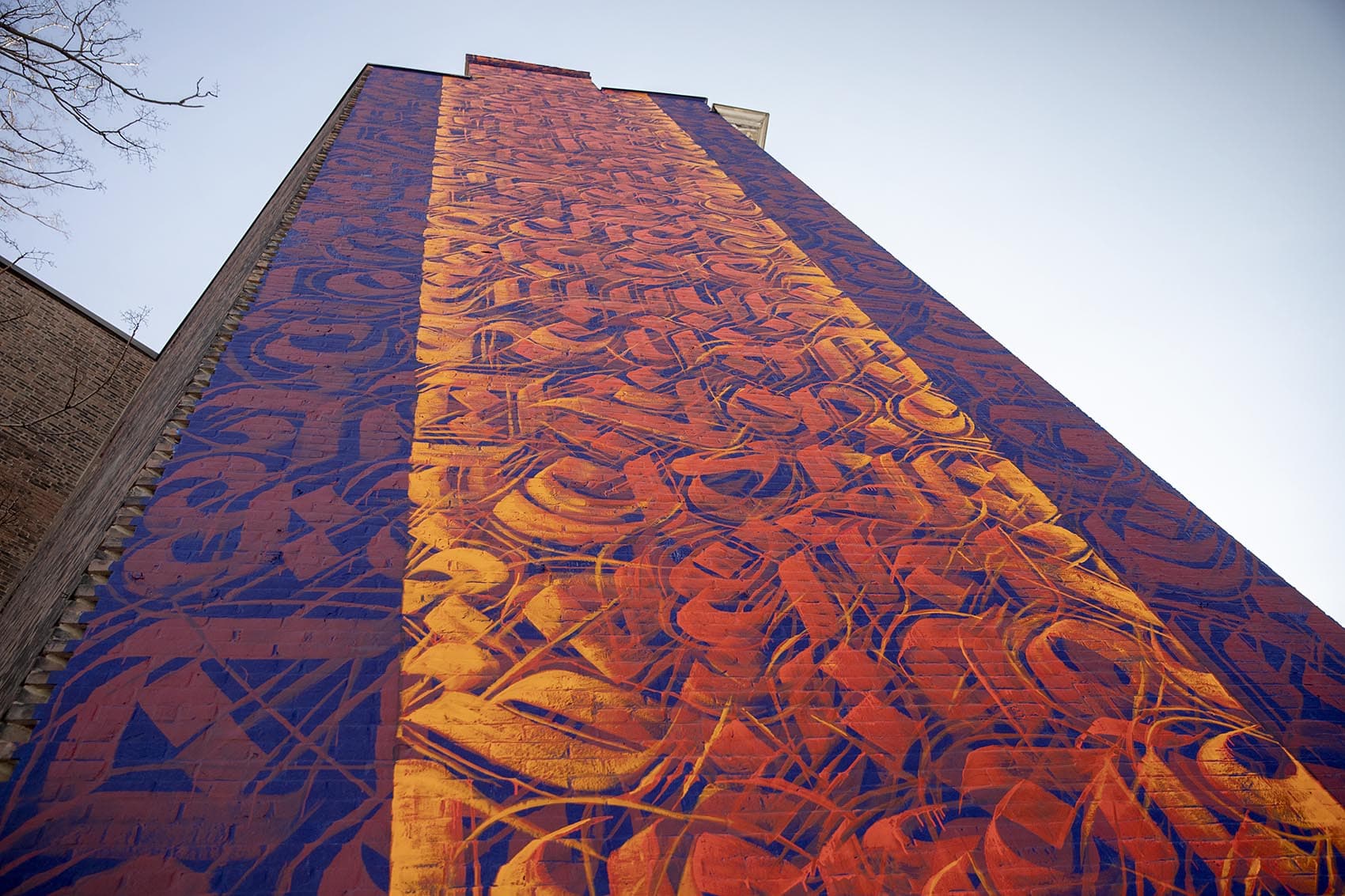
One of her most prominent works is a 7-storey tall mural on the side of an MIT building in Boston that she completed in 2024 using a cherrypicker to lift her high above the street.
Shrestha also holds a Master’s from Harvard, and is the Arts Program Manager at the university’s Mittal South Asia Institute.
“I had never met a professional artist, and did not go to museums or galleries much, although I always liked painting and drawing,” said Shrestha, wearing large glasses and a bleached afro. She was in conversation last week with Nepal Art Council curator Swosti Rajbhandari Kayastha.
Shrestha recalled discovering graffiti in Boston, and liking the fact that it involved letters as primary expression. But she felt her calligrafitti was “too American”, so she moved briefly back to Nepal.
While she had no calligraphy training as a child, she did take an Arabic course in college that taught her to see letters as images.
ART AND COMMUNITY
“Where in my work was my voice? That is when I started wondering if our culture had an appreciation for clean, beautiful writing,” says Shrestha, whose MIT mural was inspired by the vibrant oranges and reds found in flowers and rituals back home.
“It was a challenging piece, so prominent and central in Cambridge,” says Shrestha. “The work has become part of the city and the community, it does not belong to me anymore.”
Previously, Shrestha would have seen success as an individual achievement. Now, she regards herself and her art as a continuum of family, community and the Newa heritage.
Shrestha is close to both parents. Her artist nom de plume IMAGINE is a translation of her mother’s name Kalpana, and she makes sure all the art she makes is up to the standard to carry that emphasis on mindfulness. Shrestha’s mother also features in her latest series ‘Celebrations’ about immigration.
Shrestha has fond memories of her father gifting her an iPad which speeded up her process of sketching and outlining. Father and daughter go shopping to stock up on lokta paper whenever she is in Nepal.
Sneha Shrestha has some pragmatic advice for young Nepali artists: “You must do a lot more behind the scenes to make art,” she says. “You have to learn how to speak and write about your work, no one else will do it for you.”
She is active on Facebook and Instagram, promoting her art through short form content in which she talks to the audience. Shrestha hopes that her work helps viewers feel cultural pride, a reminder that we come from an important place. At the same time, she also wishes for her audience to be inspired to express themselves in any unorthodox ways.
Her last message is one of detachment and impermanence when her murals get painted over: “This is part of the medium. These walls belong to everybody. These pieces are transient.”