
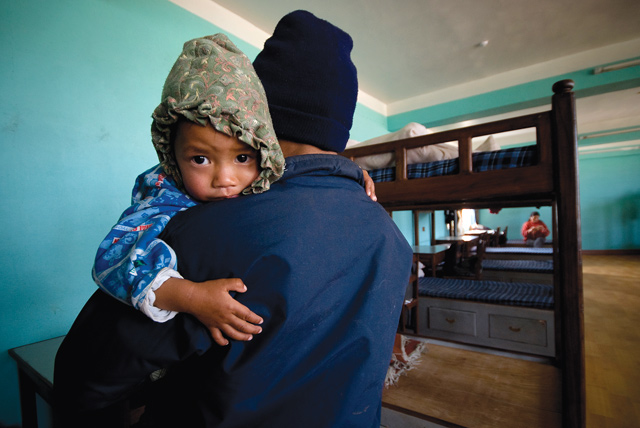
In February 2014 the founder of Happy Home Orphanage in Dhapakhel, Bishwa Pratap Acharya, was arrested on charges of fraud, kidnapping and child trafficking after years of physically and psychologically abusing the children at the home, most of whom were not orphans.
But Acharya was released one year later after it was ruled that the case lacked sufficient evidence, largely due to witness tampering by Acharya’s wife, Pooja. Today, the couple continues to run Happy Home, business as usual, profiting from foreign volunteers and donors.
This is not an isolated story. For-profit and fake orphanages are rife in Nepal, evidenced by the fact that over 80 per cent of all the 600 registered orphanages in the country are concentrated within the five tourism-heavy regions of Kathmandu, Pokhara, Chitwan, Bhaktapur and Kaski.
During the conflict, child trafficking was a lucrative business as recruiters cajoled impoverished parents to give up their kids, promising an education and a better life. Instead they were marketed off as ‘conflict orphans’ in the city and in India. Since the end of the war in 2006, donors and volunteers armed with good intentions but lacking useful skills have flooded in again, fuelling trafficking, sexual abuse and psychological harm.
“There is literally no role that tourists can play in volunteering in children’s homes and orphanages – there are no skills required that cannot be found within the professional arena in Nepal,” says Andrea Nave, director of Forget Me Not, a former children’s home turned NGO that has worked to reconnect 58 ‘paper orphans’ back with their families.
Though technically illegal on a tourist visa, around 30,000 well-meaning foreigners each year are duped into forking over hundreds of dollars per week each to volunteer at operations that masquerade as charities, unknowingly contributing to a vicious cycle of abuse.
Many of the ‘orphans’ they serve are not actually orphans – more than two-thirds of the 16,000 minors in children’s homes around Nepal have at least one living parent.
“One young girl who lived at one of these so-called orphanages told me that the management use the orphans like crops, harvesting them for their own personal gain,” says Barbara Weibel, owner of Hole in the Donut Cultural Travel, who spent two years researching orphanage voluntourism. “This practice is nothing less than human trafficking and should be stopped at all costs.”