
 |
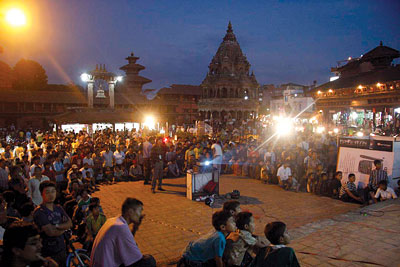
Every four years, bars and restaurants and living rooms across Nepal transform themselves into mini-stadia for cheers, screams, oohs and aahs. Even those who shun the merry-go-round of national football leagues find themselves drawn in, and let's not even talk about the real football fans. If anything, this edition of the World Cup has been marked by even more frenzied ululations.
In 1998, I drew on Italian philosopher Umberto Eco to illustrate how the political chatter so beloved of Nepalis was being smothered by sports chatter (Football, politics and public conscience, The Kathmandu Post, July 8, 1998). Back then, recurring parliamentary shootouts attracted their fair share of attention …until the World Cup carnival rolled into town. But what does this sports chatter really signify? Allow me the liberty of retreading my exposition of Eco, who argues that sports chatter fulfils the role of the fake conscience, absolving those who engage in it from any real interest in matters of the state:
"What we experience in the small hours of the morning on our TV sets is by no means simply 'sports'. Sports, in itself, is a healthy waste of energy by an individual, or by people competing against each other. Once this competition is taken up by trained athletes, then the simple act of throwing a stone, or kicking a ball, becomes a spectacle for others to watch, without themselves engaging in it.
So 'sports performance' is sports squared. It does not end here – at one further remove is the discussion of this sport which has been seen, most characterised by the sports press, thus sports cubed. Once we discuss the sports press, and various opinions expressed thereof, we are raising sports to its zenith of power. What we ordinary citizens experience in our readings and impassioned guesstimates, then, is the World Cup at several removes. We are essentially discussing the soccer press, and if FIFA was to recruit actors to run around for 90 minutes for the live broadcasts, a fictitious World Cup could theoretically go on undisrupted.
What this all means, basically, is that for us the World Cup is an abstraction – in much the same way politics is. Despite our genuine interest, our discussions of the World Cup are not really linked to the real action; so this debate shifts to a purely political level. We are as removed from what the Colombian coach had to say to Faustino Asprilla as we are from what KP Bhattarai might have to say to our Prime Minister.