
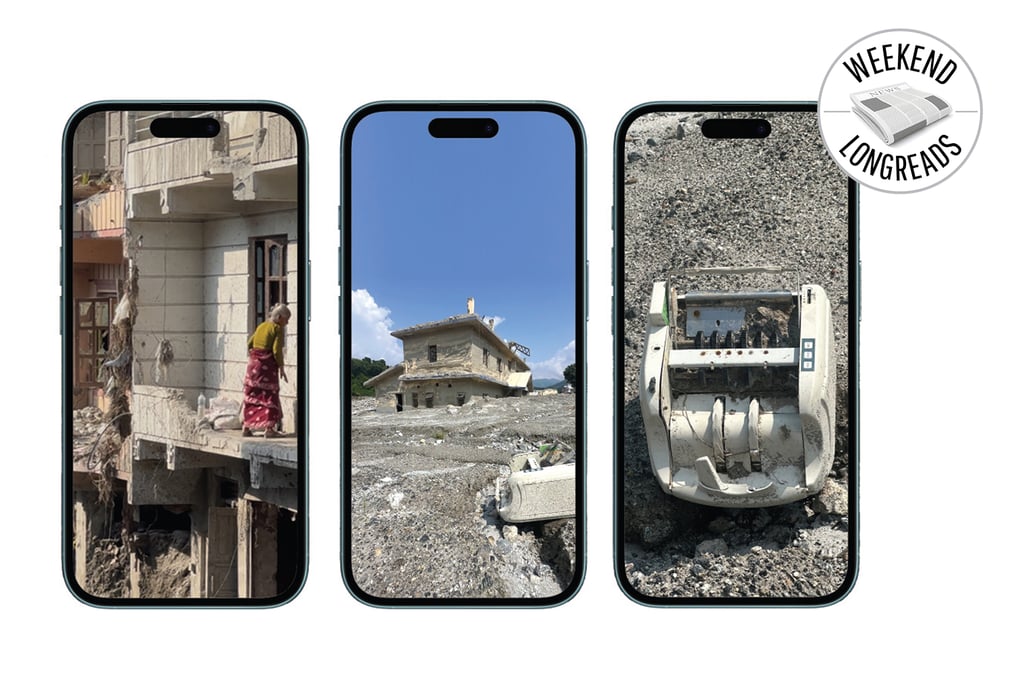
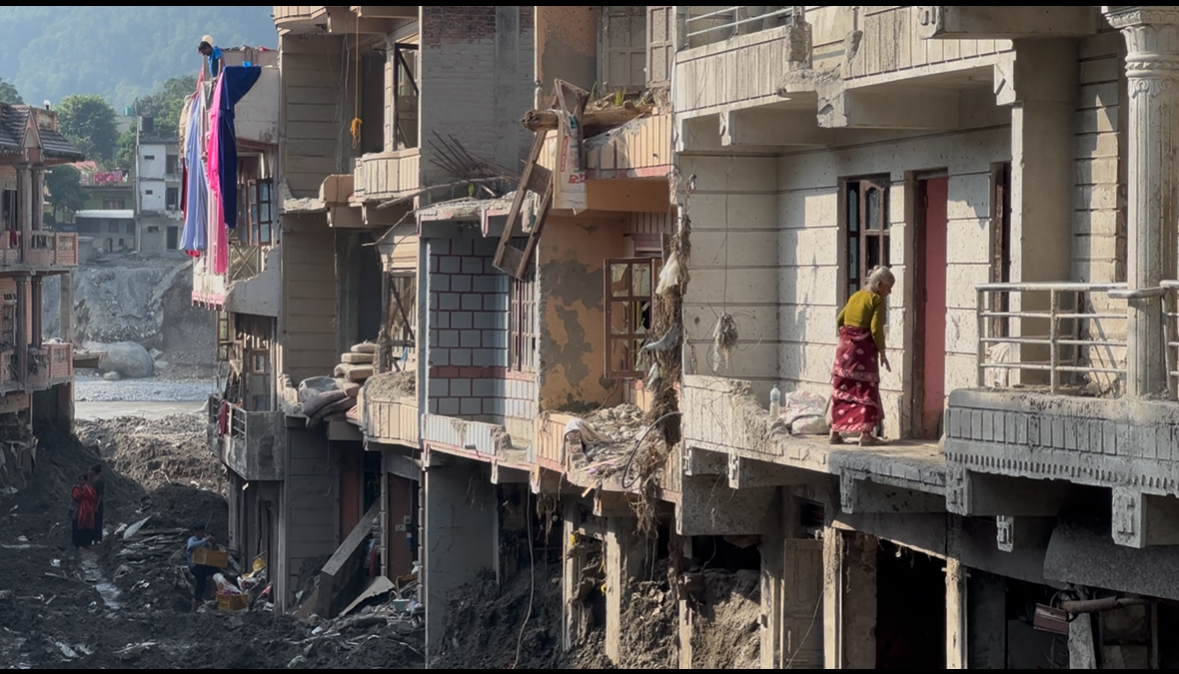
A dark, viscous trench of sludge is where our street used to be in Devighat. An elderly woman in a red sari paces a second-floor balcony with its concrete balustrade missing.
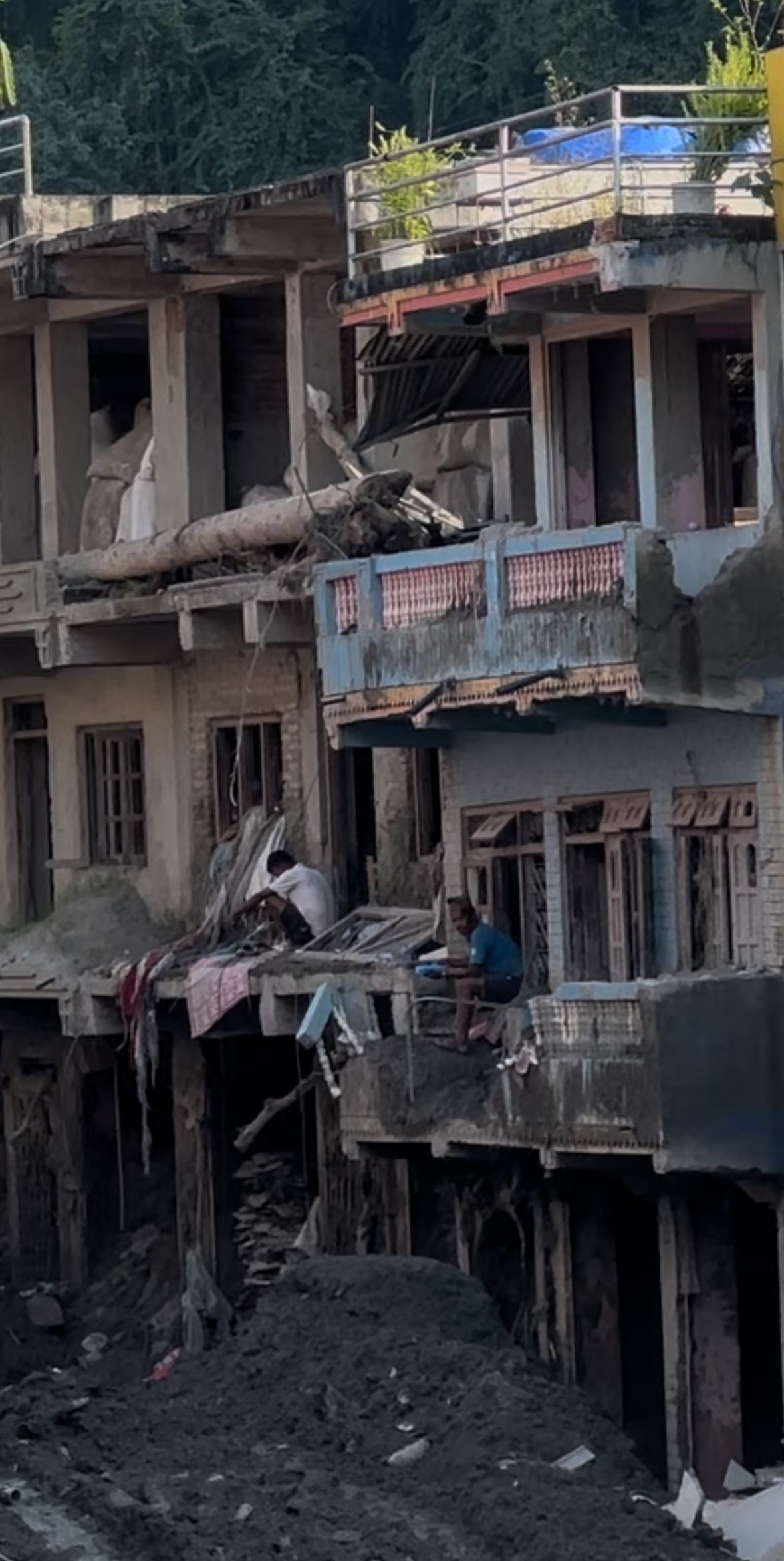
Laundry hangs from exposed rebars of a half-collapsed building. Men are having lunch on a crumbling ledge below an uprooted tree lodged in the floor above them.
These scenes were different from the visual grammar through which I had seen the disaster of my ancestral home online, in which the destruction arrived as a reel.
The Nepali psyche is drowning in 15-second floods of hopelessness. Local heartbreak becomes repeatable content, circulated through systems that measure our attention more readily than they understand our grief. Synthetic sympathy, political performance, and a vocabulary announces that the future is already finished.
One of the viral videos was of the Trisuli bridge being swept away. Next to it stood my grandfather’s metal workshop, where he spent years making grills and teaching people to weld. I learnt it was gone through that reel.
It stripped away memory, physical presence and emotion from the space. The small rectangle in my hand suddenly held more than the comment section could explain about the flood.
This is the intimacy of mediated witnessing – encountering an event through a representation while feeling implicated in its consequences. Mud has no smell on a screen. Yet a familiar location can make the image feel almost tactile.
The viewer personally affected by the disaster knows where that road led, whose business occupied that building, and which part of the landscape should still be there.
A thumb can pause the water, enlarge the damage, replay the collapse. You can comment, share it on Instagram story and describe how maddening it is, while blaming climate injustice.
These gestures offer false control over the representation, exposing our inability to intervene in what has happened.
A viral meme describes climate change as a series of disasters watched through phones, with the footage coming closer and closer until you become the person filming. Environmental catastrophe moves from a news location to our own community. Understanding the multidimensional nature of environmental catastrophe requires more than its most dramatic seconds captured through a phone.
As a child I used to run along Devighat’s steep streets, buying chatpatey from a vendor and finding friends to play chungi with next to the pipal tree and chautara.
Returning after the flood, none of those landmarks remained. My memory supplied roads that the landscape could no longer confirm. Augmented reality provided remembrances of the uphill run, the cart, the platform, the windows.
Environmental philosopher Glenn Albrecht’s concept of ‘solastalgia’ gives language to this distress: the pain of an environment changing around people who remain connected to it, undermining familiarity and security associated with home. A person can remain at home, and still feel homesick.
For those returning to a transformed hometown, the concept also illuminates the distance between geographical arrival and emotional recognition. You can reach the location, and still feel that you have failed to arrive.
The phone allows a place to become unfamiliar even before we physically return. It delivers the rupture, leaving memory to reconstruct what has disappeared outside the frame.
This helps explain the urge to keep watching. A viewer may replay a flood clip to identify a building, locate a relative’s street or understand whether a route remains usable. Repetition is an attempt to regain orientation, and can continue long after the footage has stopped revealing anything new.
What does it mean to inhabit a media environment where searching for evidence of your own loss becomes a signal to deliver more destruction? Where the time spent trying to understand a ruined neighbourhood is processed alongside the time spent watching a cute cat video, yet another advertisement for Xtreme energy drink or an argument between jholey and ghantey.
We have to make sense of a disaster amidst all this noise, where an intimate act of recognition and solidarity becomes another algorithmic spectacle.
TikTok’s account of its recommendation system identifies watch time, viewing completion and other interactions among the signals used to rank content. Concern, disbelief and fascination can all involve sustained attention. A platform can therefore register a video as ‘virally compelling’ when a viewer is trying to comprehend the destruction of home.
This is the content-ification of disaster: the conversion of a situated event into units that can circulate, compete for attention and acquire value through engagement. The place has a history, the clip has a duration.
The impulse is a guilty pleasure, an uncomfortable compulsiveness. But a return to the screen can begin in care, fear or the hope that the next video will clarify what happened. Eventually, watching and rewatching can become the most readily available response to the distress that watching produces.
‘WE’RE SO COOKED’
This repeated, difficult-to-stop consumption of negative information is called doomscrolling. A 2024 study involving 800 university students in Iran and the United States found an association between doomscrolling and existential anxiety. The survey design cannot establish causation, and its findings cannot simply be transferred to Nepali audiences, but it offers a useful starting point to examine how information-seeking becomes entangled with a diminished sense of possibility.
In the fatalistic sense familiar from livestreams, memes and influencer culture, the phrase ‘We’re so cooked’ announces that the outcome has already been decided. Its humour makes helplessness socially shareable. It allows people to acknowledge danger without having to articulate a response.
Applied to a devastated community, the phrase makes a claim far larger than the available evidence. A place has suffered terrible devastation, and a hopeless zoomer and detached doomer’s interpretation extends that destruction indefinitely into the future.
Then there is NGOmaxxing, where clips are farmed by relief groups to raise funds. The form of the clip encourages this extension. A bridge falls. The video ends. The bridge falls again.
Clearing debris, finding temporary premises, replacing equipment and reopening a business have a different rhythm. They unfold over time, through negotiations and unremarkable days of work. A feed dominated by instant of collapse can leave the slower history of recovery outside its account of the disaster.
The future then feels stolen twice: first through material destruction caused by climate collapse, and again through a representation that makes survival difficult to imagine.
One Nepal flood relief agency poster online is an AI-generated image of a generic Himalayan settlement beside a coffee-coloured river. The debris looks arranged, and the village uses a vaguely pan-Asian visual vocabulary. A Nepal flag supplies national identity, although its proportions and celestial symbols were distorted.
AI CATASTROPHE
This visualisation locates the disaster inside an imagined Nepal, carrying almost none of the specificity of the place being mourned. There is no recognisable Nuwakot or Rasuwa in it, no way to connect the composition to a street, a household or a person -- a synthetic image for ready-made fundraising.
‘Pray for Nepal’ is another caption for the AI-generated image. This outsources the act of looking. Actual devastation is messy, uneven and difficult to compose. Its details refuse to behave symbolically: laundry on rebar, lunch beneath a tree lodged inside a building, somebody arranging the small remainder of an ordinary life.
A generated image can remove that friction of having to actually witness a disaster. It can make ruins look complete, balanced and available for circulation. The people whose experience should anchor the image become unnecessary to its production. We have content-ified raising awareness for real disasters with imagined ones generated by AI data centres.
There is a material contradiction here too. The International Energy Agency estimated that electricity use by data centres produced around 180 million tonnes of indirect carbon dioxide emissions in 2024. Servers require power, and electricity generation can produce emissions. The supposedly frictionless image belongs to a system embedded in the same material world it depicts.
An industry with an environmental footprint is supplying synthetic expressions of grief about environmental destruction. Digital compassion arrives without material consequences in an endless contest conducted through machines for attention, likes, shares, comments, market position, and for authority over the future.
A disaster becomes footage. The footage becomes a signal. The signal becomes another recommendation. The damaged place continues outside the loop.
That is also why physical witnessing mattered. I went to Nuwakot because the phone had shown me what happened. Once there, the disaster exceeded the content through which I had encountered it.
Designer Michael Bojkowski’s project The Catastrophic Image & The Skin of Your Eye, developed after experiencing Australia’s fire season, describes this impulse -- seeking evidence he could see, and looking becomes a physical encounter with a world capable of altering the observer.
It also offers a way to understand why recording a disaster can matter to those experiencing it. A person holding a camera may be making evidence, preserving a disappearing landscape or trying to comprehend what stands before them. The resulting footage enters platforms that turn disaster into spectacle. Its origin can still lie in an urgent need to establish reality.
No single motive can be assigned to everyone filming, and physical presence may not automatically confer understanding. But the act of witnessing can itself become a relationship with a place, with obligations that last beyond recording it.
In Parul Sehgal’s profile of Jenny Offill, the novelist discusses normalcy bias through her research into disaster psychology: the difficulty of recognising an unprecedented situation when familiar experience supplies the mind’s expectations.
“I have not experienced this,” Offill says, describing that internal resistance. “I do not think I am experiencing this now.”
Her example involves people straightening their desks during emergencies. In Devighat, familiar routines persisted among shattered balconies and thick mud on third floor terraces.
Weeks after a flood, hunger continues. Clothes need drying. The remnants of a home still require attention. This unsettles the media’s preferred division between catastrophe and its aftermath. The disaster remains present, while ordinary life resumes inside it. That coexistence is difficult to capture in a clip built around a single spectacular moment of a bridge collapsing.
'HERO IMAGE'
It is also vulnerable to political simplification, and gets entangled in partisan narratives. A complex crisis becomes material for familiar political conflict.
A disaster does not happen in an empty information environment, it arrives among existing loyalties, grievances and incentives. The question of what happened can quickly become a competition over whose interpretation wins.
In Nepal, that competition includes the search for a defining ‘hero image’. A minister carrying an oxygen cylinder, a relief package being handed out, volunteers wearing branded jackets.
Such images can document useful activity, but also encourage a much larger inference: that visibility establishes competence, presence establishes responsibility, and the person most prominently photographed is the person on whom recovery depends.
A visit by a politician cannot establish cynical intent, but it does invite scrutiny of how the event is presented and whether attention follows through to the people receiving assistance. However, treating every public image as a stunt would flatten these differences as thoroughly as treating every appearance as proof of service.
Michel Foucault’s concept of biopolitics helps extend the question beyond the photograph. A person can be highly visible in flood footage while remaining difficult to locate within a relief system. The public may know the image of their destroyed house and still have little idea whether they have shelter, whether their loss has been recorded or whether assistance has reached them.
This is where the governance question belongs within the media argument. The Finance Ministry’s flood-update portal publishes donations, balances and information about transfers and initiatives.
The next standard of visibility should connect assessed needs to assistance delivered. Trained field enumerators could help establish who needs what, while public reporting could show allocation and delivery without exposing sensitive household details.
Yet information alone will not resolve the deeper paralysis. We also need ways of imagining a future that can survive contact with the evidence.
The useful framework in Jenny Offill’s work is her attention to catastrophe as something already entangled with ordinary obligations.
Planetary danger exists alongside relatives who need care, errands that remain unfinished and bodies that continue to require food and rest. Dread has to coexist with the next necessary action.
Her work also asks how the circle of domestic care can expand, so that intense concern reserved for those closest to us can become a basis for obligations towards others. That expansion gives climate grief somewhere to go.
For disaster coverage, this suggests a different discipline of attention. Follow the family after the dramatic photograph. Return to the business after the floodwater recedes. Record the unresolved need with the same seriousness given to the moment of destruction. Empower survivors to become content creators themselves to document rehabilitation.
The neglected subjects of recovery deserve narrative weight: replacement tools, temporary rooms, reopened routes, the labour required to make an ordinary day possible again.
SPREADING HOPE
This also changes what it means to imagine hope. A hopeful account can retain uncertainty, anger and incomplete recovery. It can show attempts whose success remains undecided. Its value lies partly in keeping those attempts available to public thought.
My grandfather gave me a small example of this. After I returned, he asked whether I “had fun” and “saw things”. The wording sat strangely beside the doom I had witnessed. He had lost a life’s work in his metal workshop, yet he was already thinking about what might still be possible.
Orphaned young, he had learnt to build a life from limited resources. He worked with metal, taught others to weld, worked on the Trisuli hydropower project and wrote for the local newspaper. None of that gives me access to the full extent of his grief. His manner may conceal feelings he chooses to keep private.
What I can describe is the proposal he has made: using family property to build small shops where displaced businesses can reopen. His plan gives the future a shape. Land. Materials. A place to work. A livelihood that can resume.
Such boomer hope is in sharp contrast to the ‘We’re so cooked’ doomer shorthand vocabulary. Local effort needs resources and institutions capable of supporting it. Communities cannot be expected to compensate indefinitely for inadequate public action.
Hope becomes politically useful when it generates demands as well as gestures of care: demands for accountable relief, safer reconstruction and a meaningful say in what recovery should look like.
The same principle applies to witnessing. People who cannot travel to Nuwakot can still sustain a relationship with what they see. They can check before sharing, listen to those affected, support verified local needs and remain interested after the story stops trending on the feed.
The phone that delivers despair can also carry those connections. Its role is shaped partly by the practices and institutions built around it.
Accepting ‘We’re so cooked’ as a complete account of the future makes those choices disappear, and turns a warning into a verdict. It allows responsibility to dissolve into a general atmosphere of inevitability, convenient for institutions whose decisions still matter.
We can ignore the synthetic image that asks us to mourn an AI-generated Nepal. We can refuse the political photograph that demands gratitude before accounting for delivery. We can block a media rhythm in which the collapse is endlessly replayed.
That refusal needs somewhere to lead: towards people, towards sustained attention, towards the difficult and unfinished work of making a place habitable again.
The men eating lunch in Devighat cannot carry the burden of proving either humanity’s denial or its resilience. They are people living inside the consequences of a disaster. Their lives continue beyond the uses to which an image of them might be put.
A future worth imagining would allow that meal to be eaten in a safe building. It would offer space to a displaced shopkeeper, workers to recover their tools, a child to find a route home from school again.
The bridge keeps falling whenever the clip restarts. Our responsibility is to make the reopening as imaginable, and as worthy of sustained attention, as the collapse.
Nobel Rimal is a researcher of digital culture and political communication.