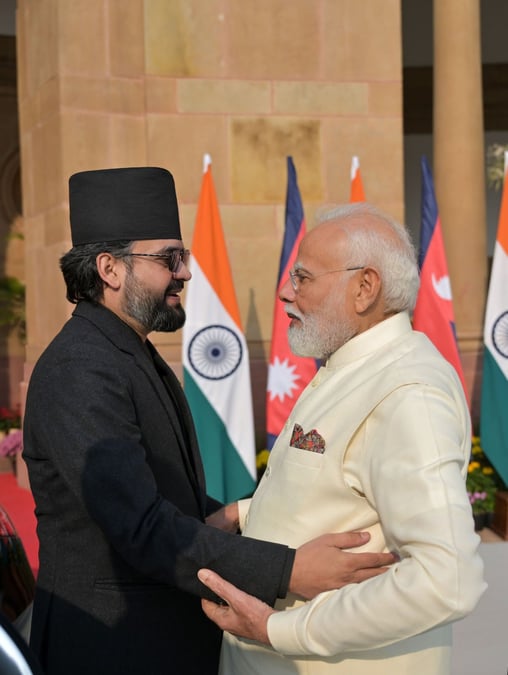
Prime Minister Balendra Shah’s 24-hour, 25-minute state visit to India during which he had a tête-à-tête with his Indian counterpart Narendra Modi was heavy on symbolism, light on substance.
New Delhi needed to size up Nepal’s young prime minister, and PM Shah was finding the need to be less reclusive and engage with Nepal’s big neighbours whom he had abused in the past with rude social media posts.
The two leaders are 40 years apart, but they seem to have hit it off, given the effusive mutual praise at a joint press meet. The Indian mainstream press gave the visit headline treatment and hailed the visit as New Delhi’s successful attempt to ‘reset’ relations with Nepal and ensure that Kathmandu does not lean too much towards China.
The $1.6 billion grant and loan package includes a $377 million grant for reconstruction of the Bhote-Kosi Trisuli, although where and how the loan component will be spent is not yet known. The long list of MoUs were impressive, but on second glance were mostly a rehash of past deals which were never followed up by both sides.
“There was much curiosity about Balen in India and this was an icebreaking event. Modi came out of it praising the vision and farsightedness of the young Nepali prime minister,” says Akanshya Shah, a Nepali journalist based in New Delhi. “Despite ups and downs between the two countries and past baggage, Balen himself can start with a clean slate.”
Within Nepal, too, the visit has been seen as a chance for PM Shah to replace his past posture with a more pragmatic approach, and his supporters on social media showered him with praise for making a dramatic departure from the past by flying commercial and the fast turnaround.
Besides the $1.6 billion, among the more tangible outcomes were commitments for fast-tracking the long languishing East-West Railway project, launching the 669MW Lower Arun, making the B365 air route open to two-way traffic. However, records show that many of these were signed by previous Nepal governments.
“The only new thing from this visit is that this is the largest ever development package, and the agreement on IIT as well as Gujarat and Odisha ports,” adds Shah.
Three inbound air routes overflying Janakpur, Mahedranagar and Bhairawa waypoints were supposed to be made two-way under agreements ten years ago, but they never got off the ground. Only the B345 air route was agreed upon this time, and depending on altitude restrictions over Indian air space would only be useful for flights serving Pokhara.
High altitude entry through B345 would not be feasible for Bhairawa, and would only cut flight time to Kathmandu by a few minutes. Nepal had pressed for the L626 route overflying Mahendranagar to be two-way because it would reduce flight times from the west into Kathmandu, Pokhara and Bhairawa considerably. L626 would also provide a shortcut to Indian carriers flying to its northeastern states.
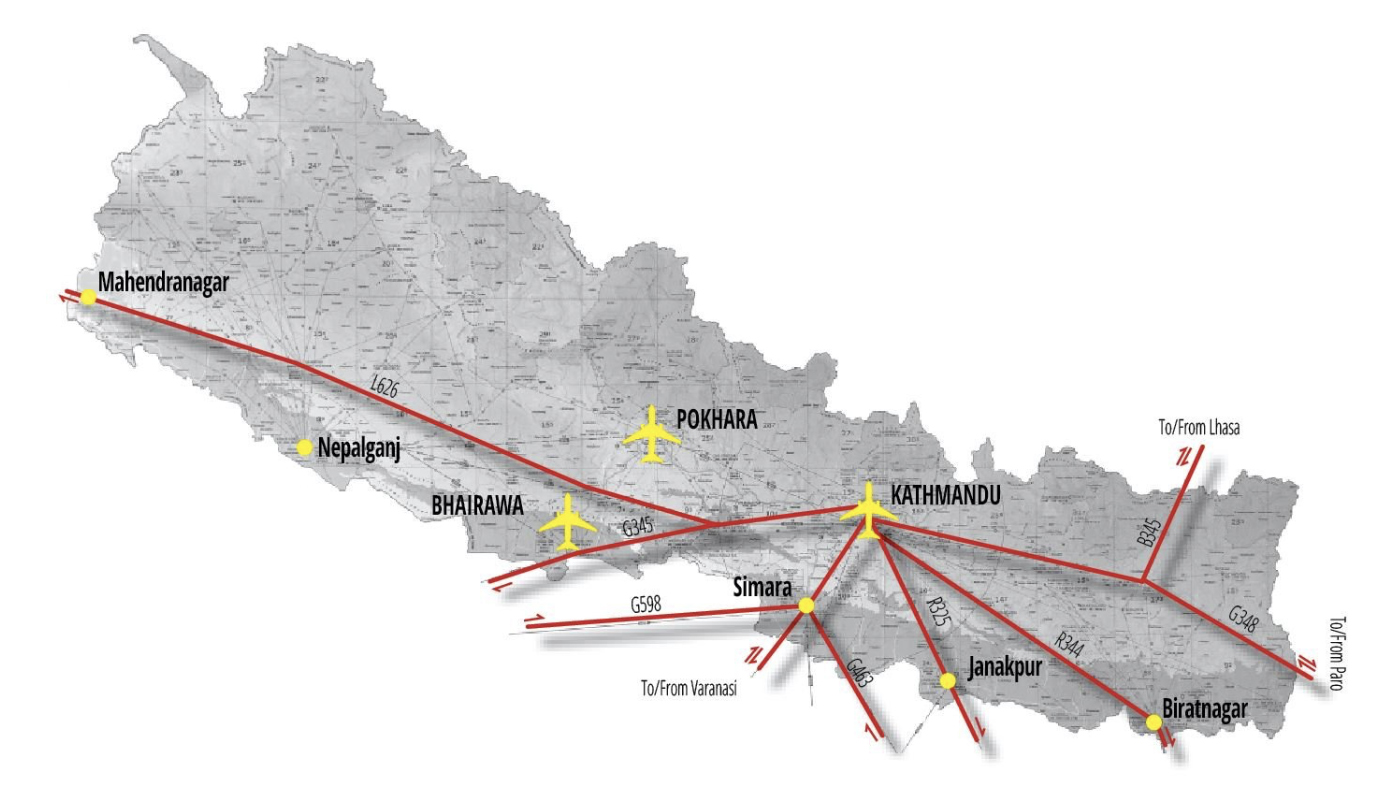
Negotiations were reportedly stuck because of Nepal’s reluctance to allow its air space for planes on standard patterns around Bagdogra airport in India’s sensitive Chicken’s neck corridor. The Indian side also had no response to Nepal's request for direct flights between Pokhara and Indian cities.
In Nepal, opposition parties have seized upon PM Shah not raising the Lipulek border dispute in his meetings. They pointed to Shah, as mayor of Kathmandu, hanging a map of Greater Nepal in his office after Modi hung an Akhanda Bharat map in his. Statements from India and Nepal contradict each other whether this was a talking point.
Others sensitive subjects supposedly also sidelined were the suspension of recruitment of Nepalis into the Indian Army and the Eminent Persons’ Group report on Nepal-India relations which has never been formally received by the Modi government. It is clear that both sides did not want any to spoil this show of trust-building.
In preparation for last week’s Narendra-Balendra summit, Finance Minister Swarnim Wagle has visited New Delhi several times, saying the visit would “reset” bilateral relations by changing Nepal’s priority away from anti-Indian nationalism and more about economic opportunity and connectivity. Wagle faced flak back home for this remark.
Meanwhile, India’s mainstream media insisted on making Prime Minister Shah’s visit not about Nepal, but about settling scores with China. This reflects the long-held displeasure in Indian officialdom about Nepal’s policy of ‘equidistance’ between its giant neighbours. New Delhi regards Nepal as being in its sphere of influence, and has made a point of blocking out Chinese involvement in Nepal’s infrastructure projects.
It is only a matter of time before Balendra Shah makes a reciprocal trip to Beijing, and this is bound to once more ruffle feathers down South. A 20-member delegation from ruling RSP led by General Secretary Bipin Acharya returned to Nepal on Thursday after a prolonged tour of China to lay the groundwork.
Since the days of founding king Prithvi Narayan Shah, Nepal’s challenge has always been to keep its relations with India and China in equilibrium. Alok K Bohara at the University of New Mexico writes in a commentary for Nepali Times: ‘The paradox is that New Delhi and Beijing are rivals, yet China is India’s largest merchandise trading partner. Nepal’s opportunity is not to make the two giants friends, it is to find activities where their technology, capital, markets and know-how can work together inside Nepal.’
Zhang Jiadong of the Center for South Asian Studies at Fudan University wrote in Beijing-based Global Times this week: ‘The [Balendra] Shah administration has made it clear that de-politizing diplomacy is a central strategy. Its goal is not to alter the China-India dynamic, but to minimize the extent to which geopolitical factors encroach on Nepal’s room for independent action.’